


The short answer
- Yes: $1 million lets Tom and Lisa spend $5,800 a month after tax, with $879K left at 95.
- Two sets of CPP and OAS cover more than half their income from day one.
- They have room to spend about $1.6K/mo more.
Estimates from Scenario Lab+, in today's dollars.
See the demo plan$1 million is one of the most common retirement goals in Canada, and for a couple it often goes further than people expect. At 65, both partners start CPP and OAS right away, which means four government cheques arrive every month before you touch your savings. Add two tax returns to spread your income across, and the same $1 million can support a very comfortable retirement. If you're a couple retiring at 65 with $1 million, it's worth seeing just how much of the work your benefits do.
Here at Loonie Nest, our mission is to provide free and affordable personal finance education to Canadians so they can gain confidence in their retirement.
Tom and Lisa's plan at a glance
$1,000,000
saved at 65
RRSP
$700,000
Taxed as income when withdrawn
TFSA
$220,000
Withdrawals are tax-free
Non-registered
$80,000
Only the capital gain is taxed
Spending after tax, in today's dollars
$69,600
$62,640
$55,680
Tom
CPP $1,050 a month from 65
OAS $742 a month from 65
Lisa
CPP $800 a month from 65
OAS $742 a month from 65
Our $1 Million Retirement Scenario
Let's meet Tom and Lisa. They're both 65, married, and living in Kelowna, BC. Tom spent his career as a sales manager at a car dealership, and Lisa ran the front office at a dental practice. Neither had a workplace pension, but they saved steadily and have $1 million between them, with more of it in Tom's name. They're both retiring this year and want to know what their savings can really support.
We'll run Tom and Lisa's numbers through Scenario Lab+.
Scenario Lab+ is our proprietary retirement planning software. We'll use it to generate and review a tailored retirement plan for the two of them.
To start, here's how their numbers look as they retire at 65:
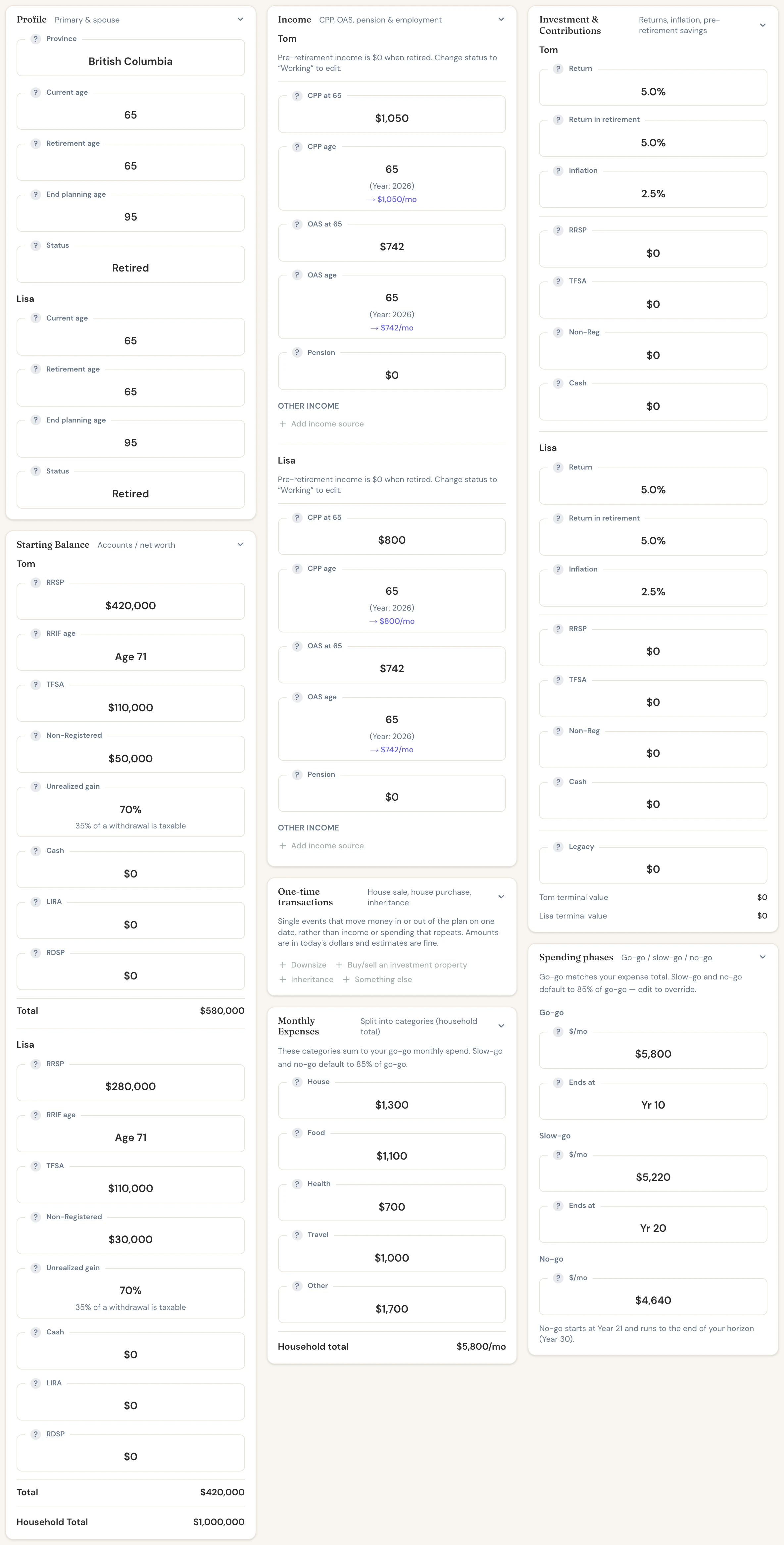 Tom and Lisa's plan inputs: their profiles, account balances, CPP and OAS, and monthly spending.
Tom has more of the savings. Tom has $580,000 ($420,000 in his RRSP, $110,000 in his TFSA and $50,000 non-registered), and Lisa has $420,000 ($280,000, $110,000 and $30,000). That gap matters less than you might expect, as we'll see in their taxes.
Two CPP cheques and two OAS cheques, from 65. Tom's CPP Statement of Contributions shows $1,050 a month at 65 and Lisa's shows $800. Each of them also gets the full OAS pension, about $742 a month. If you want a refresher on how both programs work, see our guide to CPP and OAS.
A balanced portfolio. Their plan assumes their investments grow 5% a year.
Their spending falls as they age. Their plan starts at $5,800 a month for the household and assumes that their spending steps down as they reach 75 and again at 85. In Scenario Lab+, these steps are the plan's Spending Phases.
A few other important assumptions: all figures are in today's dollars, they own their home with no mortgage, inflation runs at 2.5% a year, and we plan their retirement until both of them are 95.
Tom and Lisa's retirement budget
Here is how their $5,800 a month breaks down in their first ten years:
| Category | Monthly | Annual |
|---|---|---|
| Housing (property tax, utilities, insurance, upkeep) | $1,300 | $15,600 |
| Food and dining | $1,100 | $13,200 |
| Health and dental | $700 | $8,400 |
| Travel | $1,000 | $12,000 |
| Everything else (cars, gifts, grandkids, entertainment) | $1,700 | $20,400 |
| Total | $5,800 | $69,600 |
Costs vary a lot across the province. Our guide to the best places to retire in Canada compares cities and regions.
Is $1 Million Enough for a Couple to Retire?
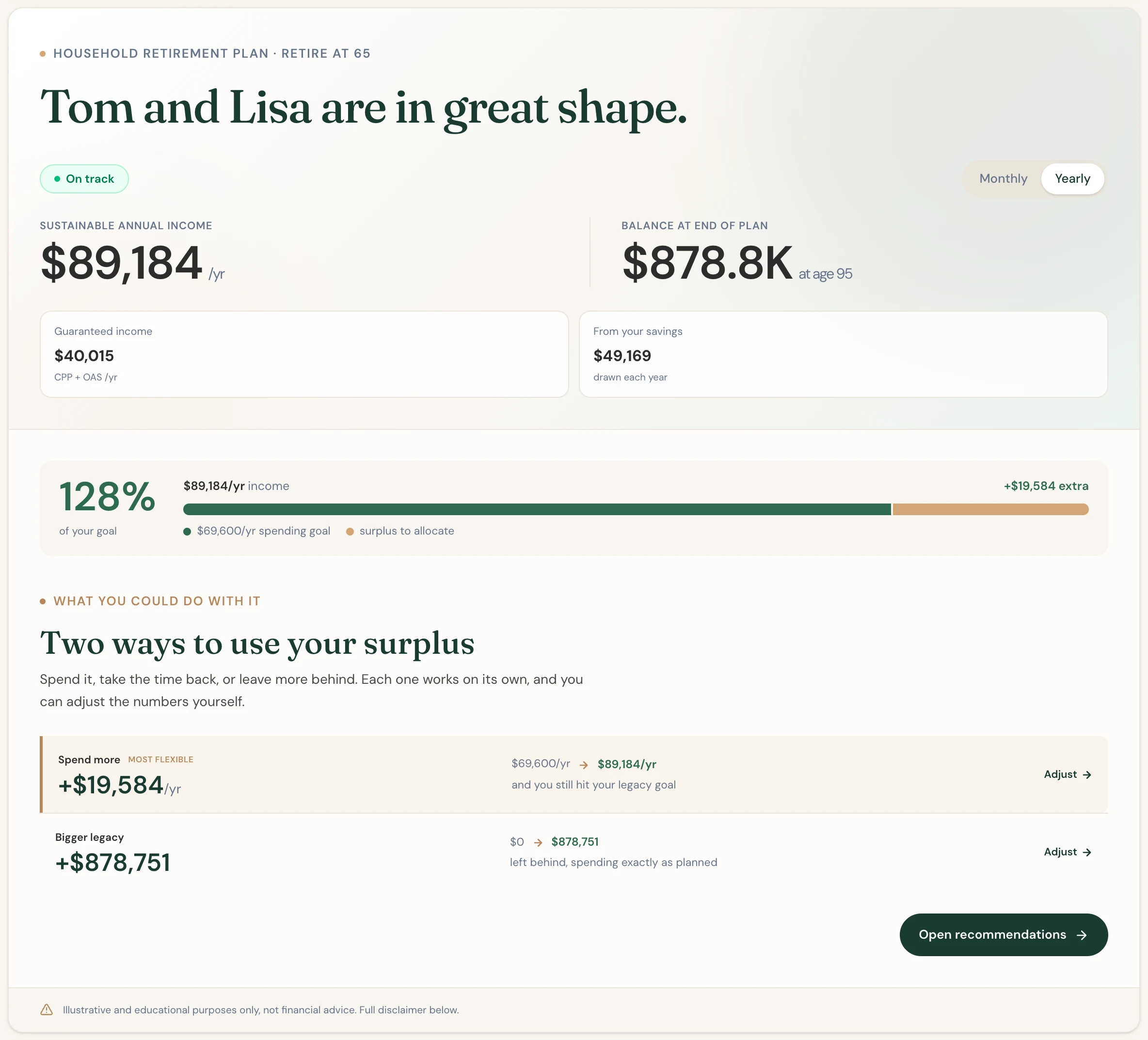 Scenario Lab+'s results for Tom and Lisa's plan.
For Tom and Lisa, the results say yes. Their plan covers their spending every year and still has $878,751 left when they're both 95. Scenario Lab+ estimates they could spend about $1,632 more a month and still make it.
That's better than a generic 4% rule would suggest. Under the 4% rule, $1 million supports about $40,000 a year. Tom and Lisa only need to draw about $32,900 from their savings in their first year, less than 4%, because their government benefits cover so much of their spending.
How Much Income Does $1 Million Provide for a Couple?
So how much retirement income does a $1M nest egg generate for a couple? For Tom and Lisa, $1 million plus their CPP and OAS provides $72,909 of gross income in their first year, which works out to $5,800 a month after tax.
In their first year of retirement, they draw on five sources:
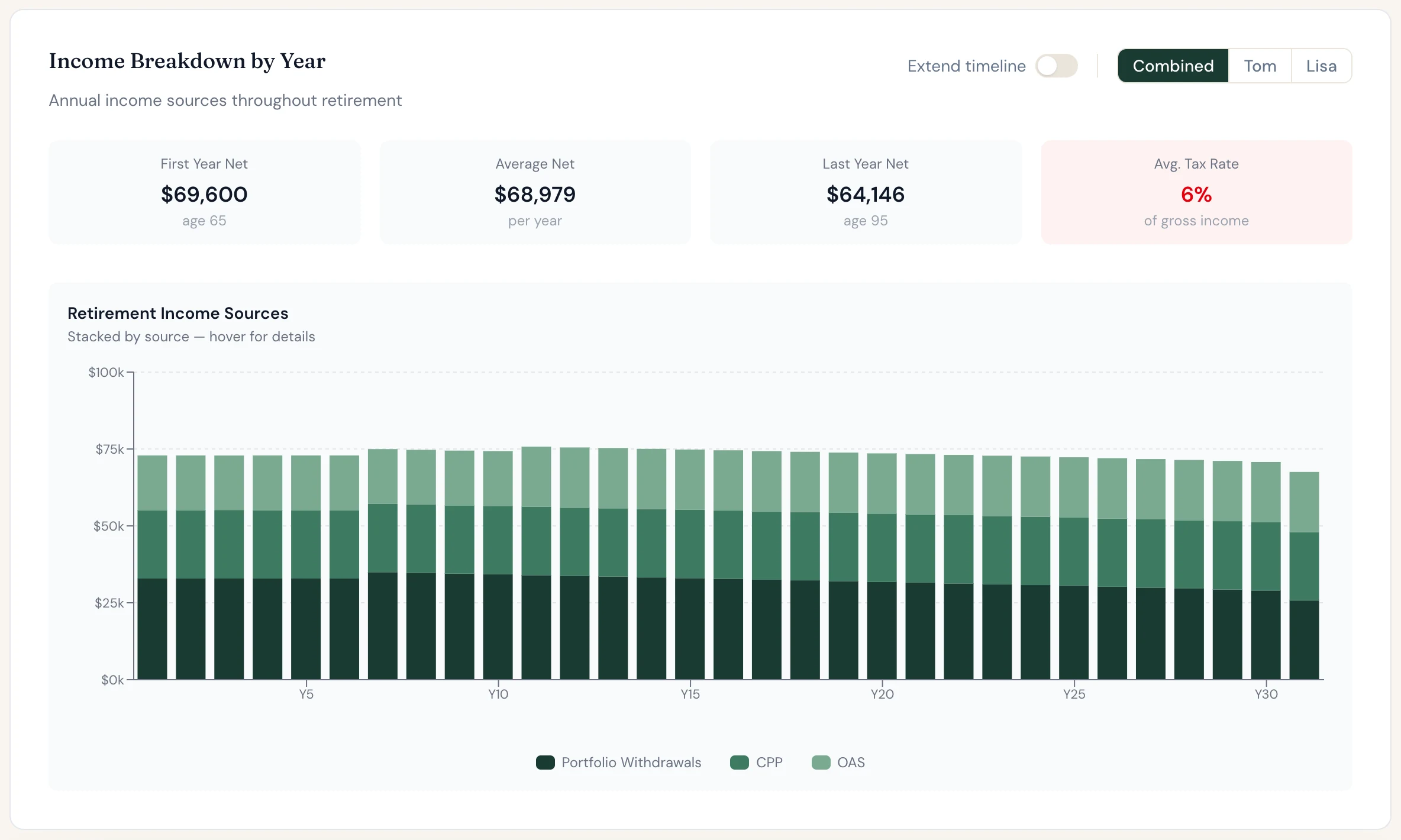 Where Tom and Lisa's income comes from each year, by source.
| Source | Amount | Taxable? |
|---|---|---|
| CPP (both) | $22,200 | Yes |
| OAS (both) | $17,815 | Yes |
| RRSP withdrawals | $22,800 | Yes |
| TFSA withdrawals | $7,520 | No |
| Non-registered withdrawals | $2,574 | Only the capital gain |
| Gross income | $72,909 | |
| Income tax | $3,309 | |
| Spending money | $69,600 |
CPP and OAS bring in $40,015 a year between them. That's more than half of their income, paid for life and indexed to inflation. For a single retiree with the same $1 million, like Susan, the same benefits cover about a third.
Scenario Lab+ uses its Proportional drawdown strategy by default, drawing from every account each year roughly in proportion to its balance. For a couple, it also pools the household's costs, so one partner's spare income covers the other's shortfall. The Drawdown tab runs the same plan through other withdrawal strategies, such as Sequential and RRSP Meltdown, and compares the lifetime tax of each.

Planning to retire as a couple?
Scenario Lab+ builds this same year-by-year plan for two people, with both sets of accounts, benefits and tax returns.
Try Scenario Lab+How Much Tax Tom and Lisa Pay
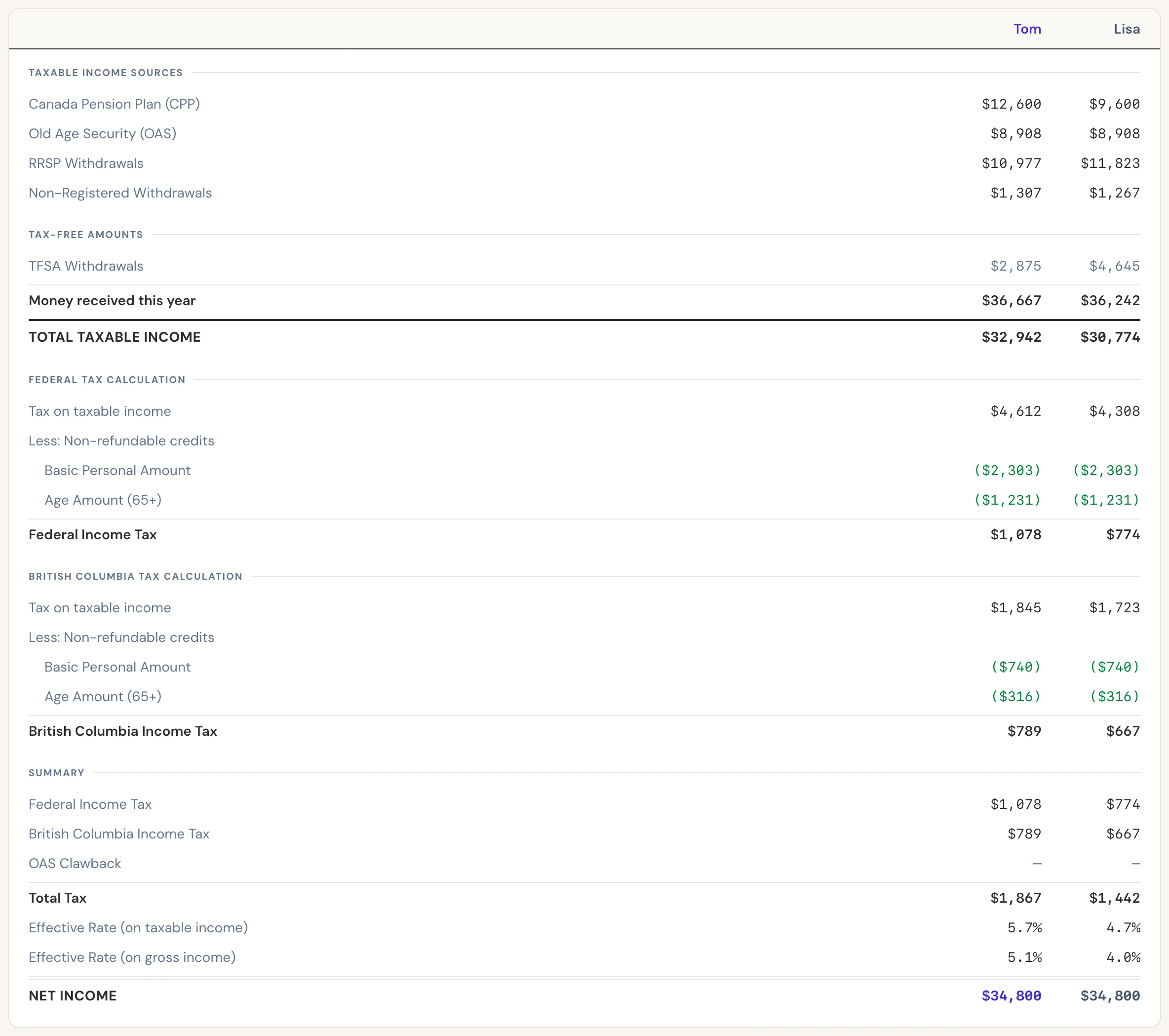 Tom and Lisa's tax bills in their first year of retirement, at 65.
Tom and Lisa pay $3,309 in income tax in their first year of retirement between them: $1,867 for Tom and $1,442 for Lisa. That's about 4.5% of their gross income.
Their bill is low because TFSA withdrawals are tax-free, and because their income is spread across two tax returns. Each return gets its own basic personal amount and, at 65, its own age amount.
Neither of them ever comes close to the OAS clawback.
What about pension splitting?
At 71, Tom's larger RRSP becomes a RRIF, and its minimum withdrawals push his income above Lisa's. That's the situation pension income splitting was designed for, so you might expect it to save them a lot.
For Tom and Lisa, it barely matters. Even after 71, Tom's income stays inside the lowest federal and BC tax brackets, the same as Lisa's, so moving income from his return to hers changes little. Scenario Lab+ applies splitting automatically wherever it lowers their total tax, and for Tom and Lisa that's only a few years, moving between $1,700 and $2,400 a year of Tom's RRIF income onto Lisa's return at 71 and from 75 to 77. Splitting tends to pay off when one partner's income reaches a higher bracket than the other's.
How Their Plan Changes Over Time
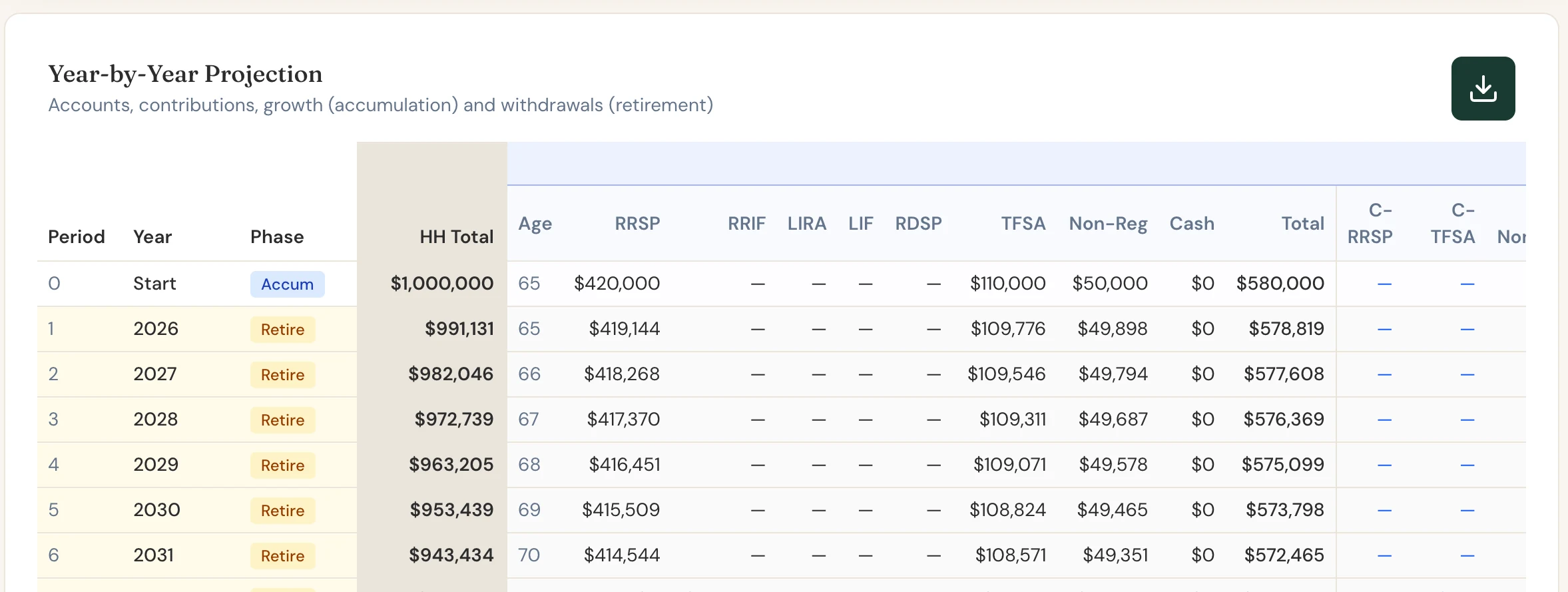 Year-by-year account balances from 65.
In Scenario Lab+, the Table tab shows every account for every year, and the whole table downloads as an Excel file.
Like most couples, Tom and Lisa's retirement will not look the same every year.
At 71, their RRSPs become RRIFs. Every Canadian has to convert their RRSP by the end of the year they turn 71, and a RRIF has a minimum withdrawal each year. Their RRIF withdrawals rise from $22,800 to $34,946, and they stop drawing from their TFSAs. Our RRIF guide covers the rules.
At 75, their OAS goes up 10% and their spending steps down. OAS pays more from age 75, and their household spending drops to $5,220 a month.
Their savings barely shrink. They start retirement with $1 million and still have $878,751 at 95. Their CPP, OAS and investment growth cover almost everything they spend.
At the end of their plan, most of what's left is in their TFSAs ($634,447), with $105,786 in their RRIFs and $138,517 in their non-registered accounts.
Based on their numbers, Scenario Lab+ estimates Tom and Lisa could spend about $1,632 more every month and still make it to 95.
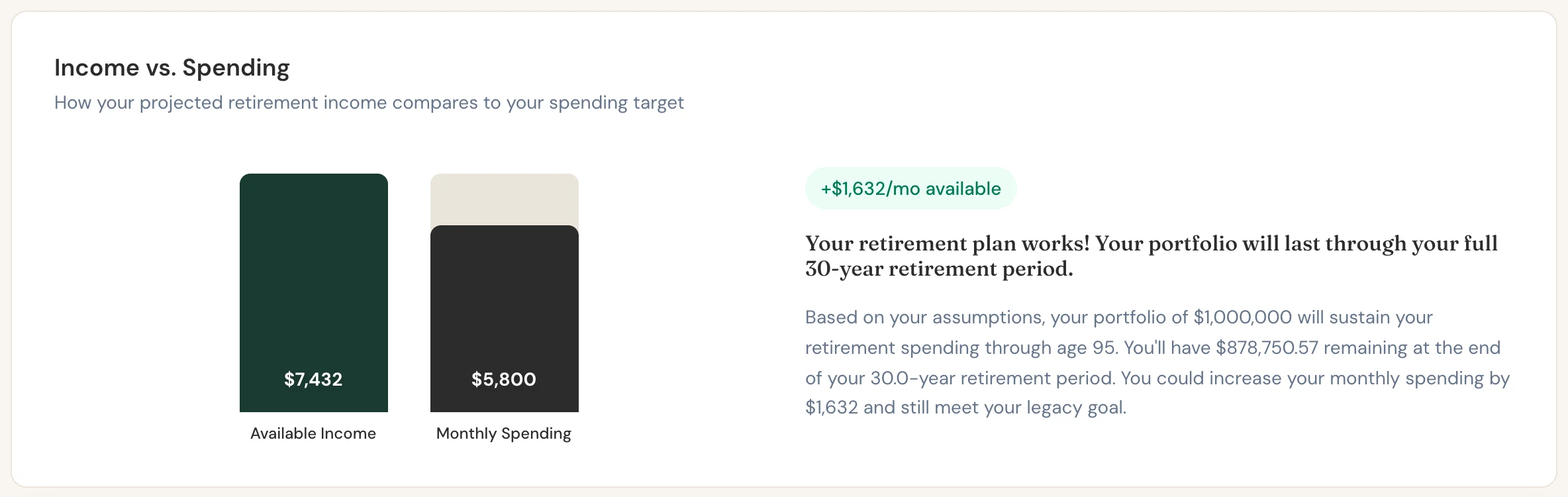 Income available to Tom and Lisa compared with what they plan to spend.
Scenario Lab+ shows this in its Recommendations tab, where you can apply the extra spending with one click and see the plan rebuild around it.
But What If We Change the Assumptions?
Tom and Lisa's plan has plenty of room. So we looked at what they could do with it, and at one change that would give them even more. We took their plan and changed one assumption at a time.
4 versions of Tom and Lisa's plan
One assumption changed in each. Charts show the portfolio from 65 to 95 in Scenario Lab+.
Tom and Lisa's base plan
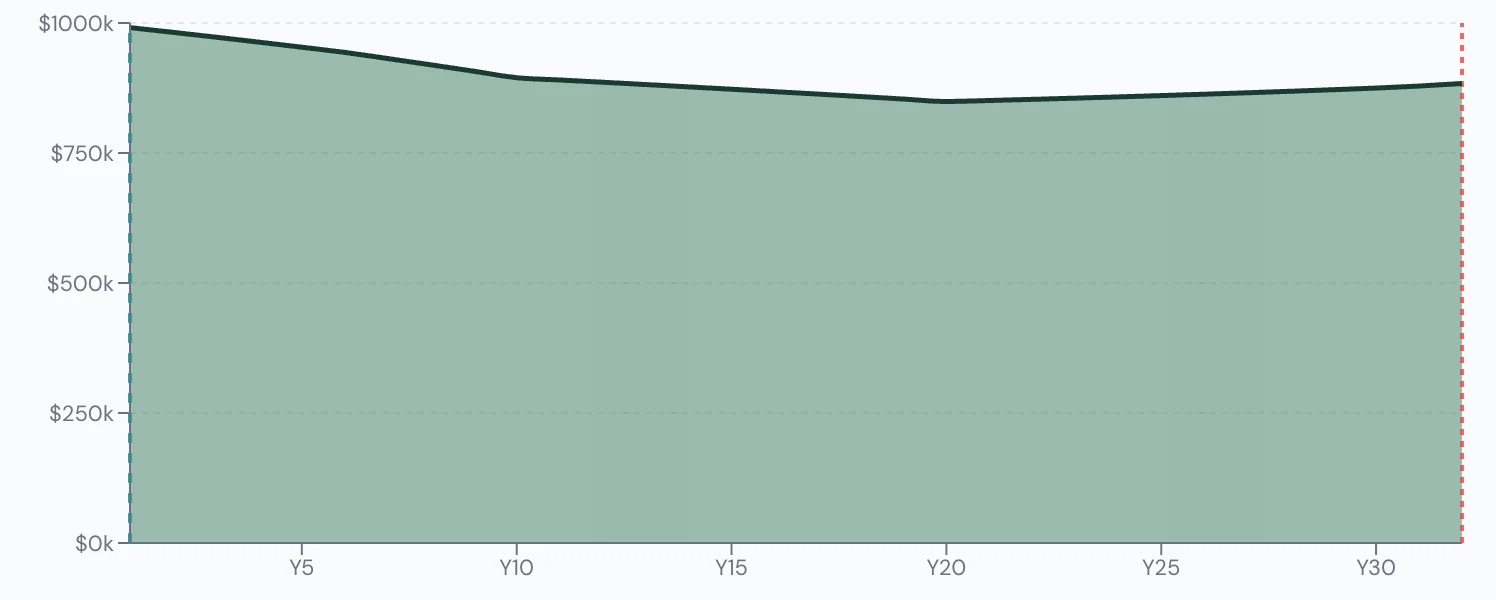
- Spends at 65
- $69,600/yr
- Money lasts
- Past 95
- Left at 95
- $878,751
Spends $1,000 more a month
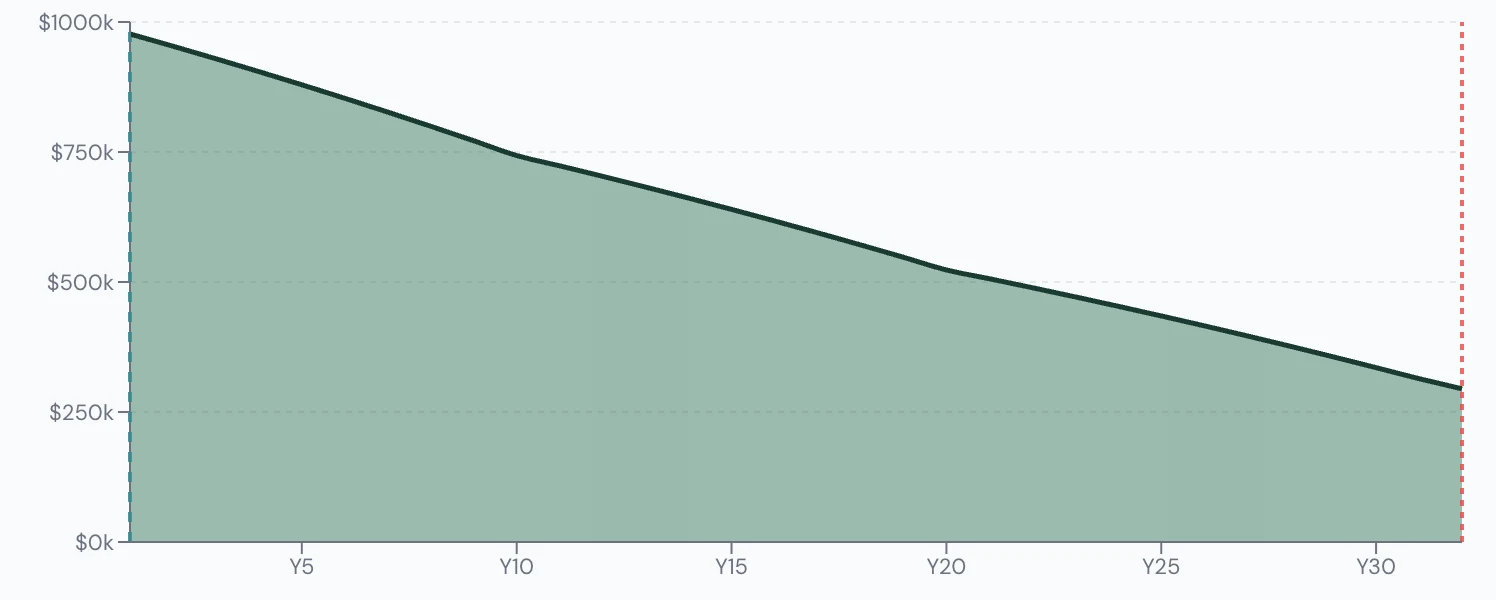
- Spends at 65
- $81,600/yr
- Money lasts
- Past 95
- Left at 95
- $314,091
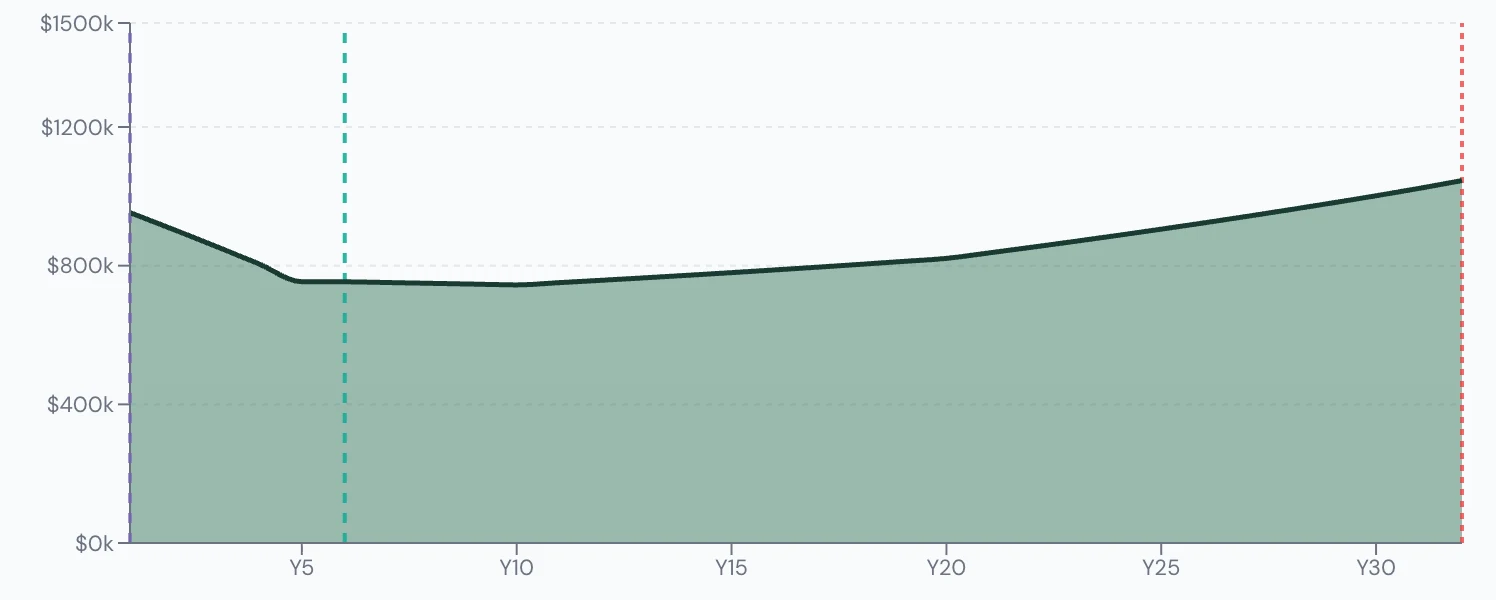
Both delay CPP and OAS to 70
- Spends at 65
- $69,600/yr
- Money lasts
- Past 95
- Left at 95
- $1,022,888
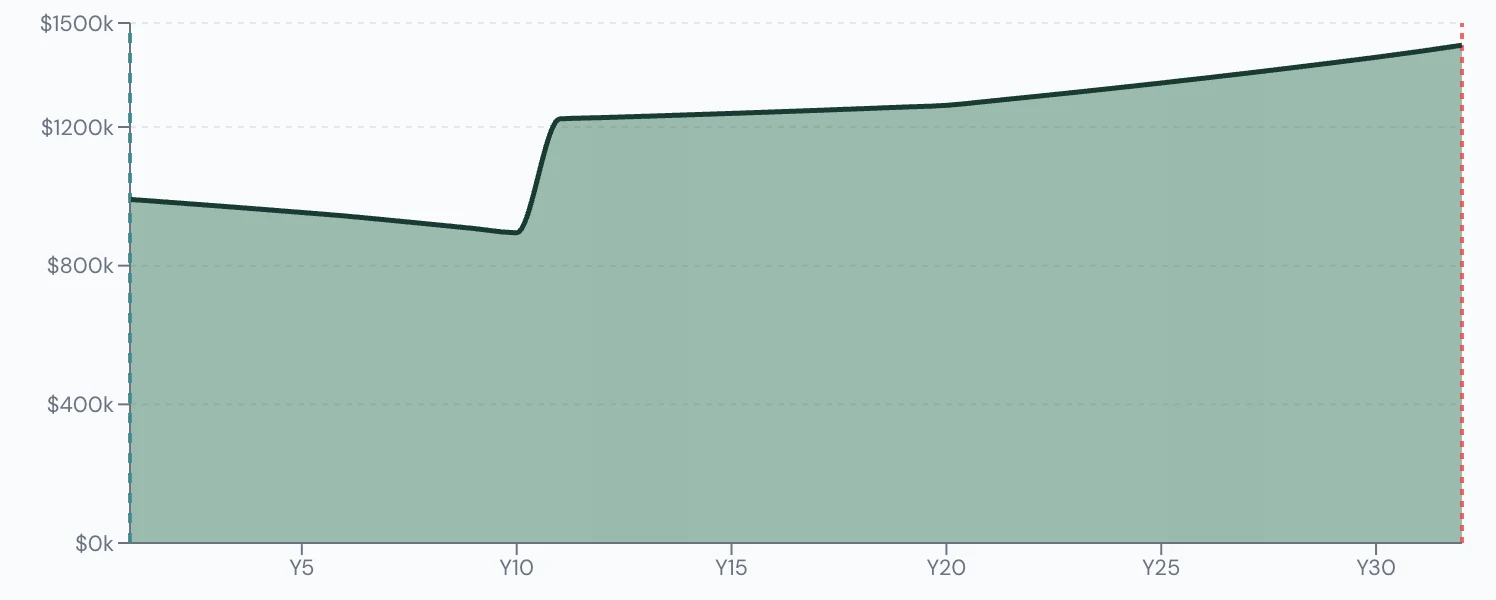
Sells the house and buys a condo at 75
- Spends at 65
- $69,600/yr
- Money lasts
- Past 95
- Left at 95
- $1,417,836
Scenario 1
Spends $1,000 more a month
- Spends at 65
- $81,600/yr
- Money lasts
- Past 95
- Left at 95
- $314,091
What if they spend $1,000 more a month, in every phase of their retirement, on travel and the grandkids?
Their plan still works. They reach 95 with $314,091 left, and Scenario Lab+ still estimates room for about $528 more a month on top of that. Their tax bill in their first year rises to $5,291.
For a couple with two sets of benefits, $1 million can support a lot more than a modest lifestyle.
Scenario 2
Both delay CPP and OAS to 70
- Spends at 65
- $69,600/yr
- Money lasts
- Past 95
- Left at 95
- $1,022,888
What if they both delay CPP and OAS to 70? Both programs pay more if you wait: CPP rises 42% and OAS rises 36%. Between them, that's $31,524 a year of CPP instead of $22,200, and $24,229 of OAS instead of $17,815.
The catch is that they live on their savings alone from 65 to 69. By 69 their portfolio is $753,516 instead of $953,439. After that, the bigger cheques do most of the work, and they finish at 95 with $1,022,888, about $144,000 more. Their tax bill in their first year also drops to $955, because they have no CPP or OAS income yet.
Delaying is a bet on a long retirement, and with two people the odds that at least one of them lives a long time are better. Our CPP and OAS break-even calculator shows where that line falls for you.
Scenario 3
Sells the house and buys a condo at 75
- Spends at 65
- $69,600/yr
- Money lasts
- Past 95
- Left at 95
- $1,417,836
What if they sell their house at 75 for $900,000, buy a condo in town for $575,000, and invest the $325,000 difference? In Scenario Lab+, that's one entry under One-Time Transactions: a downsize, with the sale price, the purchase price and the age.
Because it's their principal residence, the sale isn't taxed. Their portfolio is $1,223,370 at 75 instead of $890,443, and they finish at 95 with $1,417,836. Scenario Lab+ estimates room for about $2,621 more a month.
Their plan doesn't need the move. But for many couples, the house is the biggest asset they own, and planning a downsize as an option rather than a necessity gives them a lot of flexibility later.
Your $1 Million Is Not Tom and Lisa's $1 Million
So can a couple retire with $1 million in Canada? Tom and Lisa can, comfortably, with room to spend more. Their plan is a starting point, not an answer for anyone else.
Two couples with exactly $1 million can end up with very different retirements. What they spend, how much CPP and OAS they each receive, how their savings are split between them, and when they retire can make all the difference. If you're comparing, see Raj and Priya's plan at 60 with $1.5 million, or Susan's plan as a single retiree with the same $1 million.
The bigger risk is guessing whether your number is enough without running your own scenario.
That's why we built Scenario Lab+.
It is the software behind every number in this article. Give it your own accounts and spending, for one person or two, and it builds the same year-by-year plan for you, including every what-if above. If you'd like to see it first, Tom and Lisa's full plan is open to explore.

Build Your Own Canadian Retirement Plan
Enter your own savings, benefits and spending in Scenario Lab+ to see whether your number is enough and what happens when your assumptions change.
Start now