


The short answer
- Yes, on a lean budget: $4,000 a month after tax lasts Nicole to 95, with $672K left.
- She funds ten years from savings before CPP and OAS start.
- Spending $500 more a month would leave only $116K at 95.
Estimates from Scenario Lab+, in today's dollars.
See the demo planFreedom 55 has been the Canadian retirement dream for decades. Walking away from work in your mid-fifties means years of travel and time with family while your health is at its best. But retiring at 55 asks a lot of your savings. CPP can't start until 60 at the earliest, OAS not until 65, and your money has to last for 40 years instead of 30. Most people who retire this early make a trade: they live on a little less, in exchange for a lot more time. If you're hoping to retire at 55 with $1 million, it helps to know which trade-offs matter most.
Here at Loonie Nest, our mission is to provide free and affordable personal finance education to Canadians so they can gain confidence in their retirement.

Nicole's plan at a glance
$1,000,000
saved at 55
RRSP
$650,000
Taxed as income when withdrawn
TFSA
$150,000
Withdrawals are tax-free
Non-registered
$200,000
Only the capital gain is taxed
Spending after tax, in today's dollars
$48,000
$43,200
$38,400
CPP $950 a month from 65
OAS $742 a month from 65
Our $1 Million Retirement Scenario
Let's meet Nicole. She's 55, single, and living in Ottawa, ON. Nicole spent her career as an IT project manager at a private software company, where she saved through a group RRSP but never had a defined-benefit pension. After three decades of steady saving she has $1 million across her RRSP, TFSA and non-registered account. She's decided that time matters more to her than a bigger budget, so she's retiring now to keep travelling while she can.
We'll run Nicole's numbers through Scenario Lab+.
Scenario Lab+ is our proprietary retirement planning software. We'll use it to generate and review a tailored retirement plan for her.
To start, here's how Nicole's numbers look as she retires at 55:
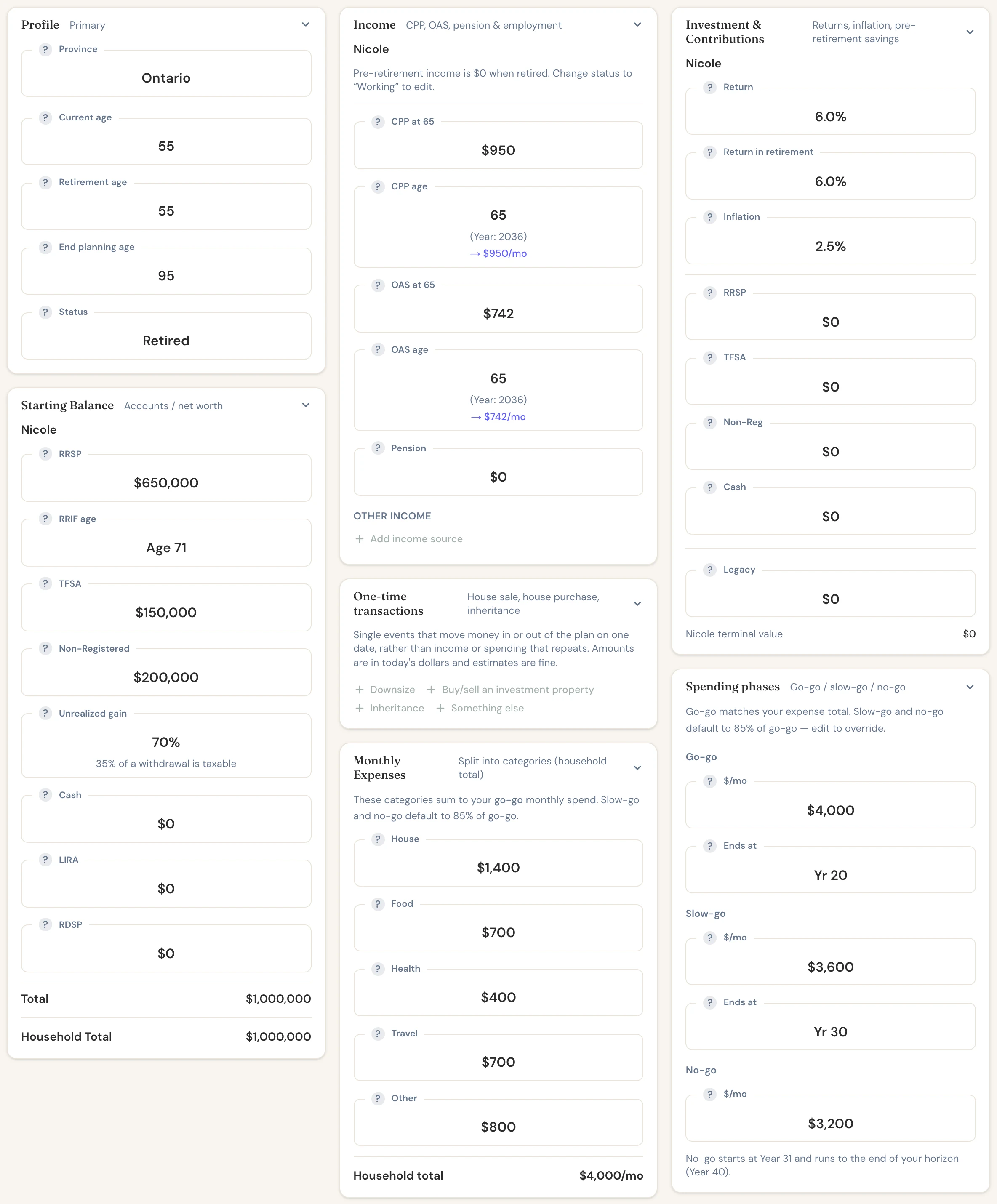 Nicole's plan inputs: her profile, account balances, CPP and OAS, and monthly spending.
Nicole's CPP is $950 a month at 65. Her CPP Statement of Contributions assumes she stops contributing at 55. Ten years with no contributions pull her estimate down from what a full career to 65 would pay. If you want a refresher on how both programs work, see our guide to CPP and OAS.
Ten years with no government income. CPP can start as early as 60, and OAS can't start before 65. In Nicole's plan, both start at 65, so her savings fund everything from 55 to 64.
Her money has a long time to grow. With a 40-year retirement ahead of her, Nicole keeps a growth-oriented portfolio, and her plan assumes it earns 6% a year.
She's planning on $4,000 a month. Her plan assumes that her spending steps down as she reaches 75 and again at 85. In Scenario Lab+, these steps are the plan's Spending Phases.
A few other important assumptions: all figures are in today's dollars, Nicole is single and owns her condo with no mortgage, and inflation runs at 2.5% a year.
Nicole's retirement budget
Here is how her $4,000 a month breaks down in her first twenty years:
| Category | Monthly | Annual |
|---|---|---|
| Housing (condo fees, property tax, utilities, insurance) | $1,400 | $16,800 |
| Food and dining | $700 | $8,400 |
| Health and dental | $400 | $4,800 |
| Travel | $700 | $8,400 |
| Everything else (transit, gifts, entertainment) | $800 | $9,600 |
| Total | $4,000 | $48,000 |
Travel is the line she protected most. It's the reason she wants to retire early. Housing is the line she'd most like to shrink, which is why one of the scenarios below looks at moving somewhere cheaper. Our guide to the best places to retire in Canada compares cities and regions.
Is $1 Million Enough to Retire at 55?
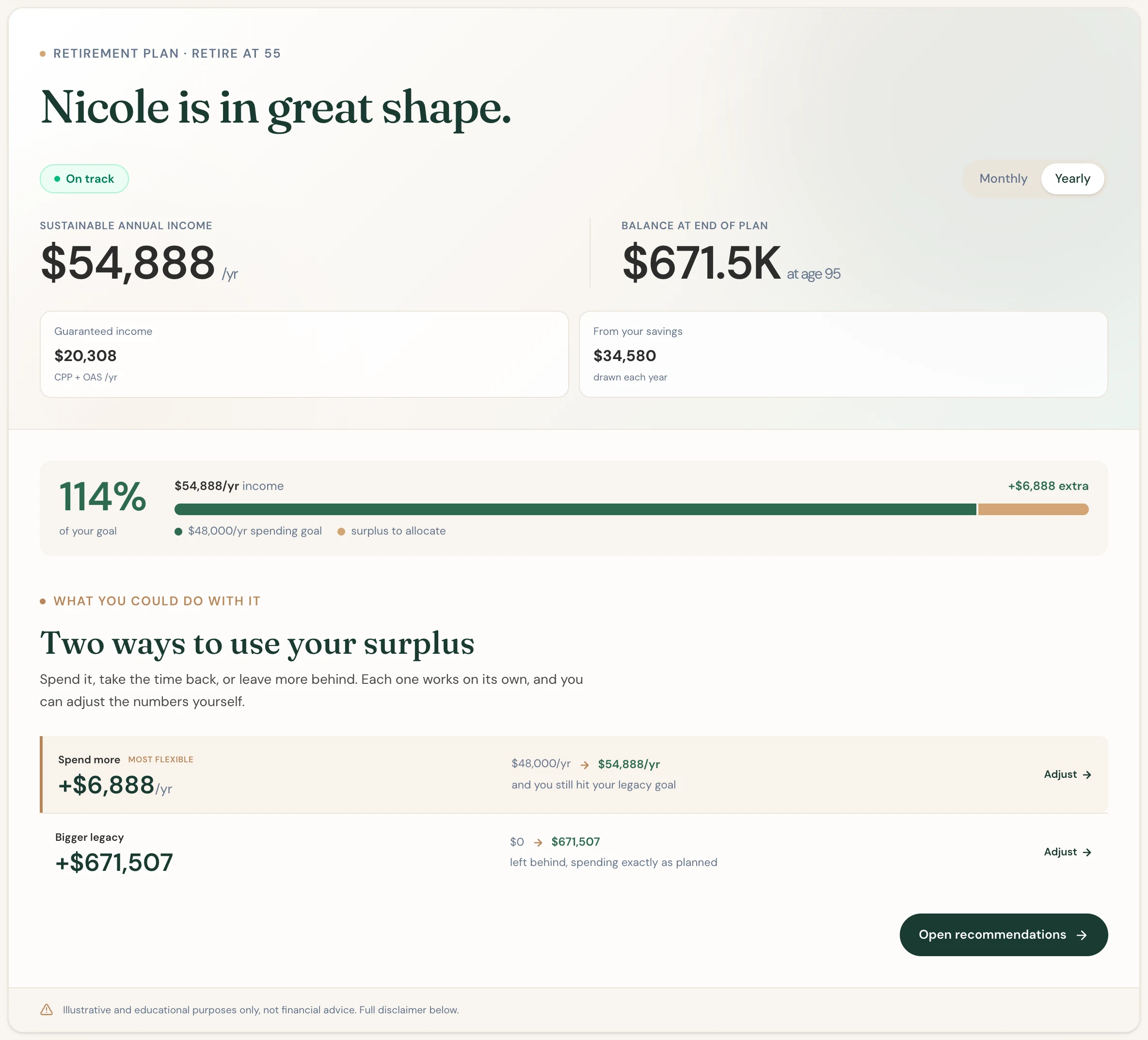 Scenario Lab+'s results: Nicole is in great shape, with money left over at 95.
For Nicole, the results say yes. Her plan covers her spending for 40 years and still has $671,507 left at 95. Scenario Lab+ estimates she could spend about $574 more a month and still make it.
A generic 4% rule would suggest $1 million supports about $40,000 a year. Nicole draws about $52,700 a year from her savings for her first ten years, more than 5% of her portfolio, because no government money has started yet. It works because two things are on her side: a lean budget and a long runway for her investments to grow.
Ten Years Before the Government Pays Anything
From 55 to 64, Nicole has no CPP, no OAS and no paycheque. Every dollar she spends comes out of her accounts.
By the end of the year she turns 64, her portfolio is down from $1,000,000 to $773,566. She uses a little under a quarter of her savings before any government money arrives. At 65, CPP ($11,400 a year) and OAS ($8,908 a year) start together, and her withdrawals drop from about $52,700 to $31,900 a year.
From there, her plan changes character. Her savings barely shrink for the rest of her life: $767,574 at 65, and $671,507 at 95. Once CPP and OAS arrive, investment growth covers most of what she takes out.
How Much Income Does $1 Million Provide?
So how much retirement income does a $1M nest egg generate at 55? For Nicole, $1 million provides $52,704 of gross income in her first year, which works out to $4,000 a month after tax.
In her first year of retirement, Nicole draws on three sources, all of them her own savings:
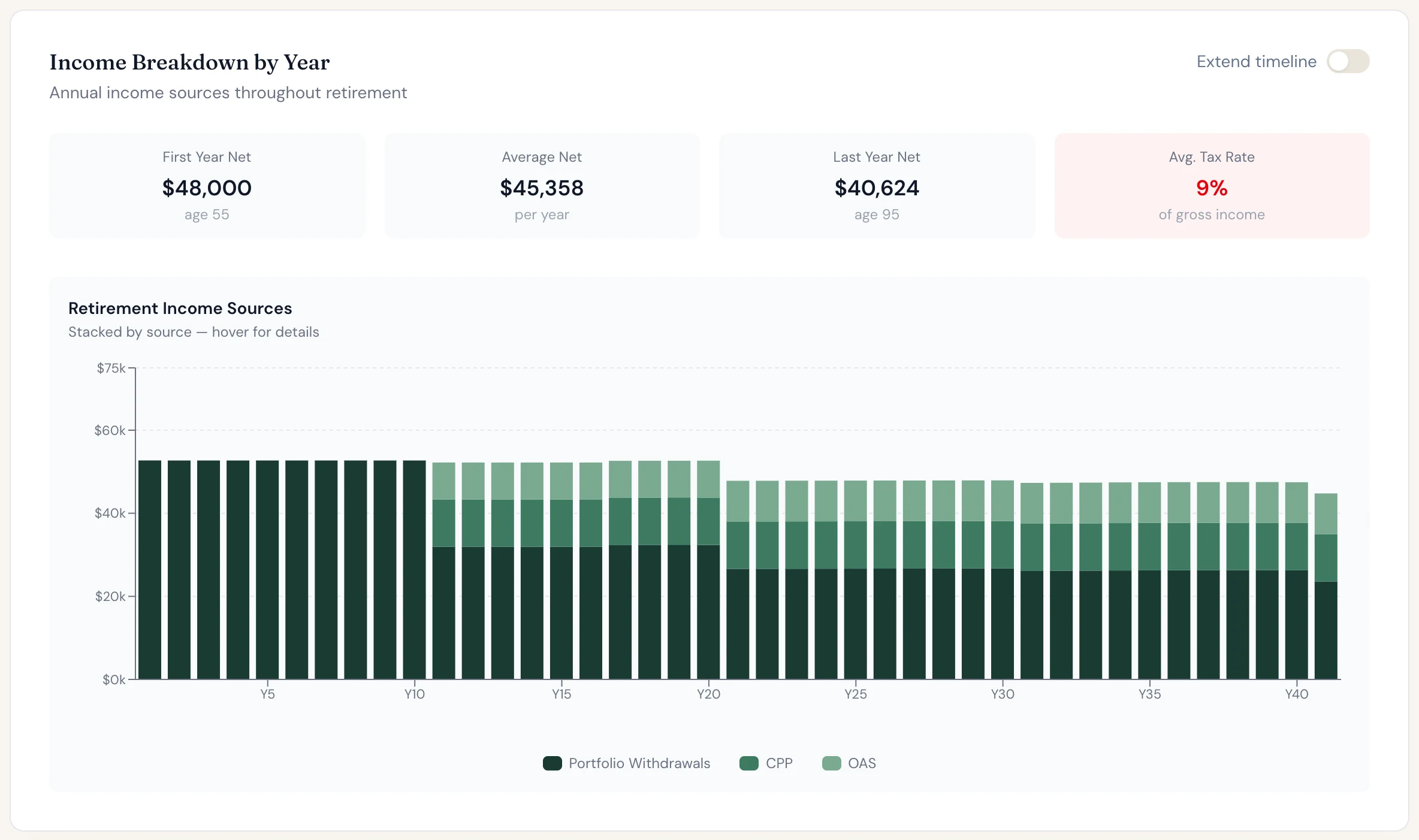 Where Nicole's income comes from each year, by source.
| Source | Amount | Taxable? |
|---|---|---|
| RRSP withdrawals | $34,258 | Yes |
| TFSA withdrawals | $7,906 | No |
| Non-registered withdrawals | $10,541 | Only the capital gain |
| Gross income | $52,704 | |
| Income tax | $4,704 | |
| Spending money | $48,000 |
At 65 the mix changes. CPP and OAS bring in $20,308 a year, and the remaining $31,900 or so comes from her RRSP, TFSA and non-registered accounts.
Scenario Lab+ uses its Proportional drawdown strategy by default, drawing from every account each year roughly in proportion to its balance. That keeps her taxable income steady from year to year. The Drawdown tab runs the same plan through other withdrawal strategies, such as Sequential and RRSP Meltdown, and compares the lifetime tax of each.

Could you retire at 55?
Scenario Lab+ builds this same year-by-year plan from your own accounts, benefits and spending, including the long stretch before CPP and OAS start.
Try Scenario Lab+How Much Tax Nicole Pays
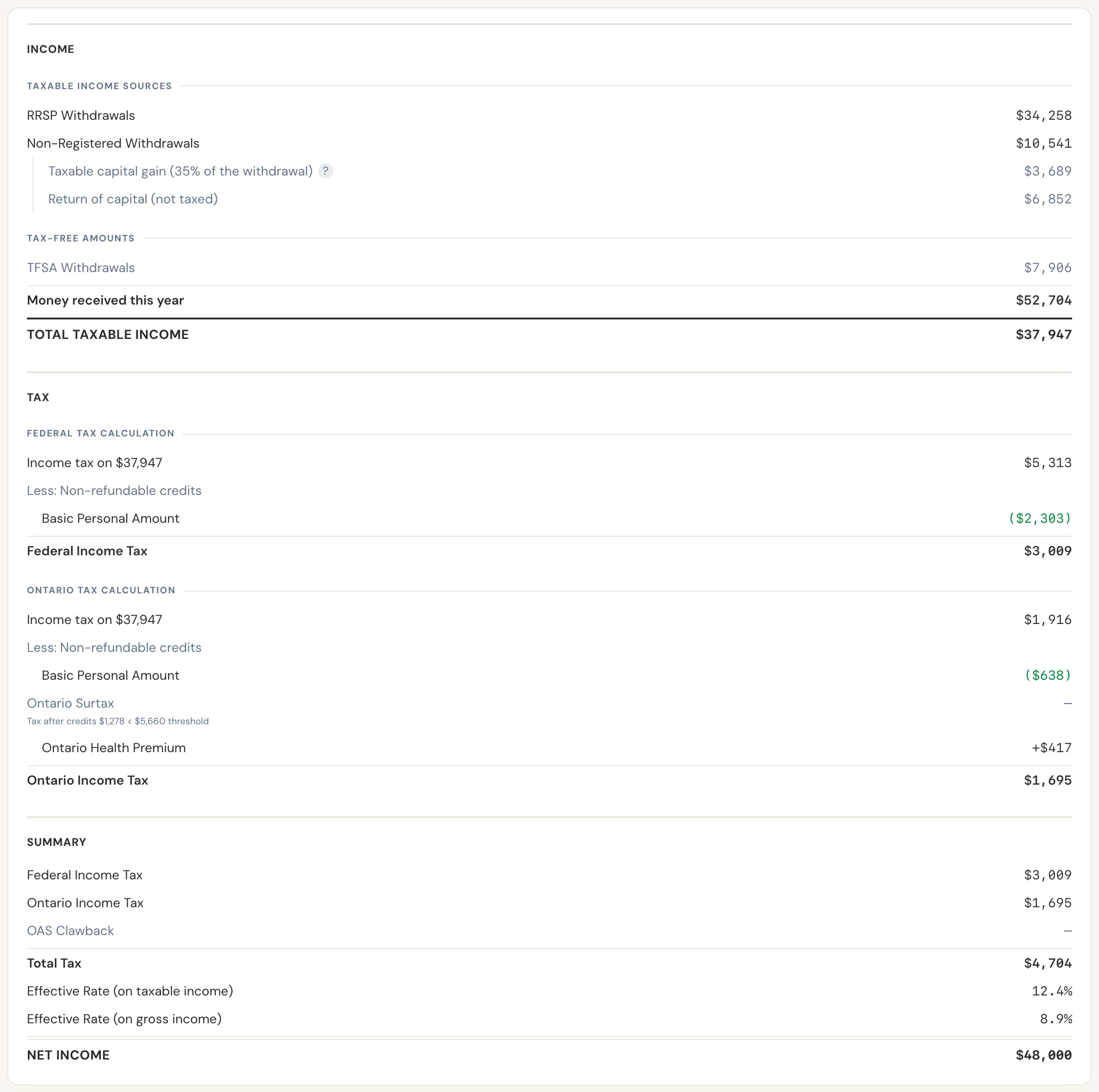 Nicole's tax bill in her first year of retirement, at age 55.
Nicole pays $4,704 in income tax in her first year of retirement. That works out to about 8.9% of her gross income.
The rate is low because only part of what she withdraws is taxable. TFSA withdrawals are tax-free. On her non-registered account, she is taxed only on the capital gain in what she sells, and only half of that gain counts as income. Her taxable income comes to about $37,900, mostly from her RRSP.
She never comes close to the OAS recovery tax (or clawback). Our explainer on the OAS clawback covers how it works and who is affected. To estimate your own bill, try our free Canadian income tax calculator.
How Her Plan Changes Over Time
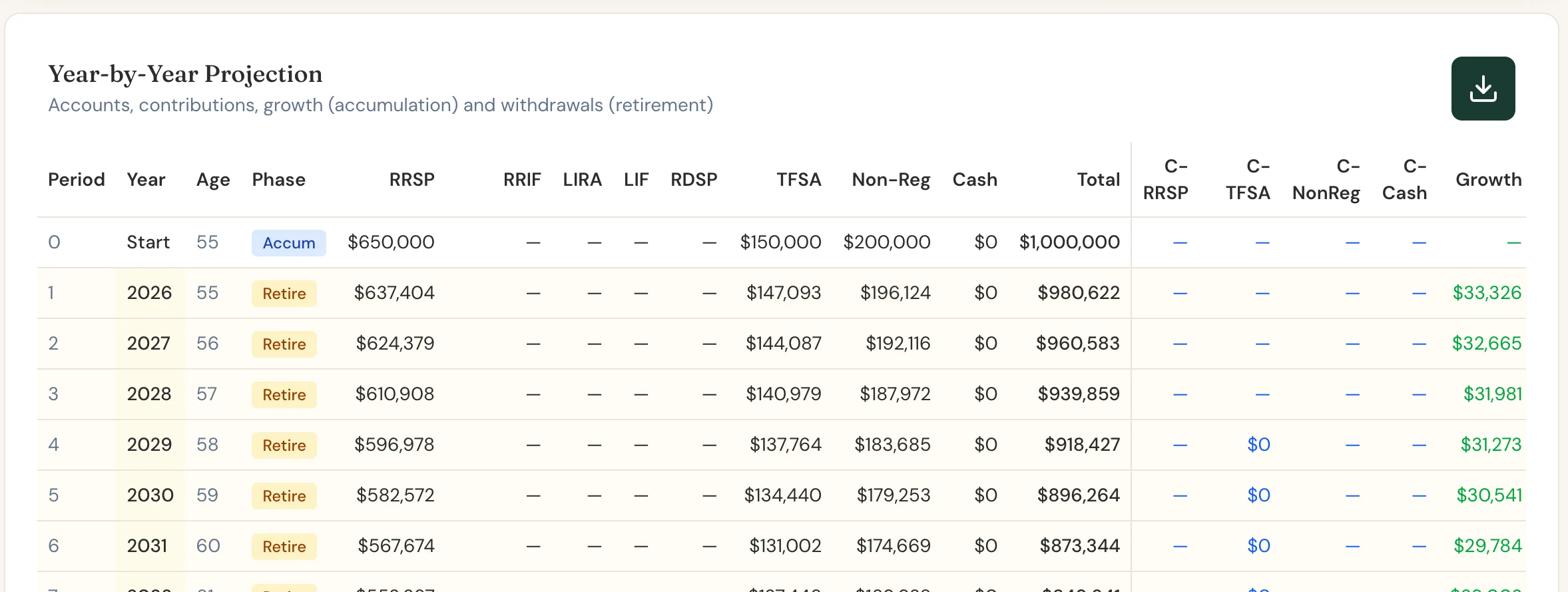 Year-by-year account balances from 55.
In Scenario Lab+, the Table tab shows every account for every year, and the whole table downloads as an Excel file.
Like many retirees, Nicole's retirement will not look the same every year.
At 65, CPP and OAS start. Her withdrawals fall by about 40%, and her portfolio levels off.
At 71, her RRSP becomes a RRIF. Every Canadian has to convert their RRSP by the end of the year they turn 71, and a RRIF has a minimum withdrawal each year. For Nicole, the minimum is more than she needs from that account, so her RRIF withdrawals rise from $20,742 to $25,205 and she draws less from her TFSA and non-registered account instead. Our RRIF guide covers the rules.
At 75, her OAS goes up 10% and her spending steps down. OAS pays more from age 75, so hers rises from $8,908 to $9,798 a year, while her spending drops to $3,600 a month.
At the end of her plan at age 95, she will still have $671,507: $97,984 in her RRIF, $277,240 in her TFSA and $296,283 in her non-registered account. Because the RRIF minimums draw her RRIF down first, most of what's left is in accounts that are cheap or free to withdraw from, or to leave to someone.
Based on her numbers, Scenario Lab+ estimates Nicole could spend about $574 more every month and still make it to 95.
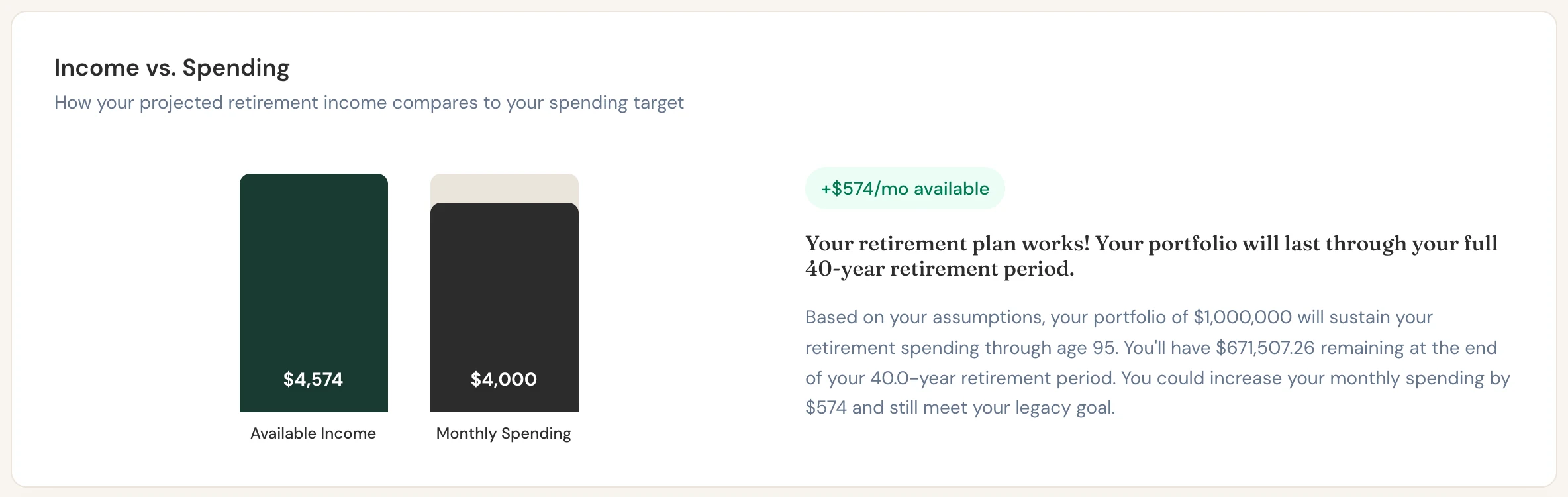 Income available to Nicole compared with what she plans to spend.
Scenario Lab+ shows this in its Recommendations tab, where you can apply the extra spending with one click and see the plan rebuild around it.
But What If We Change the Assumptions?
Nicole's plan works because of the trade-offs she's made. So we tested those trade-offs directly, changing one assumption at a time.
4 versions of Nicole's plan
One assumption changed in each. Charts show the portfolio from 55 to 95 in Scenario Lab+.
Nicole's base plan
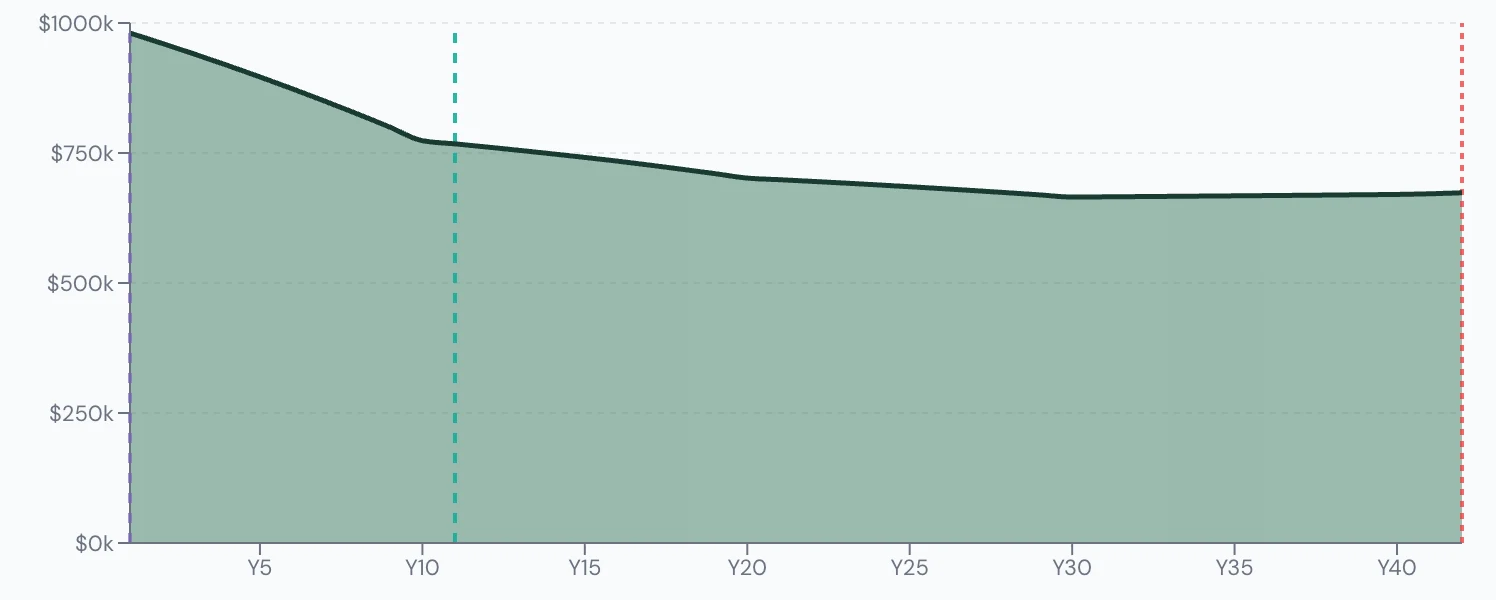
- Spends at 55
- $48,000/yr
- Money lasts
- Past 95
- Left at 95
- $671,507
Moves to a smaller, cheaper city
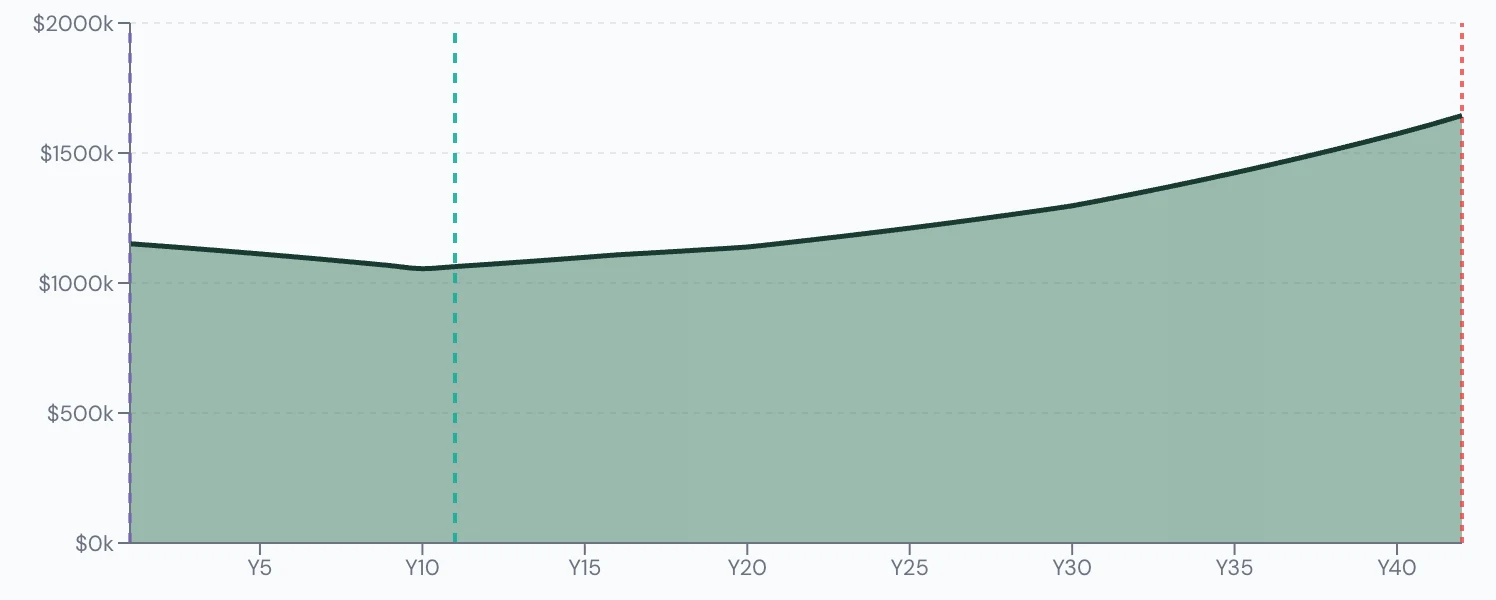
- Spends at 55
- $44,400/yr
- Money lasts
- Past 95
- Left at 95
- $1,607,667
Spends $500 more a month
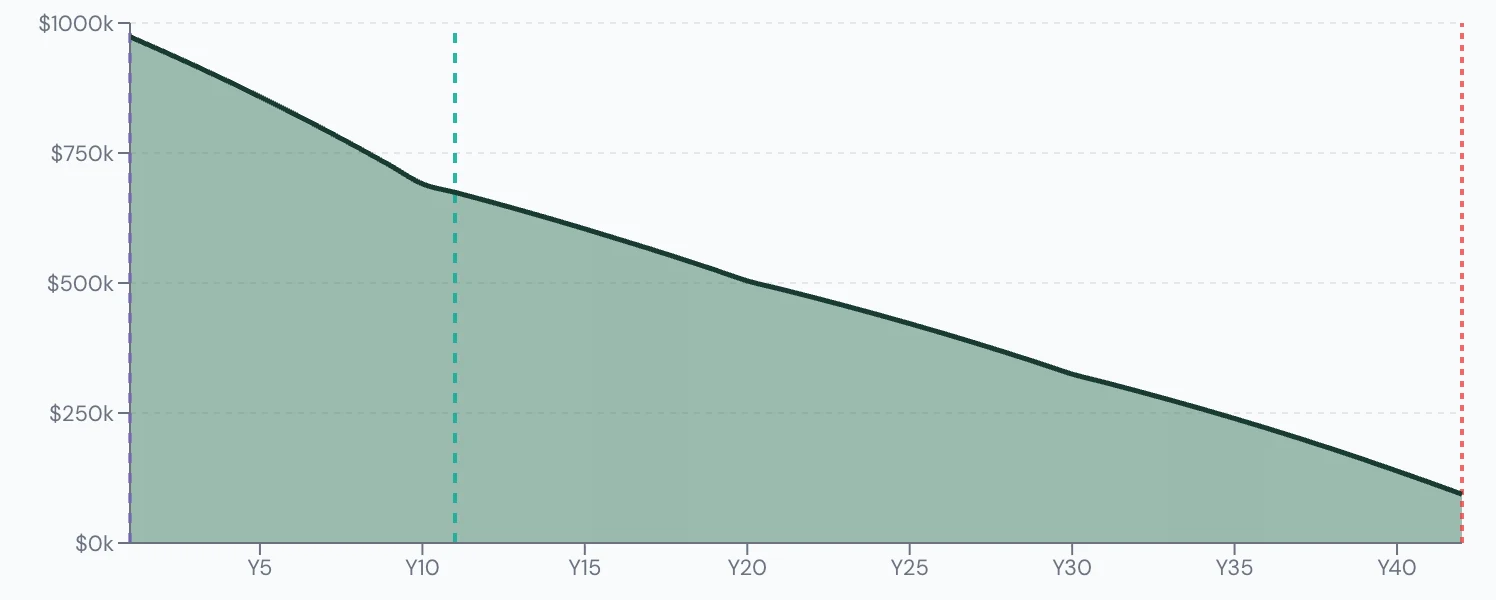
- Spends at 55
- $54,000/yr
- Money lasts
- Past 95
- Left at 95
- $116,435
Switches to a conservative portfolio
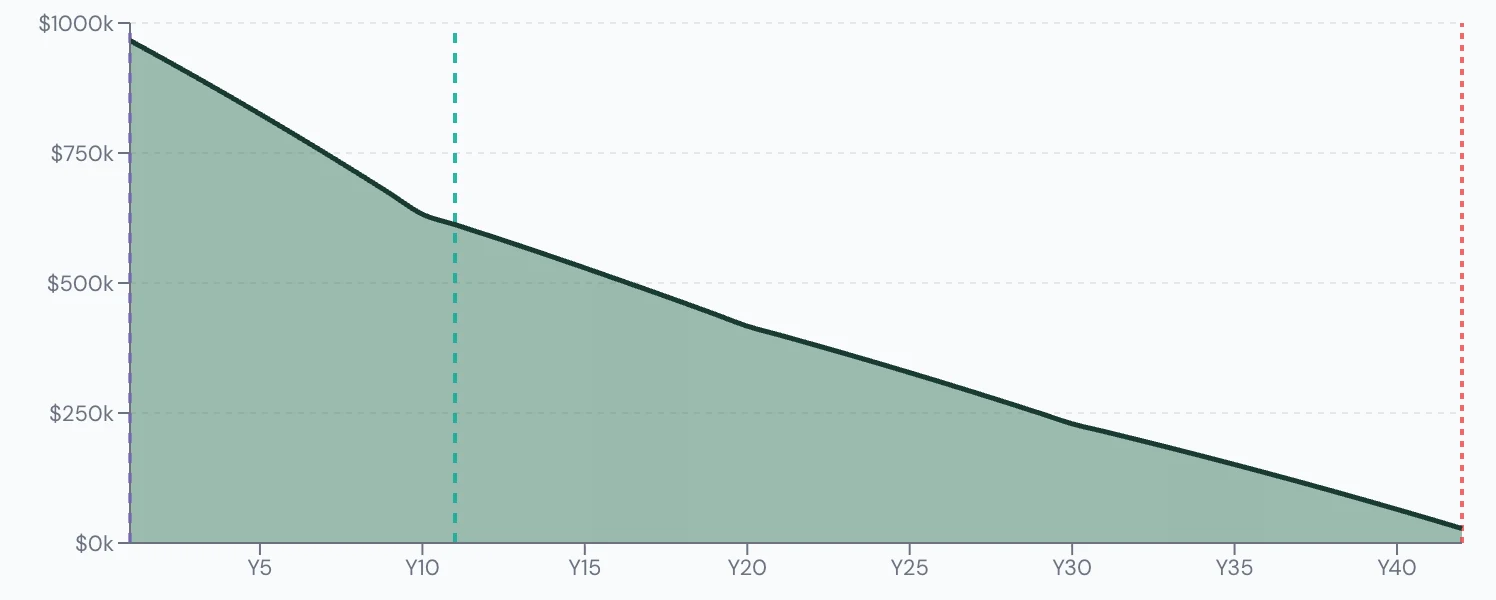
- Spends at 55
- $48,000/yr
- Money lasts
- Past 95
- Left at 95
- $46,429
Scenario 1
Moves to a smaller, cheaper city
- Spends at 55
- $44,400/yr
- Money lasts
- Past 95
- Left at 95
- $1,607,667
What if Nicole sells her Ottawa condo when she retires and moves to a smaller, cheaper city? In this scenario she sells for $500,000, buys a home for $340,000, and invests the $160,000 difference. Her monthly housing costs also drop by $300, so her budget falls to $3,700.
In Scenario Lab+, the move is a single entry under One-Time Transactions: a downsize at 55 with the sale price and the purchase price. The lower housing cost is a change to her monthly expenses.
Because it's her principal residence, the sale isn't taxed, and the extra money has 40 years to grow. By 64 her portfolio is $1,054,924 instead of $773,566, and she finishes her plan at 95 with $1,607,667.
A move like this isn't for everyone, but for an early retiree it's one of the few changes that helps twice: it adds to her savings and lowers what she has to take out of them every year.
Scenario 2
Spends $500 more a month
- Spends at 55
- $54,000/yr
- Money lasts
- Past 95
- Left at 95
- $116,435
Nicole's plan is built on $4,000 a month. What if she spends $4,500 instead? That's $6,000 more a year, in every phase of her retirement.
Her plan still works, but the cushion almost disappears. She reaches 95 with $116,435 left, and Scenario Lab+ estimates only about $48 a month of room. The ten bridge years cost more too: by 64 her portfolio is down to $690,588.
The extra $500 a month is affordable, but it uses up nearly all of the room her plan had for surprises.
Scenario 3
Switches to a conservative portfolio
- Spends at 55
- $48,000/yr
- Money lasts
- Past 95
- Left at 95
- $46,429
A growth-oriented portfolio makes sense for a 40-year retirement, but not everyone is comfortable with the ups and downs. What if Nicole switches to a more conservative mix that earns 4.5% a year instead of 6%?
Her plan still works, only just. She reaches 95 with $46,429 left, and the room to spend more disappears. Over 40 years, the difference in growth adds up to more than $600,000 at the end of her plan.
For an early retiree, investment mix matters as much as the savings balance. The longer your retirement, the more of your spending comes from growth rather than from the money you started with.
Your $1 Million Is Not Nicole's $1 Million
So is $1 million enough to retire at 55? For Nicole it is, because she's matched her budget to her timeline. Her plan is a starting point, not an answer for anyone else.
Two people with exactly $1 million can end up with very different retirements. What they spend, how much CPP and OAS they receive, how their savings are invested, and how many years they need to bridge before 65 can make all the difference. Five more years at work leaves a lot more room, as you can see in Michael's plan at 60 and Susan's plan at 65.
The bigger risk is assuming $1 million is enough without running your own scenario.
That's why we built Scenario Lab+.
It is the software behind every number in this article. Give it your own accounts and spending, and it builds the same year-by-year plan for you, including every what-if above. If you'd like to see it first, Nicole's full plan is open to explore.

Build Your Own Canadian Retirement Plan
Enter your own savings, benefits and spending in Scenario Lab+ to see whether your number is enough and what happens when your assumptions change.
Start now