


The short answer
- Yes: $2 million supports $7,000 a month after tax for Daniel, with $1.57M left at 90.
- RRIF minimums from 71 raise his tax rate from about 14% to 17%.
- He has room to spend about $2.9K/mo more.
Estimates from Scenario Lab+, in today's dollars.
See the demo planWith $2 million saved, the question changes. Whether your money will last is settled early on. The more useful questions are how much you can safely enjoy, and how to keep your tax bill in check as RRIF withdrawals grow. If you're retiring at 65 with $2 million, your plan is about making the most of it.
Here at Loonie Nest, our mission is to provide free and affordable personal finance education to Canadians so they can gain confidence in their retirement.

Daniel's plan at a glance
$2,000,000
saved at 65
RRSP
$1,200,000
Taxed as income when withdrawn
TFSA
$250,000
Withdrawals are tax-free
Non-registered
$550,000
Only the capital gain is taxed
Spending after tax, in today's dollars
$84,000
$75,600
$67,200
CPP $1,300 a month from 65
OAS $742 a month from 65
Our $2 Million Retirement Scenario
Let's meet Daniel. He's 65, single, and living in Oakville, ON. Daniel spent most of his career as a partner at a small accounting firm, with no workplace pension, and he saved aggressively along the way. Today he has $2 million, most of it in his RRSP. He's ready to retire, and he wants to know how much he can comfortably spend, and whether he can start helping his two adult kids now.
We'll run Daniel's numbers through Scenario Lab+.
Scenario Lab+ is our proprietary retirement planning software. We'll use it to generate and review a tailored retirement plan for him.
To start, here's how Daniel's numbers look as he retires at 65:
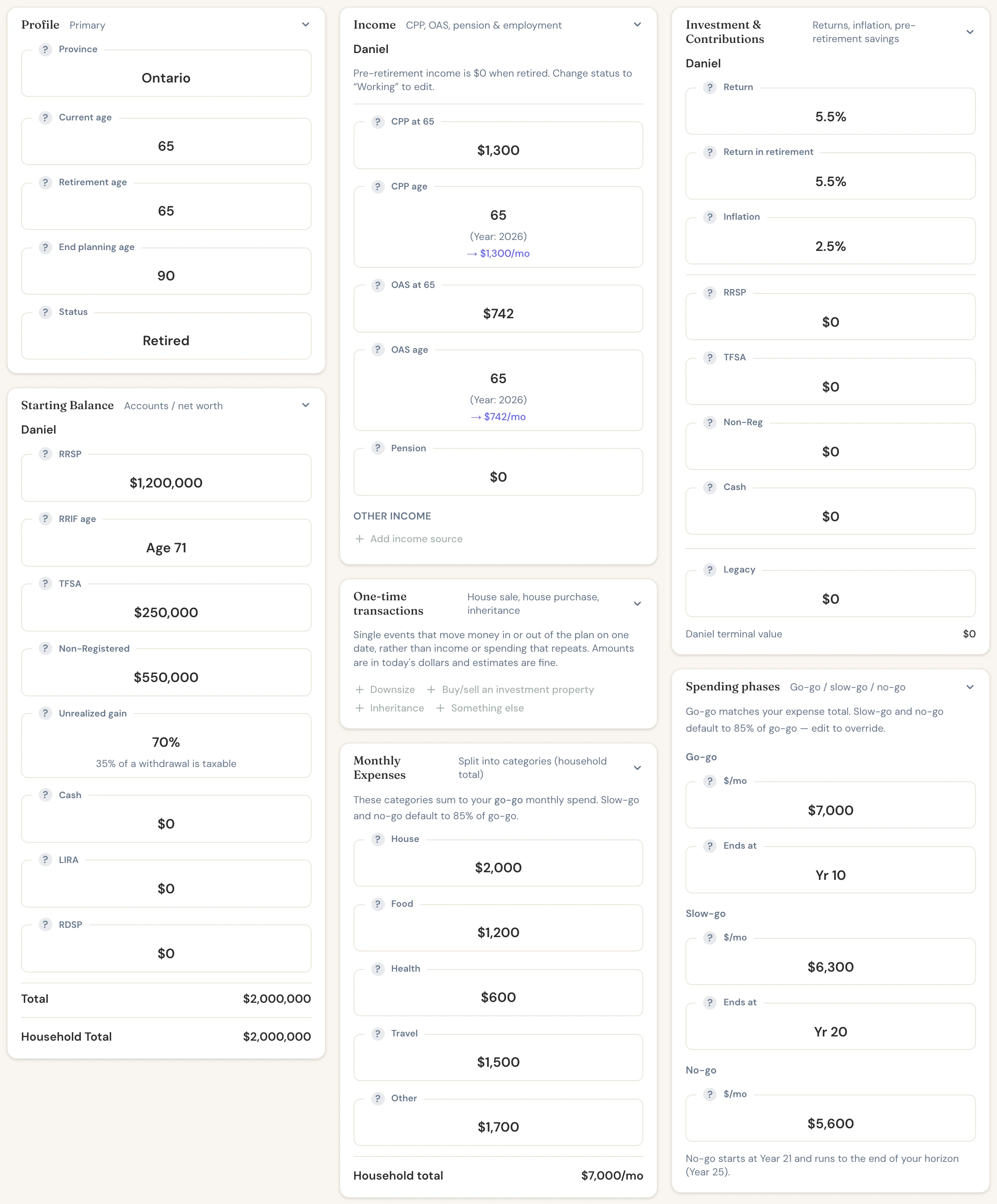 Daniel's plan inputs: his profile, account balances, CPP and OAS, and monthly spending.
Most of his money is in his RRSP. Daniel has $1.2 million in his RRSP, $250,000 in his TFSA and $550,000 in a non-registered account. Every dollar that comes out of the RRSP is taxed as income, which shapes the rest of his plan.
Daniel's CPP is $1,300 a month at 65. After decades of high earnings, his CPP Statement of Contributions shows an amount well above average. He also gets the full OAS pension, about $742 a month. If you want a refresher on how both programs work, see our guide to CPP and OAS.
A balanced-growth portfolio, planned to 90. His plan assumes his investments grow 5.5% a year. We plan his retirement to age 90.
His spending falls as he ages. Daniel's plan starts at $7,000 a month and assumes that his spending steps down as he reaches 75 and again at 85. In Scenario Lab+, these steps are the plan's Spending Phases.
A few other important assumptions: all figures are in today's dollars, Daniel is single and owns his home with no mortgage, and inflation runs at 2.5% a year.
Daniel's retirement budget
Here is how his $7,000 a month breaks down in his first ten years:
| Category | Monthly | Annual |
|---|---|---|
| Housing (property tax, utilities, insurance, upkeep) | $2,000 | $24,000 |
| Food and dining | $1,200 | $14,400 |
| Health and dental | $600 | $7,200 |
| Travel | $1,500 | $18,000 |
| Everything else (car, gifts, entertainment) | $1,700 | $20,400 |
| Total | $7,000 | $84,000 |
Costs vary a lot across the province. Our guide to the best places to retire in Canada compares cities and regions.
Is $2 Million Enough to Retire at 65?
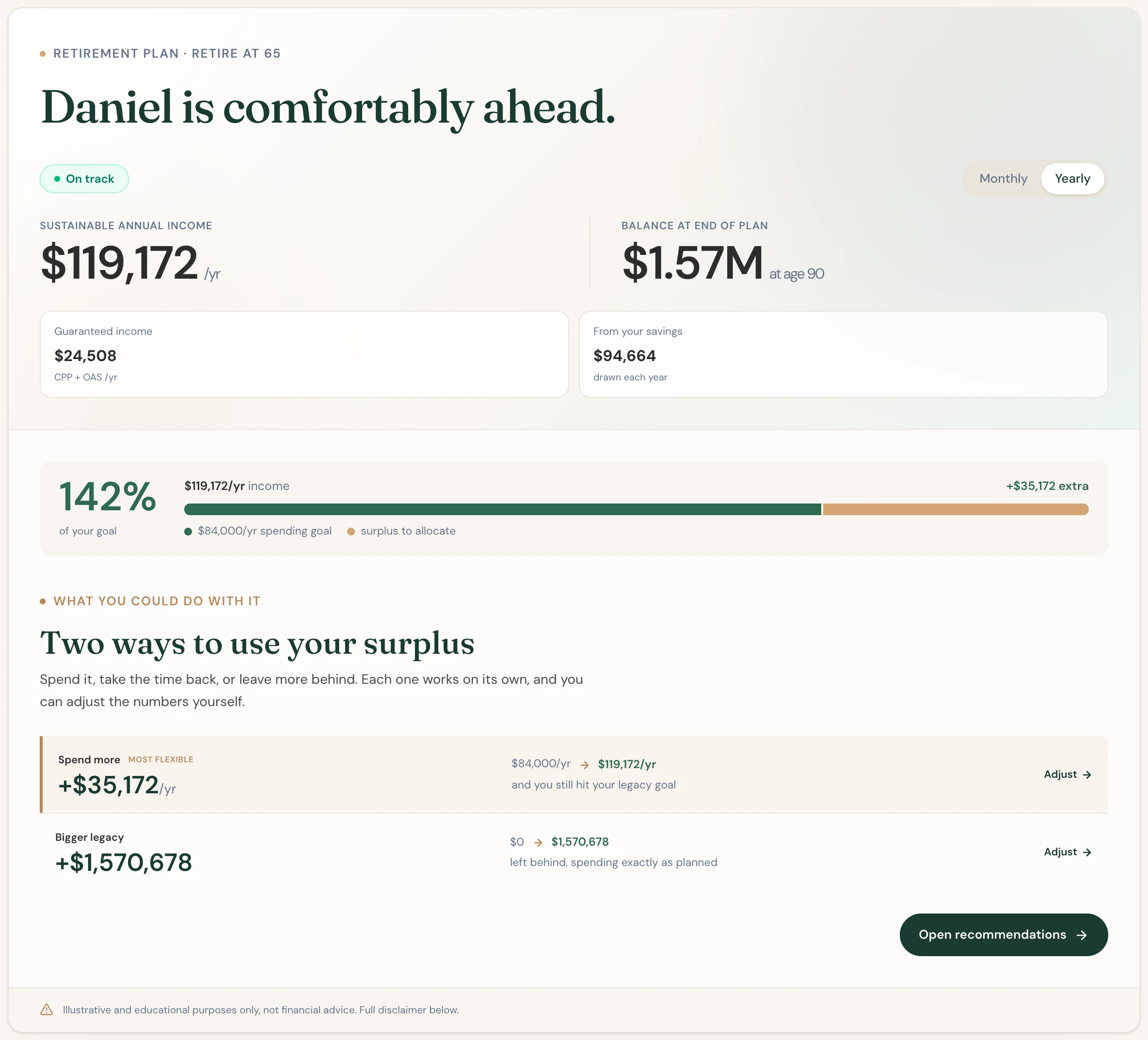 Scenario Lab+'s results for Daniel's plan.
For Daniel, the results say yes, by a wide margin. His plan covers his spending every year and still has $1,570,678 left at 90. Scenario Lab+ estimates he could spend about $2,931 more a month and still make it.
A generic 4% rule would suggest $2 million supports about $80,000 a year. Daniel only draws about $73,000 from his savings in his first year, about 3.6% of his portfolio, and his CPP and OAS cover the rest.
How Much Income Does $2 Million Provide?
So how much retirement income does a $2M nest egg generate? For Daniel, $2 million plus CPP and OAS provides $97,466 of gross income in his first year, which works out to $7,000 a month after tax.
In his first year of retirement, Daniel draws on five sources:
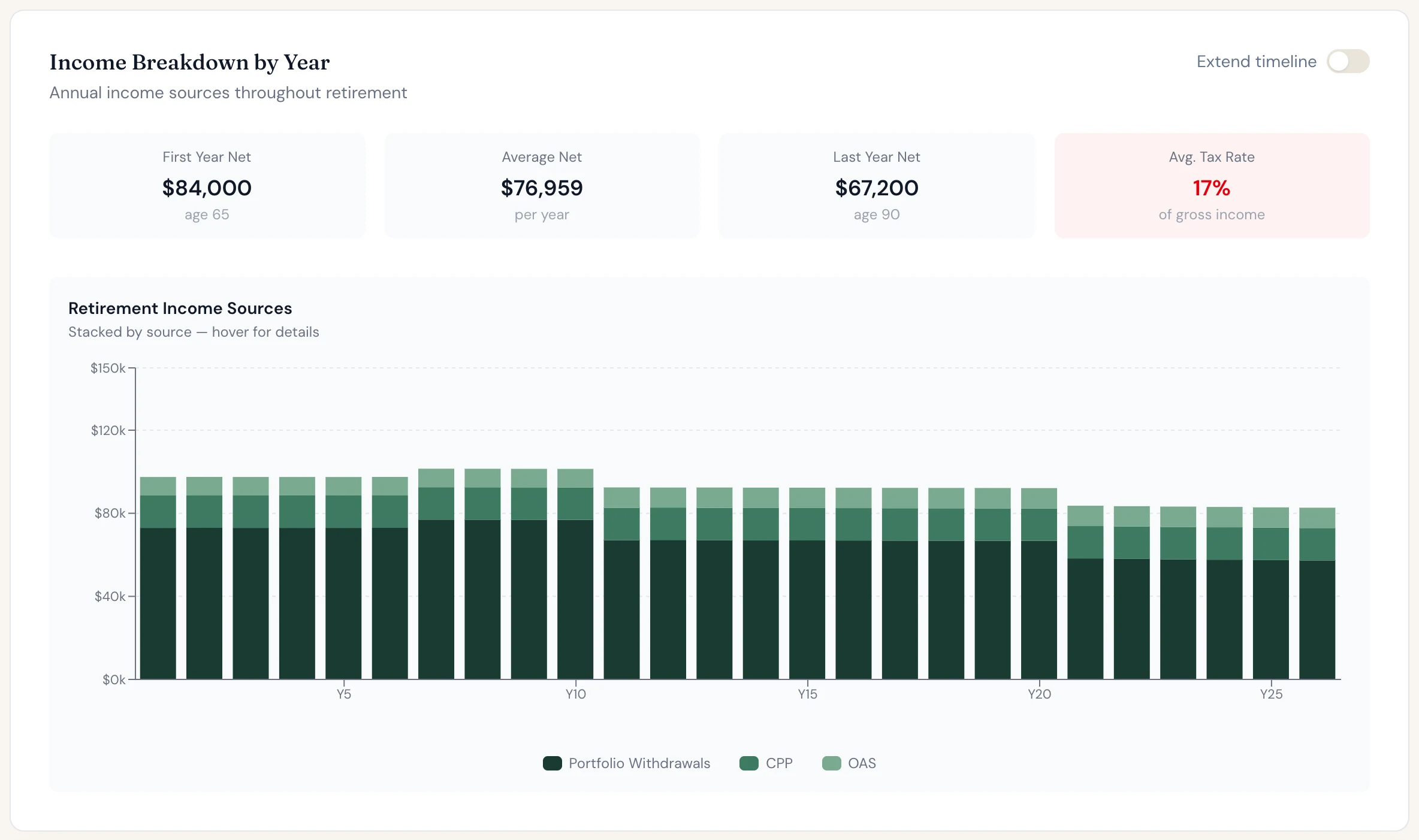 Where Daniel's income comes from each year, by source.
| Source | Amount | Taxable? |
|---|---|---|
| CPP | $15,600 | Yes |
| OAS | $8,908 | Yes |
| RRSP withdrawals | $43,775 | Yes |
| TFSA withdrawals | $9,120 | No |
| Non-registered withdrawals | $20,064 | Only the capital gain |
| Gross income | $97,466 | |
| Income tax | $13,466 | |
| Spending money | $84,000 |
Scenario Lab+ uses its Proportional drawdown strategy by default, drawing from every account each year roughly in proportion to its balance. That keeps his taxable income as steady as his RRIF rules allow. The Drawdown tab runs the same plan through other withdrawal strategies, such as Sequential and RRSP Meltdown, and compares the lifetime tax of each.

How much could you spend?
Scenario Lab+ finds the most you can spend each month and still make your money last, using your own accounts and benefits.
Try Scenario Lab+How Much Tax Daniel Pays
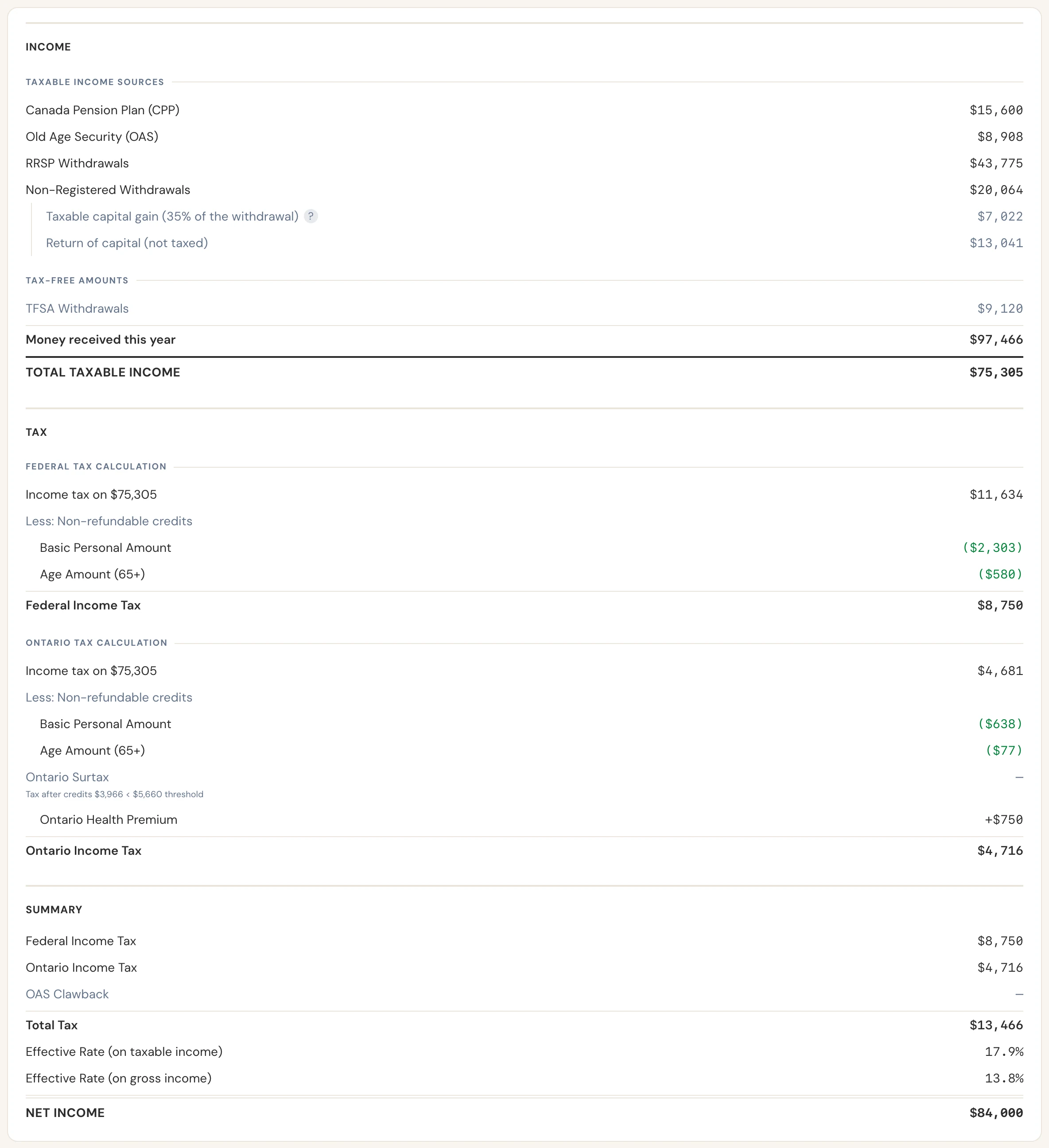 Daniel's tax bill in his first year of retirement, at age 65.
Daniel pays $13,466 in income tax in his first year of retirement, about 13.8% of his gross income. His taxable income comes to about $75,300.
That's a higher rate than most of our other case studies, and it climbs. At 71 his RRSP becomes a RRIF, and the RRIF minimum withdrawal on a balance this size is more than he needs to spend. His RRIF withdrawals jump from $43,775 to $60,211 a year, his taxable income rises to about $88,700, and his tax bill to $17,454. For the rest of his retirement he pays about 17% to 19% of his income in tax.
He comes close to the OAS clawback but never crosses into it, so he keeps his full OAS in every year of his plan. The extra RRIF money he doesn't spend goes back into his TFSA and non-registered account. To estimate your own bill, try our free Canadian income tax calculator.
How His Plan Changes Over Time
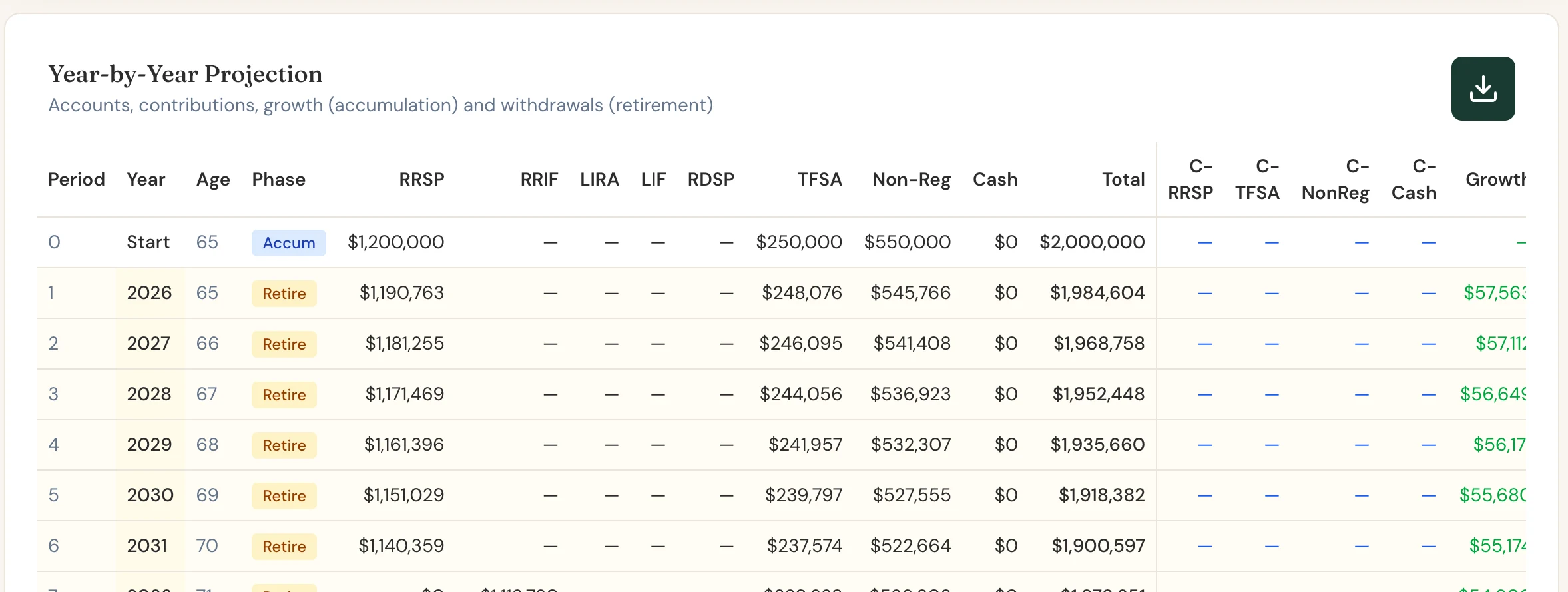 Year-by-year account balances from 65.
In Scenario Lab+, the Table tab shows every account for every year, and the whole table downloads as an Excel file.
Like many retirees, Daniel's retirement will not look the same every year.
At 71, his RRSP becomes a RRIF and his taxes go up. Minimum withdrawals take more out of his RRIF than he needs, and his tax rate rises from about 14% to about 17%. Our RRIF guide covers the rules.
At 75, his OAS goes up 10% and his spending steps down. OAS pays more from age 75, so his rises from $8,908 to $9,798 a year, while his spending drops to $6,300 a month.
His savings barely shrink. He starts with $2 million and still has $1,570,678 at 90: $435,895 in his RRIF, $355,968 in his TFSA and $778,815 in his non-registered account.
Based on his numbers, Scenario Lab+ estimates Daniel could spend about $2,931 more every month and still make it to 90.
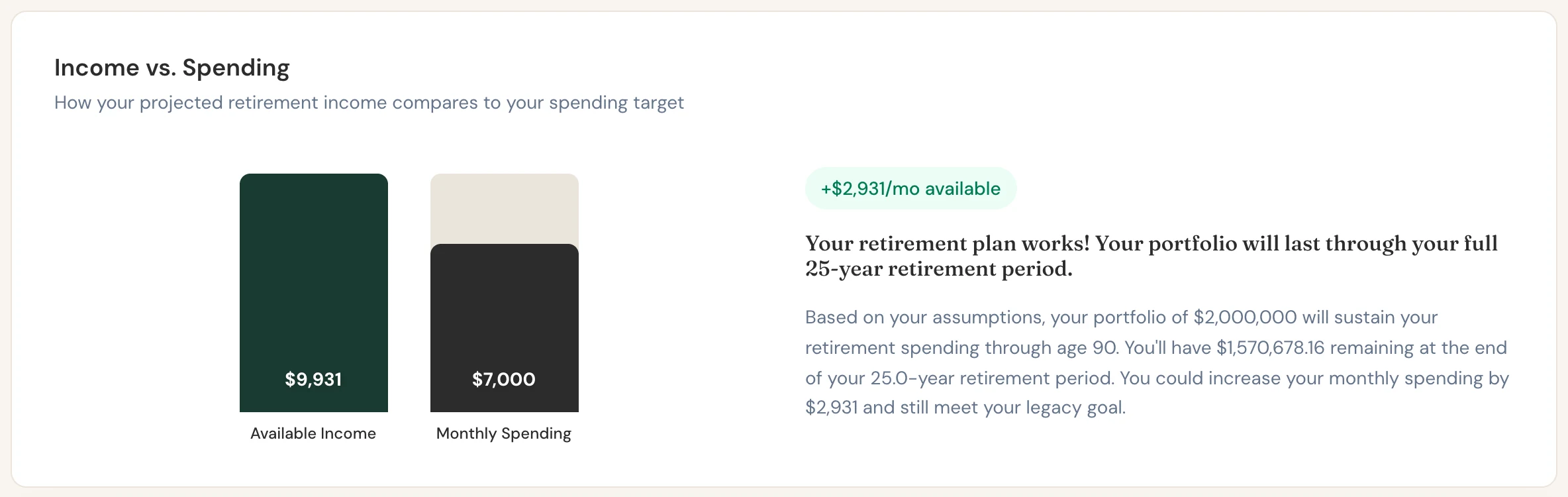 Income available to Daniel compared with what he plans to spend.
Scenario Lab+ shows this in its Recommendations tab, where you can apply the extra spending with one click and see the plan rebuild around it.
But What If We Change the Assumptions?
Daniel's plan has far more than he needs. So we looked at what he could do with the surplus, and at one change that could stretch it further, changing one assumption at a time.
5 versions of Daniel's plan
One assumption changed in each. Charts show the portfolio from 65 to 90 in Scenario Lab+.
Daniel's base plan
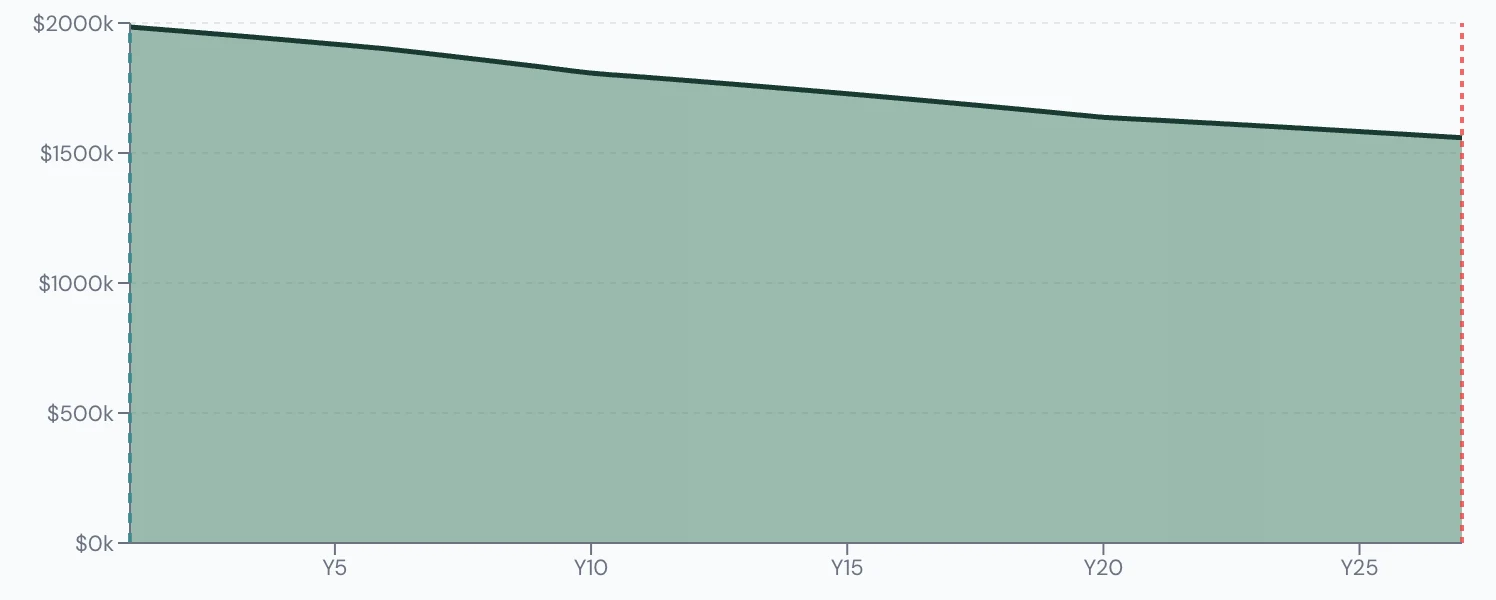
- Spends at 65
- $84,000/yr
- Money lasts
- Past 90
- Left at 90
- $1,570,678
Spends $2,000 more a month
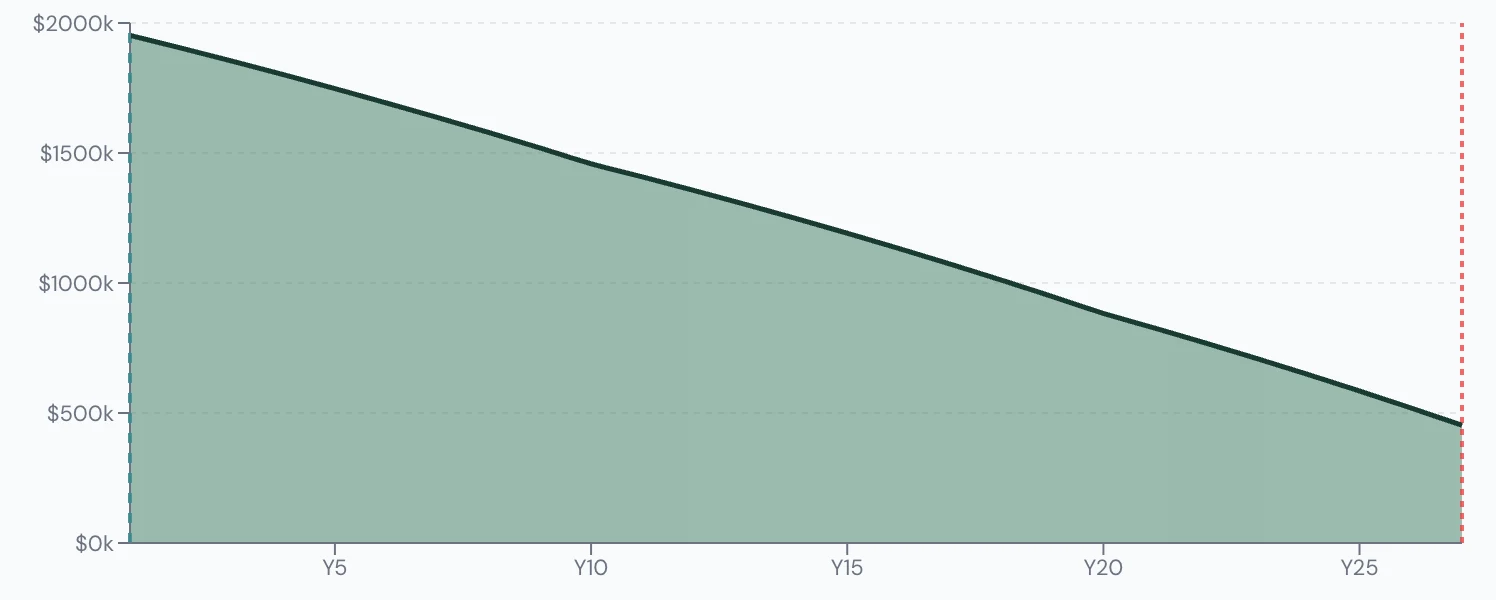
- Spends at 65
- $108,000/yr
- Money lasts
- Past 90
- Left at 90
- $519,605
Gives his kids $200,000 at 70
- Spends at 65
- $84,000/yr
- Money lasts
- Past 90
- Left at 90
- $1,124,605
Draws his RRSP down first
- Spends at 65
- $84,000/yr
- Money lasts
- Past 90
- Left at 90
- $1,482,045
Delays CPP and OAS to 70
- Spends at 65
- $84,000/yr
- Money lasts
- Past 90
- Left at 90
- $1,597,916
Scenario 1
Spends $2,000 more a month
- Spends at 65
- $108,000/yr
- Money lasts
- Past 90
- Left at 90
- $519,605
What if Daniel uses most of his room and spends $2,000 more a month, in every phase of his retirement?
His plan still works easily. He reaches 90 with $519,605 left, and Scenario Lab+ still estimates about $777 a month of room on top of that. His tax bill in his first year rises to $21,247, because the extra spending comes mostly from his RRSP, but he still never reaches the OAS clawback.
For someone in Daniel's position, spending too little can be as real a risk as spending too much.
Scenario 2
Gives his kids $200,000 at 70
- Spends at 65
- $84,000/yr
- Money lasts
- Past 90
- Left at 90
- $1,124,605
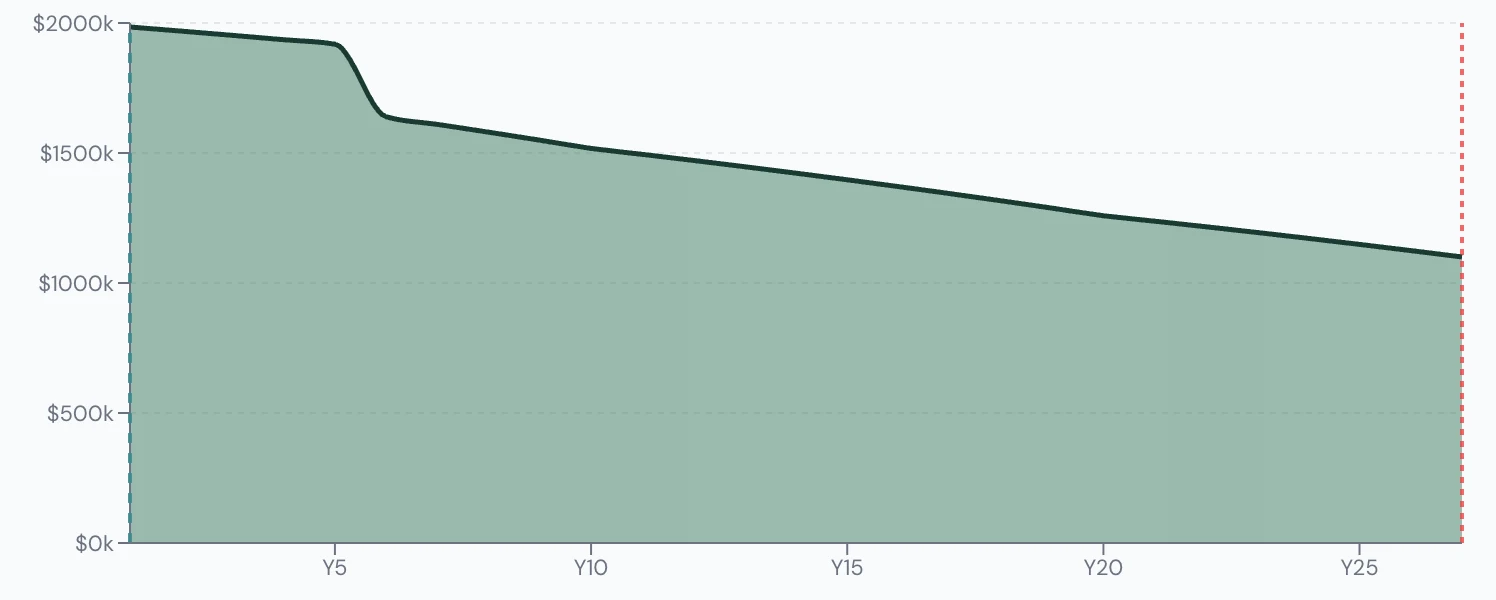
Daniel's kids are in their thirties and expect to buy homes in the next few years. What if he gives them $200,000 at 70, while he's around to see them use it, rather than leaving it to them later?
We modelled the gift with the One-Time Transactions feature in Scenario Lab+. You enter a dated, one-off amount, such as a gift, an inheritance, a home sale or a new roof, and choose which account it comes from. Scenario Lab+ then works it into every year of the plan, including the tax.
Daniel takes it from his non-registered account. In the year of the gift, his tax bill rises from $13,466 to $68,230: selling $200,000 of investments realizes capital gains, and he draws more from his RRSP that year as well. Over his whole retirement he pays about $41,000 more in tax than in his original plan.
He still reaches 90 with $1,124,605, and his own spending doesn't change. Scenario Lab+ estimates his room to spend more drops from $2,931 to about $2,063 a month.
Scenario 3
Draws his RRSP down first
- Spends at 65
- $84,000/yr
- Money lasts
- Past 90
- Left at 90
- $1,482,045
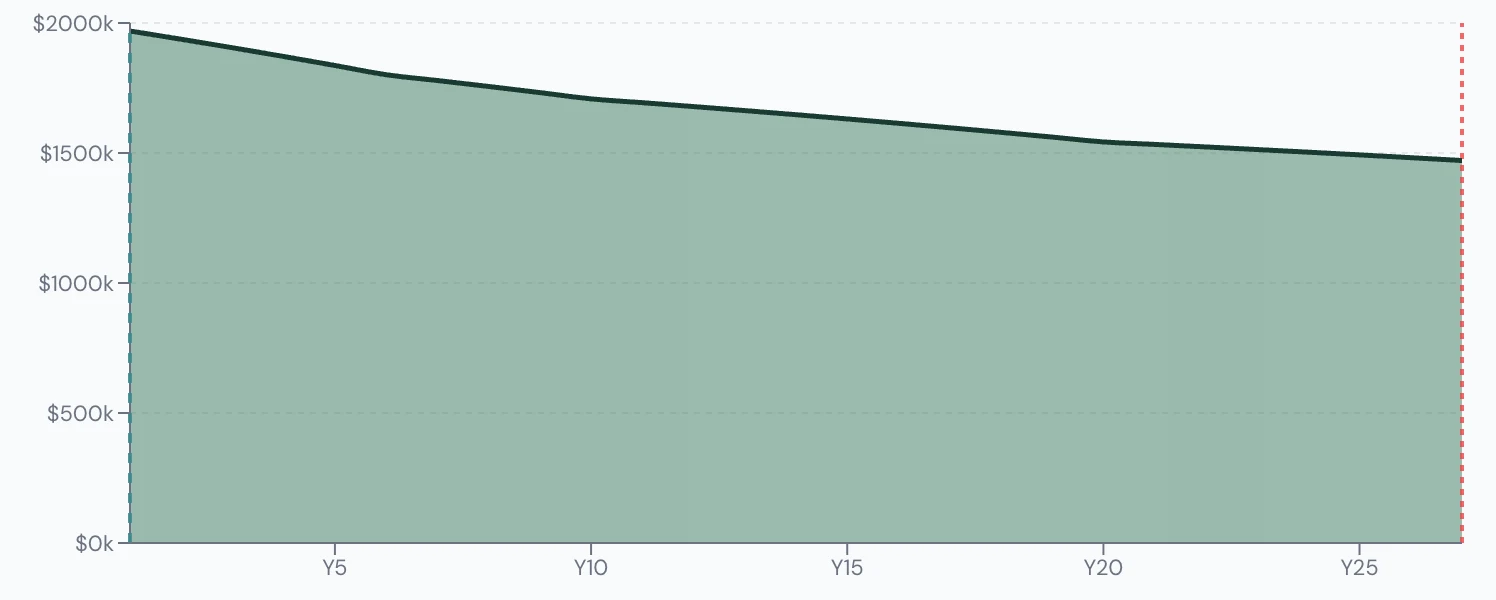
A popular strategy for people with large RRSPs is the "RRSP meltdown": drawing the RRSP down first, before the RRIF minimums and the OAS clawback start to bite. Scenario Lab+ runs it as its RRSP Meltdown drawdown strategy.
For Daniel, it doesn't pay. His tax bill in his first year jumps to $28,684, more than double his original plan, and over his whole retirement he pays about $25,000 more in tax. He finishes at 90 with $1,482,045, about $89,000 less than with the balanced approach.
The meltdown works best for people whose RRIF withdrawals would push them into the OAS clawback. Daniel already stays below it, so drawing his RRSP down faster only prepays tax he'd otherwise pay later.
Scenario 4
Delays CPP and OAS to 70
- Spends at 65
- $84,000/yr
- Money lasts
- Past 90
- Left at 90
- $1,597,916
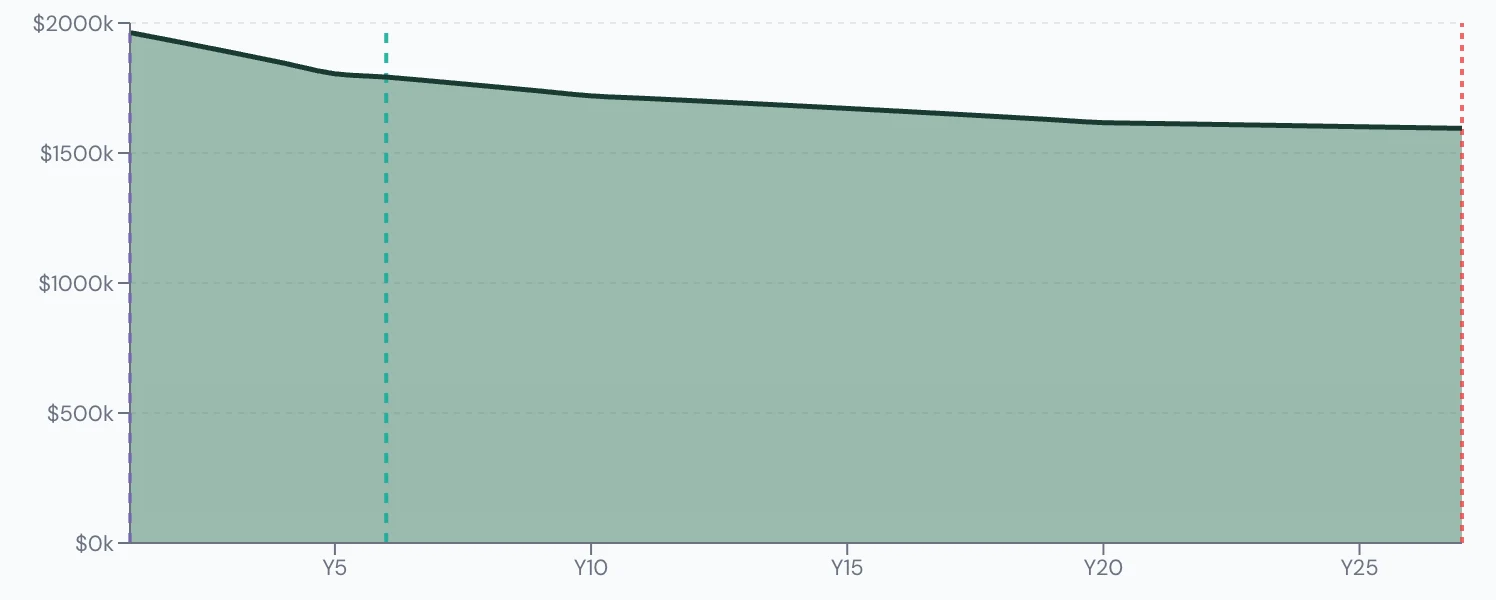
Daniel doesn't need his CPP and OAS at 65. What if he delays both to 70? CPP rises 42% and OAS rises 36% if you wait, so he'd receive $22,152 a year of CPP instead of $15,600, and $12,114 of OAS instead of $8,908.
From 65 to 69 he lives on his savings alone, and by 69 his portfolio is $1,804,568 instead of $1,918,382. From 70 the larger cheques start to close the gap. His portfolio catches up with his original plan at 87, and he finishes at 90 with $1,597,916, about $27,000 more. Scenario Lab+ estimates his room to spend more rises slightly, to about $3,010 a month.
His tax bill in his first year falls to $10,145, because there's no CPP or OAS income yet. Later, the larger benefits add to his RRIF withdrawals, and over his whole retirement he pays about $22,000 more in tax. He still stays clear of the OAS clawback in every year.
At a planning age of 90, the difference in these results is small. Delaying is a bet on a long life: the longer Daniel lives past 87, the further ahead the delay puts him. Our CPP and OAS break-even calculator shows where that line falls for you.
Your $2 Million Is Not Daniel's $2 Million
So is $2 million enough to retire at 65? For Daniel it's more than enough, with room to spend more and help his family. His plan is a starting point, not an answer for anyone else.
Two people with exactly $2 million can end up with very different retirements. What they spend, how much of their savings sits in an RRSP, how much CPP and OAS they receive, and when they retire can make all the difference. For a single retiree with half as much, see Susan's plan with $1 million at 65, and for a couple, Raj and Priya's plan at 60.
The bigger risk at $2 million is spending less than you could, or paying more tax than you need to, without ever running your own scenario.
That's why we built Scenario Lab+.
It is the software behind every number in this article. Give it your own accounts and spending, and it builds the same year-by-year plan for you, including every what-if above. If you'd like to see it first, Daniel's full plan is open to explore.

Build Your Own Canadian Retirement Plan
Enter your own savings, benefits and spending in Scenario Lab+ to see whether your number is enough and what happens when your assumptions change.
Start now