


The short answer
- Yes: $1.2 million at 65 supports $6,500 a month after tax for Greg and Anne, with $757K left at 95.
- Almost all of it is Greg's RRSP, and pension splitting moves about $26,000 a year of his income onto Anne's tax return from 71.
- Converting his RRSP to a RRIF at 65 lets them split six years sooner and saves about $19,000 of tax.
Estimates from Scenario Lab+, in today's dollars.
See the demo planMany couples retire with most of their savings in one name. One spouse earned more, or worked longer, or had the workplace RRSP, and the other spent years at home or working part time. The household total looks the same as a balanced couple's, but the tax bill can be very different.
Here at Loonie Nest, our mission is to provide free and affordable personal finance education to Canadians so they can gain confidence in their retirement.
Greg and Anne's plan at a glance
$1,200,000
saved at 65
RRSP
$990,000
Taxed as income when withdrawn
TFSA
$210,000
Withdrawals are tax-free
Spending after tax, in today's dollars
$78,000
$70,200
$62,400
Greg
CPP $1,300 a month from 65
OAS $742 a month from 65
Anne
CPP $450 a month from 65
OAS $742 a month from 65
Our $1.2 Million Retirement Scenario
Let's meet Greg and Anne. They're both 65 and live in Guelph, ON. Greg spent his career as a regional sales manager and saved steadily in his RRSP. Anne stayed home while their kids were young, then did part-time bookkeeping. Between them they have $1.2 million, and more than $1 million of it is in Greg's name.
We'll run Greg and Anne's numbers through Scenario Lab+.
Scenario Lab+ is our proprietary retirement planning software. We'll use it to generate and review a tailored retirement plan for the two of them.
To start, here's how their numbers look as they retire at 65:
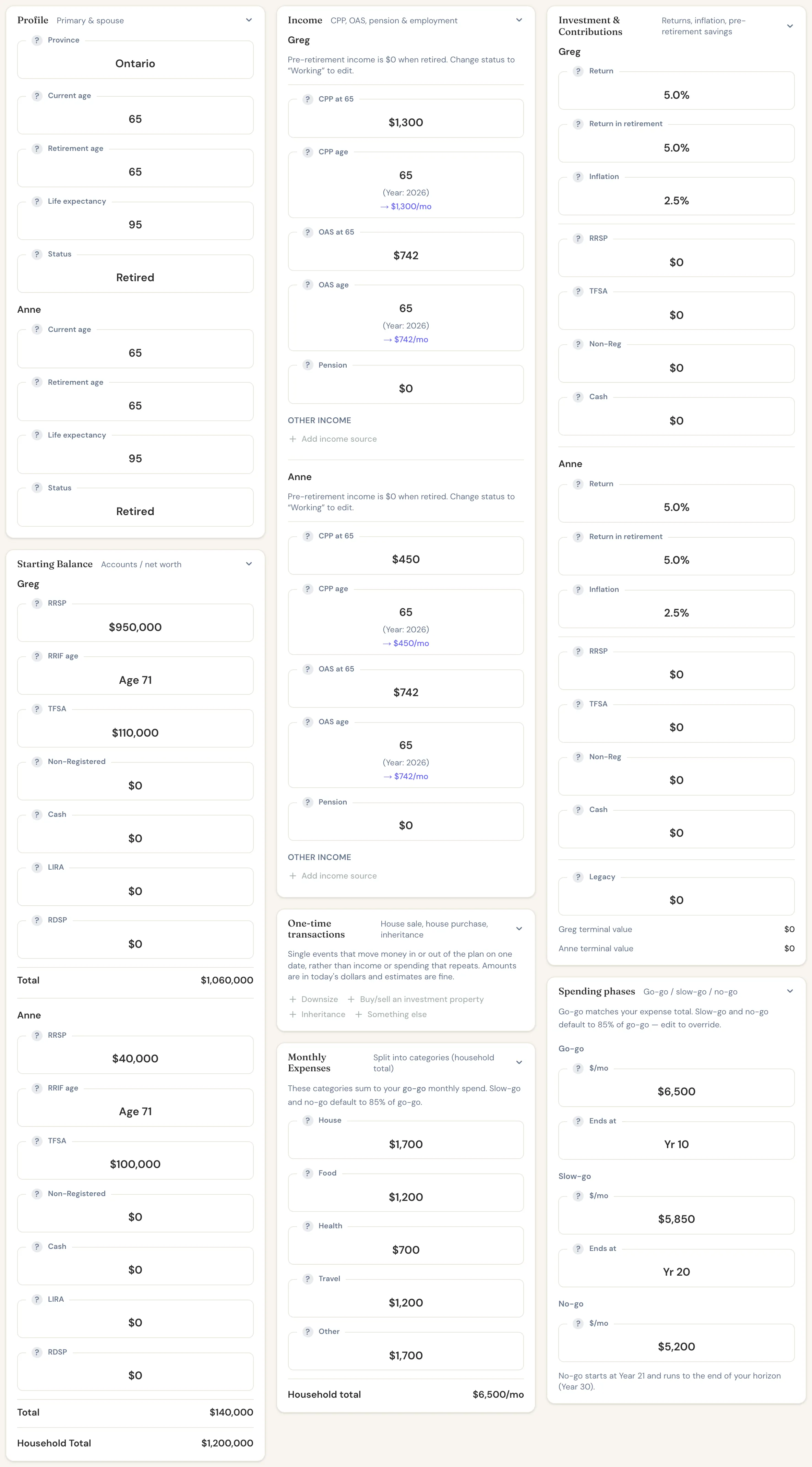 Greg and Anne's plan inputs: both profiles, their accounts, CPP and OAS, and monthly spending.
Greg has $950,000 in his RRSP and $110,000 in his TFSA. Anne has $40,000 in her RRSP and $100,000 in her TFSA. Neither has a workplace pension or a non-registered account.
Their CPP is very different. Greg's Statement of Contributions shows $1,300 a month at 65. Anne's shows $450, because of her years at home and her part-time income. Both receive the full OAS. If you want a refresher on how both programs work, see our guide to CPP and OAS.
One household budget. They spend $6,500 a month together, and Scenario Lab+ treats it as one shared budget, drawing on both partners' accounts.
Their spending falls as they age. Their plan steps down at Greg's 75 and 85. In Scenario Lab+, these steps are the plan's Spending Phases.
A few other important assumptions: all figures are in today's dollars, they own their home with no mortgage, they expect their investments to grow 5% a year, inflation runs at 2.5% a year, and we plan both of them to age 95.
Greg and Anne's retirement budget
Here is how their $6,500 a month breaks down until 75:
| Category | Monthly | Annual |
|---|---|---|
| Housing (property tax, utilities, insurance, upkeep) | $1,700 | $20,400 |
| Food and dining | $1,200 | $14,400 |
| Health and dental | $700 | $8,400 |
| Travel | $1,200 | $14,400 |
| Everything else (car, gifts, entertainment) | $1,700 | $20,400 |
| Total | $6,500 | $78,000 |
Is $1.2 Million Enough for a Couple to Retire at 65?
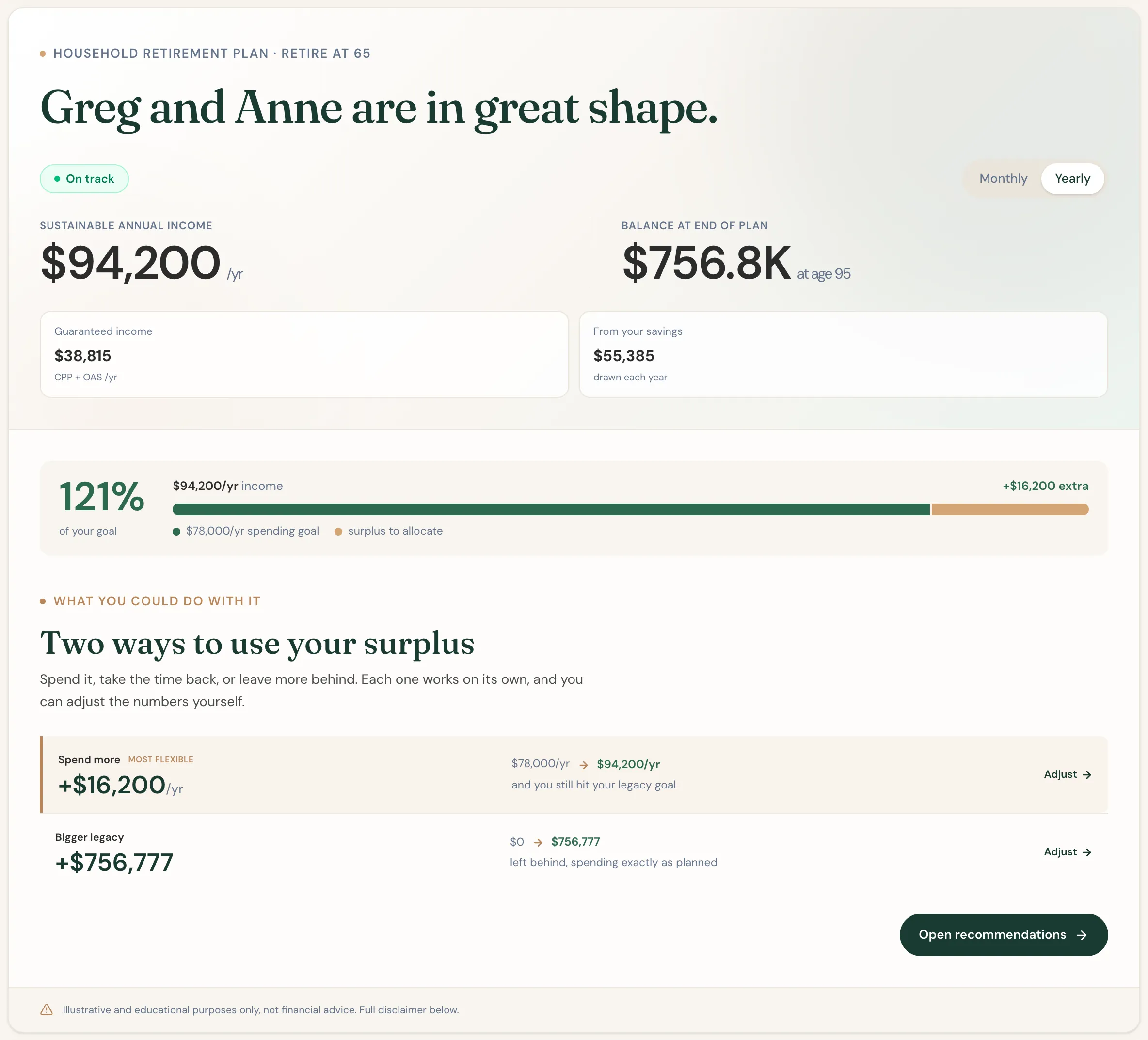 Scenario Lab+'s results for Greg and Anne's plan.
For Greg and Anne, the results say yes, comfortably. Their plan covers their spending every year and still has $756,777 left when they're both 95. Scenario Lab+ estimates they could spend about $1,350 more a month and still make it.
Their two CPP and OAS pensions do a lot of the work. Together they bring in $38,815 a year, about half of what the couple spends.
How Much Income Does $1.2 Million Provide?
In their first year of retirement, Greg and Anne draw $81,981 of gross income to spend $78,000:
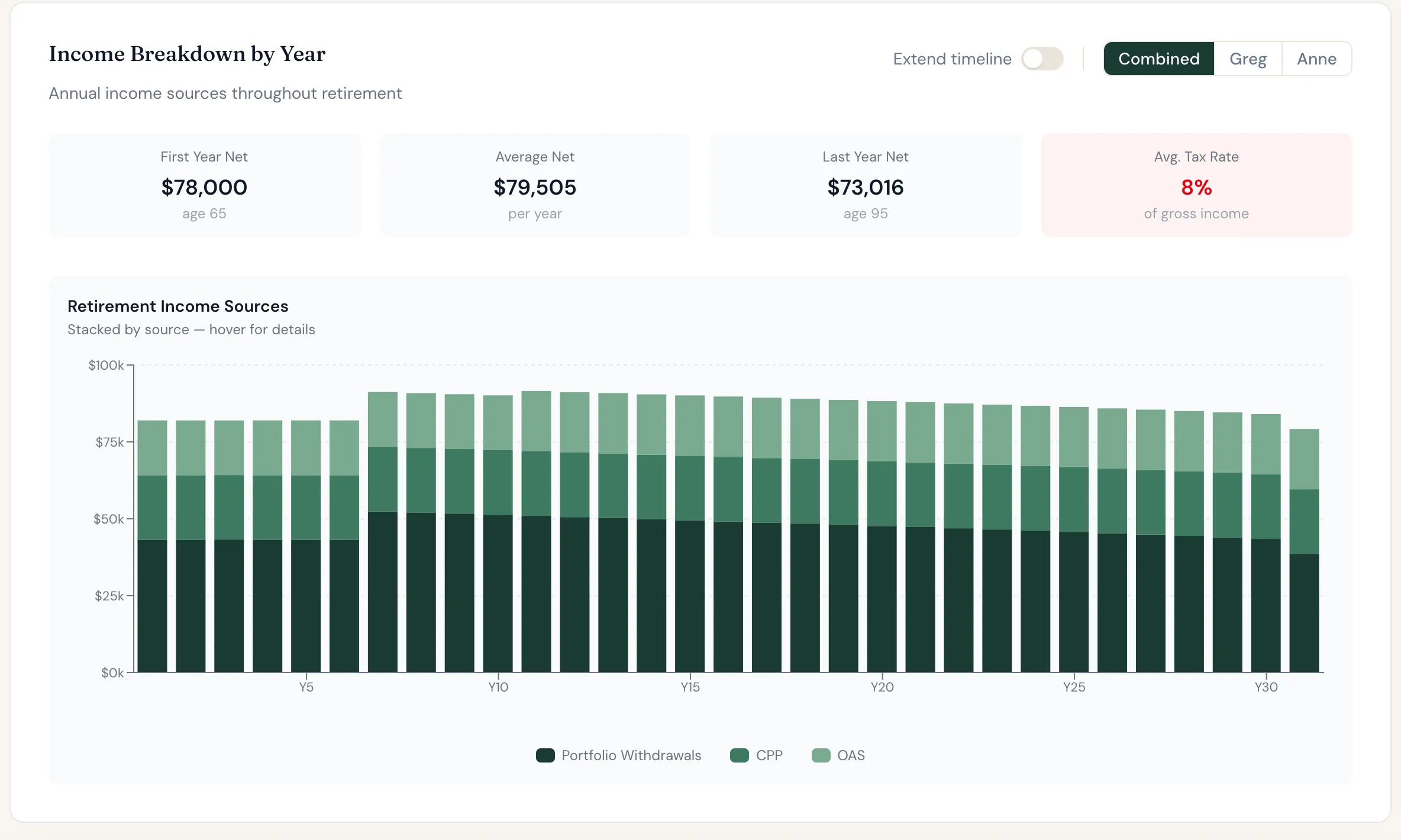 Where Greg and Anne's income comes from each year, by source.
| Source | Greg | Anne | Together | Taxable? |
|---|---|---|---|---|
| CPP | $15,600 | $5,400 | $21,000 | Yes |
| OAS | $8,908 | $8,908 | $17,815 | Yes |
| RRSP withdrawals | $16,355 | $7,119 | $23,474 | Yes |
| TFSA withdrawals | $1,894 | $17,797 | $19,691 | No |
| Gross income | $42,757 | $39,224 | $81,981 | |
| Income tax | $3,757 | $224 | $3,981 |
Their tax bill in that first year is only $3,981, about 5% of their income, because so much of it comes from CPP, OAS, and Anne's TFSA. The shared budget means Anne covers half the household's spending, so her smaller accounts carry more than their share. By 70 her RRSP and TFSA are almost empty, while Greg's RRSP has hardly been touched.

Is most of your savings in one name?
Scenario Lab+ models both partners' accounts, benefits, and tax returns, including pension splitting, year by year.
Try Scenario Lab+How Pension Splitting Works for Greg and Anne
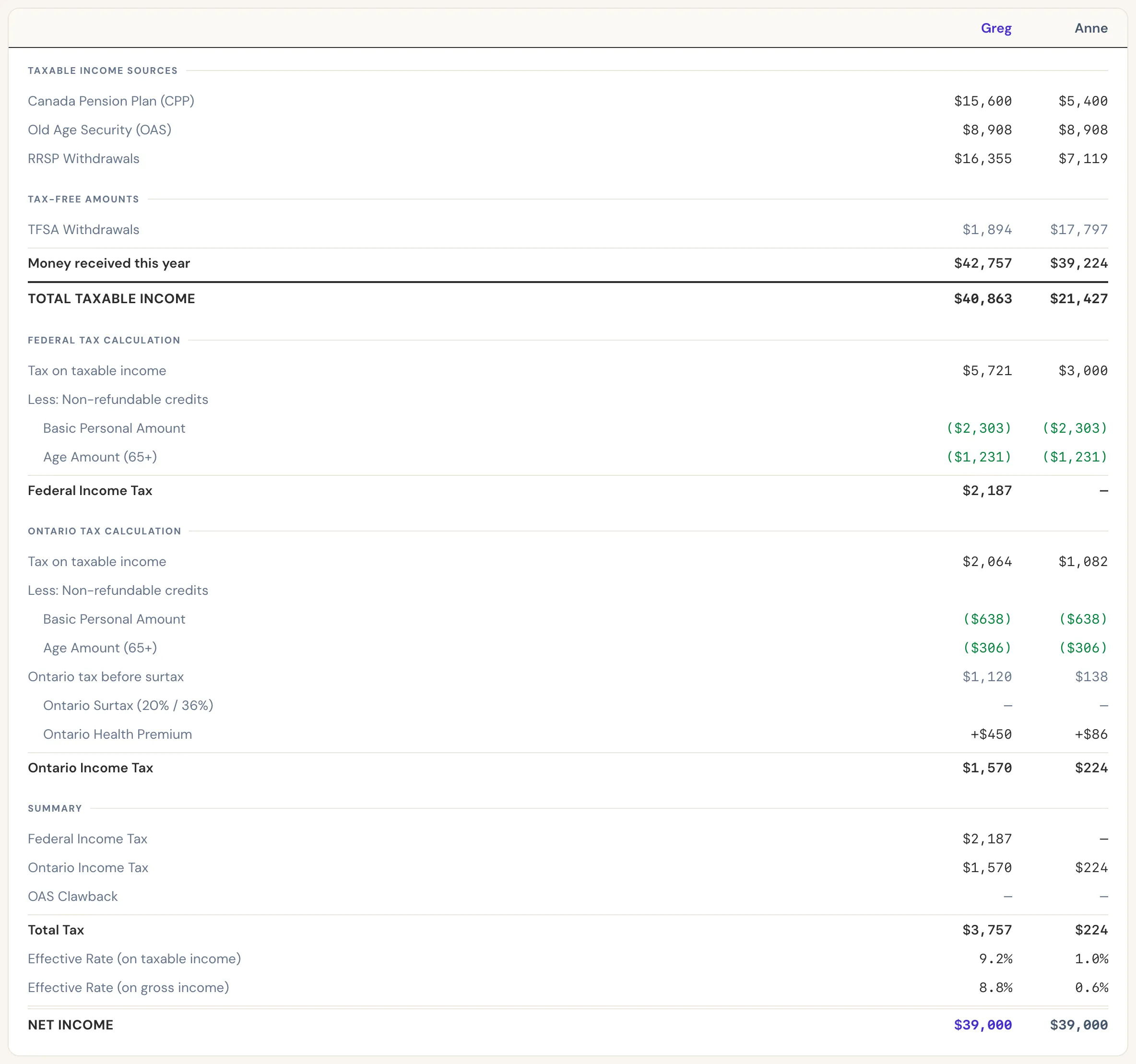 Greg and Anne's tax in their first year of retirement.
Pension income splitting lets a couple move up to half of one spouse's eligible pension income onto the other's tax return. For someone without a workplace pension, the eligible income from 65 is RRIF withdrawals. Withdrawals straight from an RRSP don't qualify. Our guide to pension income splitting covers the rules.
That rule shapes Greg and Anne's plan. From 65 to 70, Greg's money comes out of his RRSP, so none of it can be split. At 71 his RRSP becomes a RRIF, and the RRIF minimum on a balance of about $960,000 forces out $52,394 in the first year, far more than he was drawing.
From then on, Scenario Lab+ splits about $26,000 a year of Greg's RRIF income onto Anne's return: $26,190 at 71, falling slowly as his RRIF shrinks. Over their retirement, about $553,000 of Greg's income is taxed on Anne's return instead of his. Their household tax rises to $8,936 at 71, still under 10% of their income.
How Their Plan Changes Over Time
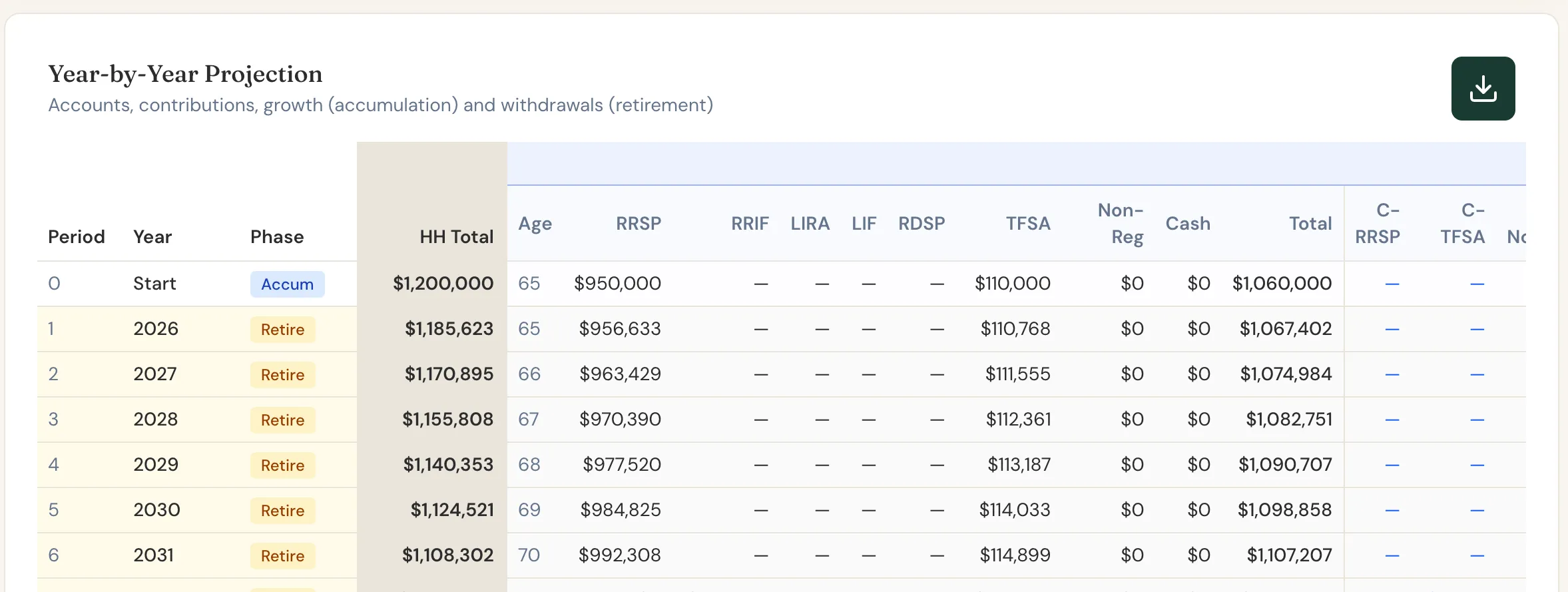 Year-by-year account balances from 65.
From 65 to 70, Anne's savings carry half the load. Her TFSA and RRSP fall to about $1,100 combined by 70, while Greg's RRSP grows to about $992,000.
At 71, Greg's RRSP becomes a RRIF and splitting starts. The minimum withdrawal is more than they need, and the extra goes back into savings. Our RRIF guide covers the rules.
At 75, their OAS goes up 10% and their spending steps down. OAS pays more from age 75, so each of them receives $9,798 a year.
At 95, they still have $756,777. That is $158,653 in Greg's RRIF, $574,964 in their TFSAs, and $23,161 in a non-registered account the RRIF surplus filled. Most of it is now tax-free.
Based on their numbers, Scenario Lab+ estimates they could spend about $1,350 more every month and still make it to 95.
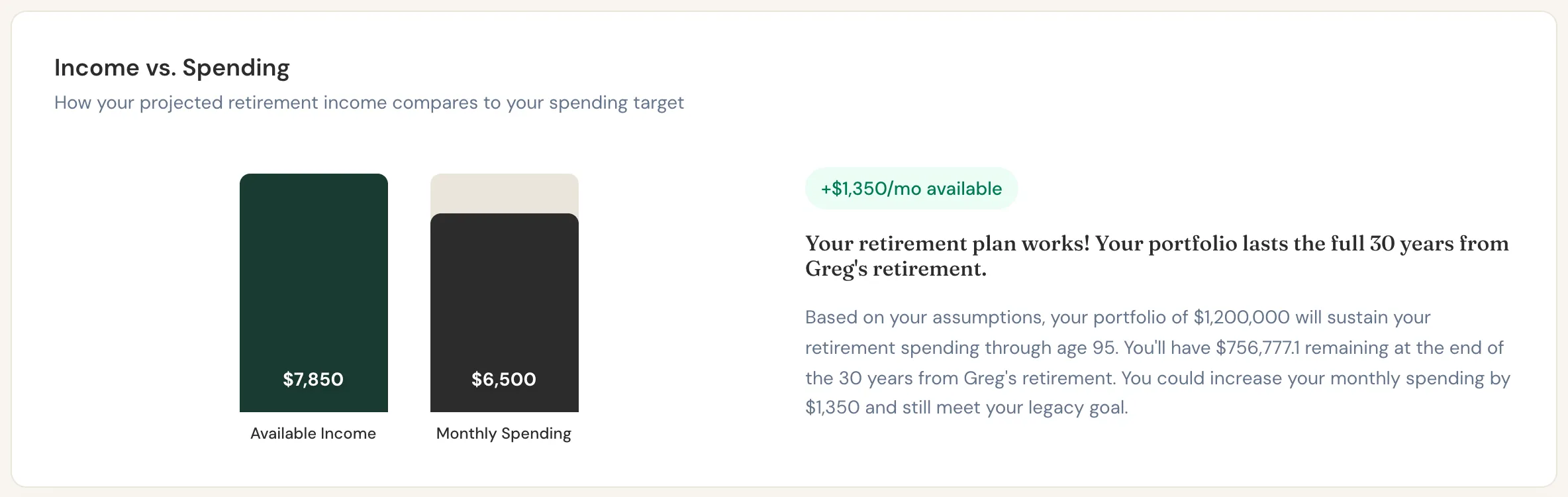 Income available to Greg and Anne compared with what they plan to spend.
But What If We Change the Assumptions?
For a couple this lopsided, the two questions that matter most are when Greg's money becomes splittable, and what happens to Anne if Greg dies first. We changed one assumption at a time.
4 versions of Greg and Anne's plan
One assumption changed in each. Charts show the portfolio from 65 to 95 in Scenario Lab+.
Greg and Anne's base plan
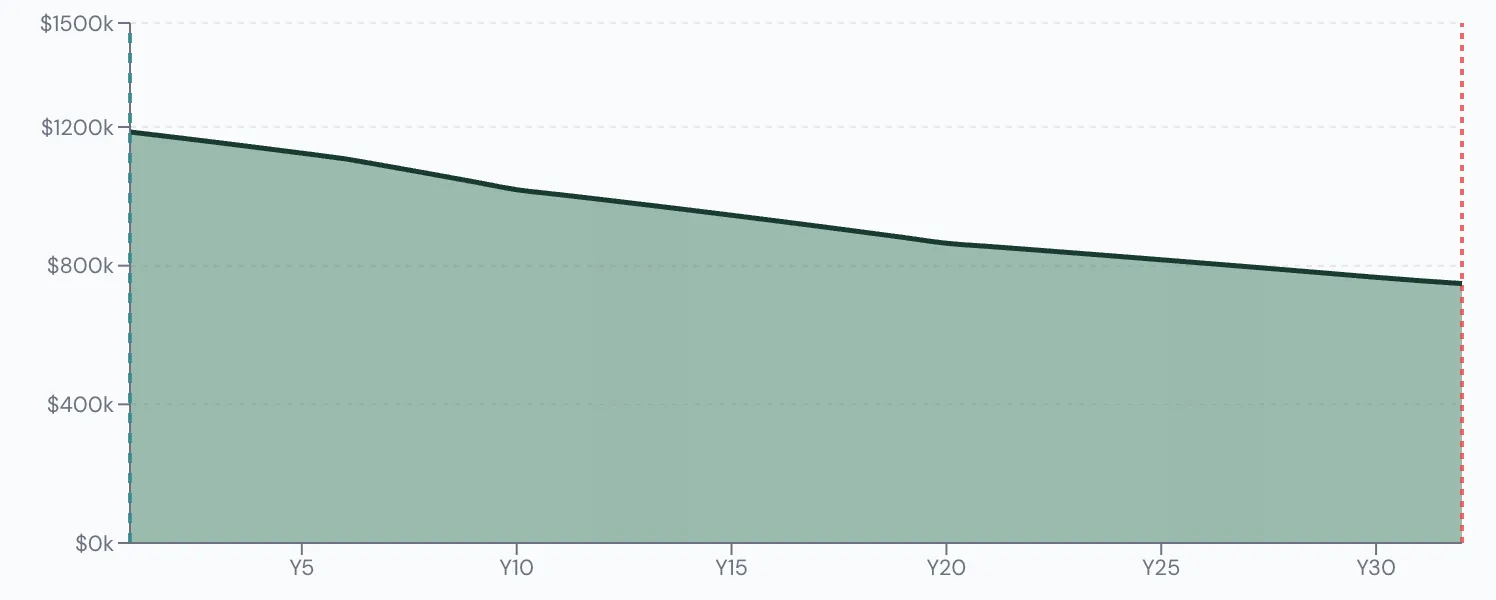
- Spends at 65
- $78,000/yr
- Money lasts
- Past 95
- Left at 95
- $756,777
Greg converts his RRSP to a RRIF at 65
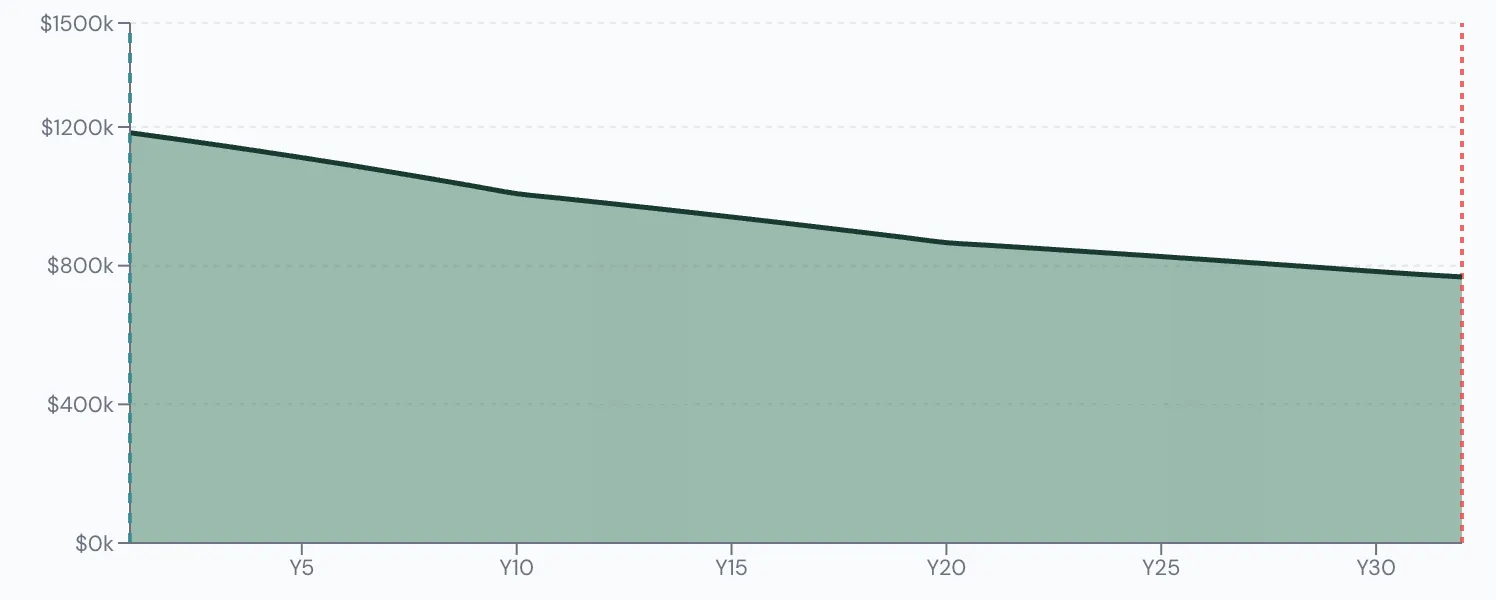
- Spends at 65
- $78,000/yr
- Money lasts
- Past 95
- Left at 95
- $774,792
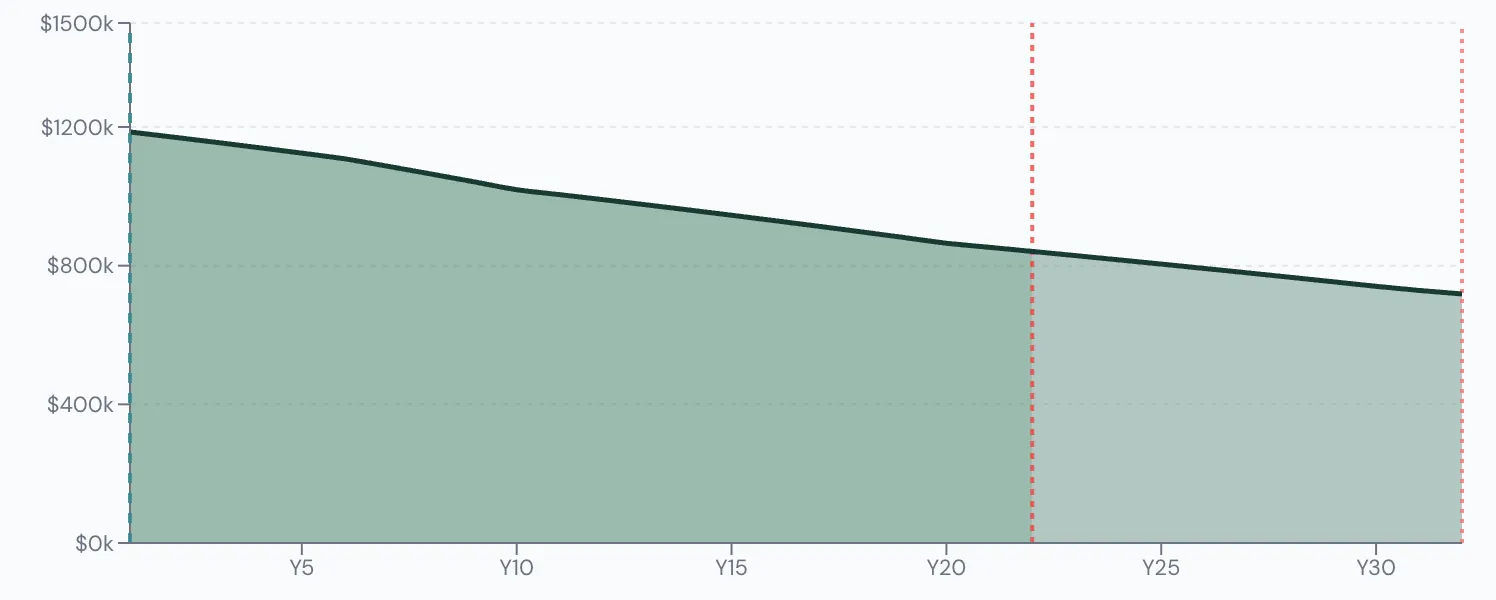
Greg dies at 85
- Spends at 65
- $78,000/yr
- Money lasts
- Past 95
- Left at 95
- $728,539
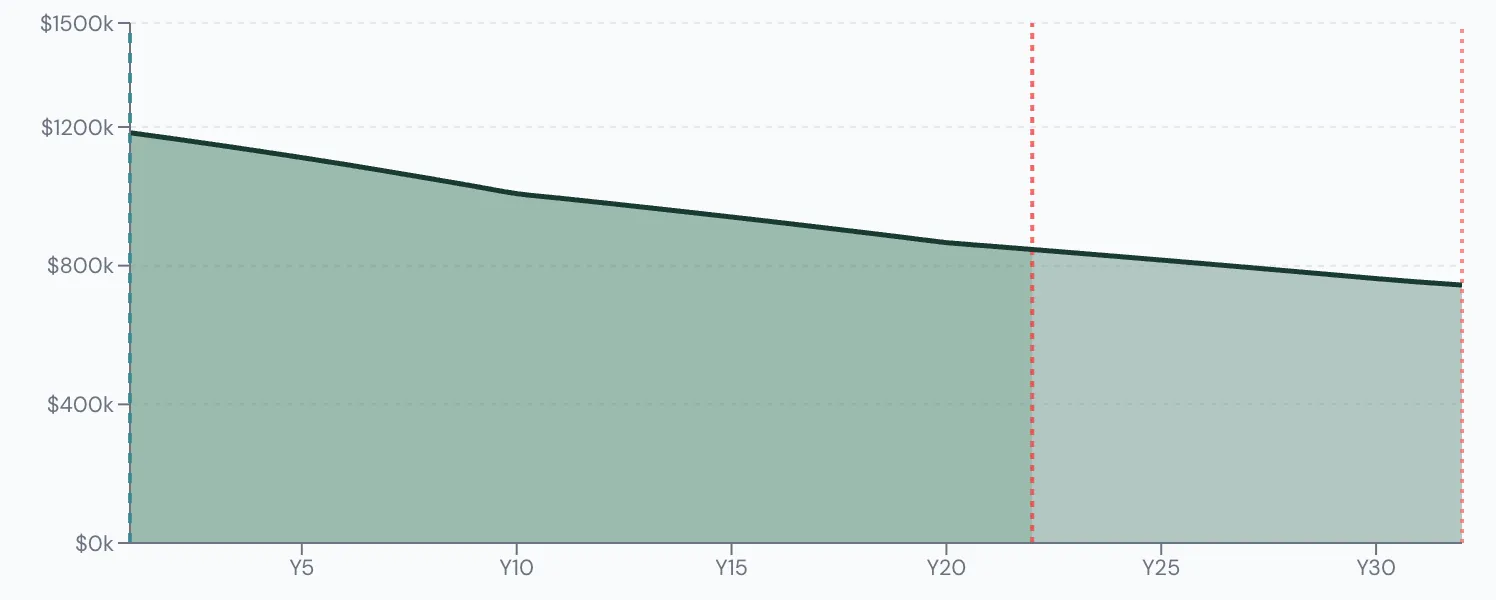
RRIF at 65, and Greg dies at 85
- Spends at 65
- $78,000/yr
- Money lasts
- Past 95
- Left at 95
- $752,765
Scenario 1
Greg converts his RRSP to a RRIF at 65
- Spends at 65
- $78,000/yr
- Money lasts
- Past 95
- Left at 95
- $774,792
Greg doesn't have to wait until 71 to convert his RRSP to a RRIF. What if he converts at 65? In Scenario Lab+, the RRIF conversion age is one input on his profile.
His withdrawals become eligible for splitting right away. At 65 he draws $38,000 from his RRIF instead of $16,355 from his RRSP, and $18,830 of it is taxed on Anne's return. Anne no longer has to draw her TFSA down so fast to cover her half, so more of it keeps growing tax-free.
Their tax in the first year rises from $3,981 to $6,112, because more of their income is taxable. But over their whole retirement they pay $209,962 in tax, about $19,000 less than the original plan, and they finish at 95 with $774,792, about $18,000 more. Scenario Lab+ estimates their room to spend more rises to about $1,412 a month.
Converting early also means paying RRIF minimums from 65, so it suits a couple who were going to draw that much anyway.
Scenario 2
Greg dies at 85
- Spends at 65
- $78,000/yr
- Money lasts
- Past 95
- Left at 95
- $728,539
Greg is the one with the money. What if he dies at 85, ten years before the plan ends? Scenario Lab+ models the first death in a couple: Greg's RRIF rolls over to Anne, and she continues alone on 70% of the household budget.
Anne inherits his RRIF, but not his income. She keeps her own CPP and OAS, starts a CPP survivor benefit, and loses his OAS and most of his CPP. Pension splitting ends, so all of the RRIF income is now taxed on one return. At 85 she pays $11,143 of tax on her own, more than the $8,190 the two of them paid together that year in the original plan, on less income.
Over their retirement the couple and then Anne pay $259,246 in tax, about $30,000 more than if both lived to 95. The plan still works: Anne reaches 95 with $728,539.
Scenario 3
RRIF at 65, and Greg dies at 85
- Spends at 65
- $78,000/yr
- Money lasts
- Past 95
- Left at 95
- $752,765
The two changes together: Greg converts at 65, then dies at 85.
Converting early does more here than it did on its own. Six extra years of splitting and larger RRIF withdrawals shrink Greg's RRIF before Anne inherits it, so less of it is taxed on her single return later. Their lifetime tax is $234,789, about $24,000 less than if Greg died at 85 without converting early, and Anne reaches 95 with $752,765.
For a lopsided couple, the case for converting early gets stronger the more likely it is that the spouse with the RRSP dies first.
Your $1.2 Million Is Not Greg and Anne's $1.2 Million
So can a couple retire on $1.2 million? Greg and Anne can, comfortably. But their plan is a starting point, not an answer for any other couple.
Two couples with the same $1.2 million can pay very different amounts of tax depending on whose name the money is in and which of them outlives the other. For a balanced couple with a bit less, see Tom and Lisa's plan. For a couple retiring at 60, see Raj and Priya's plan.
The bigger risk for a lopsided couple is leaving the RRSP until 71 by default, without seeing what splitting sooner would save.
That's why we built Scenario Lab+.
It is the software behind every number in this article. Give it both partners' accounts and your shared spending, and it builds the same year-by-year plan for you, including every what-if above. If you'd like to see it first, Greg and Anne's full plan is open to explore.

Build Your Own Canadian Retirement Plan
Enter both partners' savings, benefits, and spending in Scenario Lab+ to see whether your number is enough and what happens when your assumptions change.
Start now