


The short answer
- Yes, just: $750,000 at 62 covers Wendy's spending, mortgage included, with $33K left at 95.
- Paying the mortgage off from her RRSP costs $84,477 of tax in one year and leaves her a few months short.
- Paying it off from her TFSA and savings instead leaves her $59,000 better off than keeping the mortgage.
Estimates from Scenario Lab+, in today's dollars.
See the demo planMore Canadians are reaching retirement with a mortgage still owing, after refinancing or buying later in life. The usual instinct is to pay it off before stopping work. Whether that's right, and where the money should come from, depends on which accounts you'd draw it from.
Here at Loonie Nest, our mission is to provide free and affordable personal finance education to Canadians so they can gain confidence in their retirement.
Wendy's plan at a glance
$750,000
saved at 62
RRSP
$480,000
Taxed as income when withdrawn
TFSA
$150,000
Withdrawals are tax-free
Non-registered
$120,000
Only the capital gain is taxed
Spending after tax, in today's dollars
$67,200
$39,600
$36,000
CPP $1,050 a month from 65
OAS $742 a month from 65
Our $750K Retirement Scenario
Let's meet Wendy. She's 62, single, and living in Burnaby, BC. She's a payroll manager at a building-supply company. She refinanced her townhouse at 54 to help with a family expense, and $180,000 is still owing, at $2,300 a month until she's 70. She'd like to retire now, and she's wondering whether to clear the mortgage first.
We'll run Wendy's numbers through Scenario Lab+.
Scenario Lab+ is our proprietary retirement planning software. We'll use it to generate and review a tailored retirement plan for her.
To start, here's how Wendy's numbers look as she retires at 62:
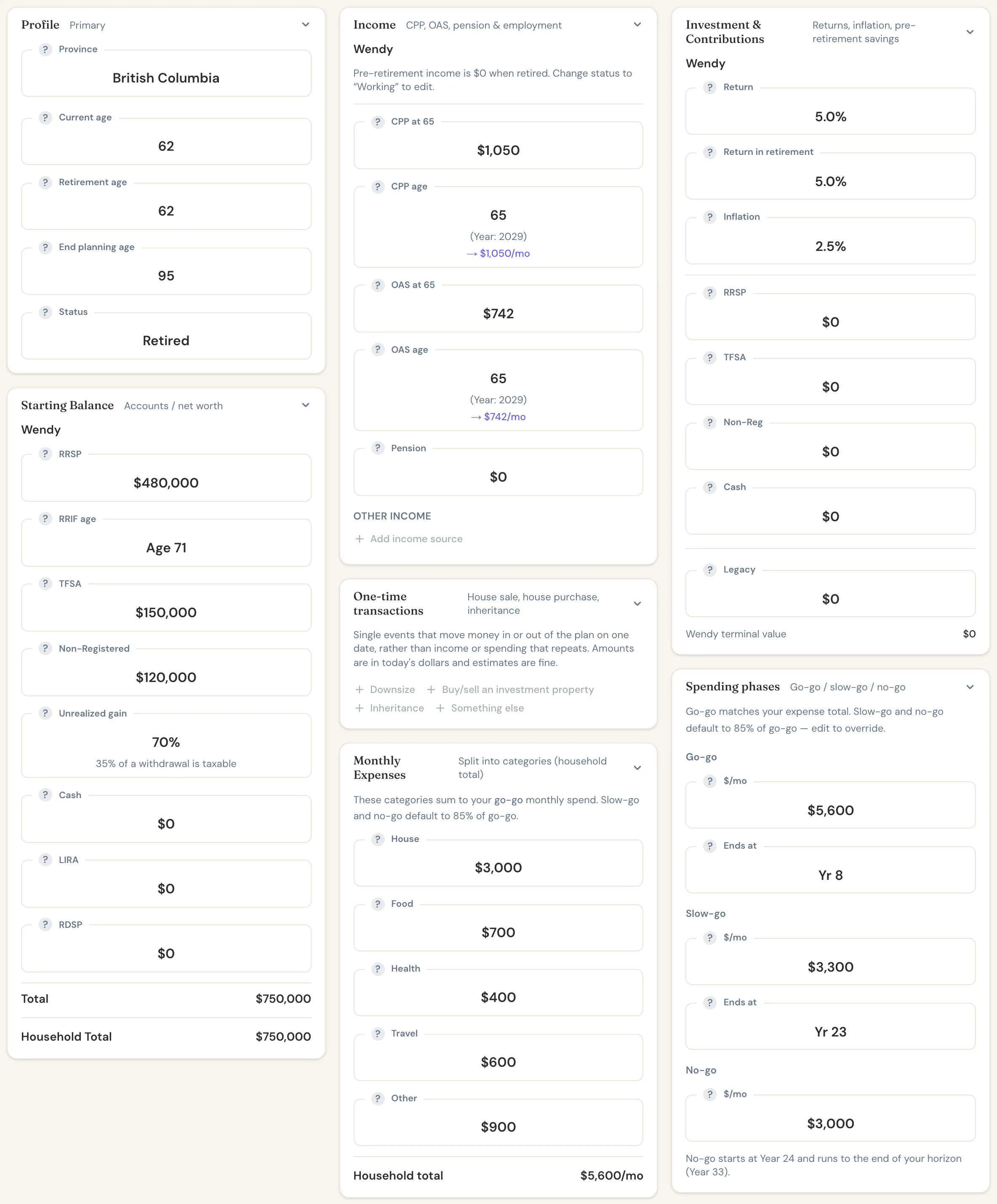 Wendy's plan inputs, including spending phases shaped around her mortgage.
$750,000 of savings. She has $480,000 in her RRSP, $150,000 in her TFSA, and $120,000 in a non-registered account.
Her spending drops when the mortgage ends. She spends $5,600 a month until 70, including the $2,300 mortgage payment, then $3,300 a month, and $3,000 from 85. Scenario Lab+'s Spending Phases let her set those ages and amounts herself, rather than the usual step-down at 75.
Wendy's CPP is $1,050 a month at 65. She gets the full OAS at 65 too. If you want a refresher on how both programs work, see our guide to CPP and OAS.
A few other important assumptions: all figures are in today's dollars, she expects her investments to grow 5% a year, inflation runs at 2.5% a year, and we plan her retirement to age 95.
Wendy's retirement budget
Here is how her $5,600 a month breaks down until the mortgage is paid off:
| Category | Monthly | Annual |
|---|---|---|
| Housing (mortgage, strata fees, property tax, utilities) | $3,000 | $36,000 |
| Food and dining | $700 | $8,400 |
| Health and dental | $400 | $4,800 |
| Travel | $600 | $7,200 |
| Everything else (car, gifts, entertainment) | $900 | $10,800 |
| Total | $5,600 | $67,200 |
Is $750K Enough to Retire With a Mortgage?
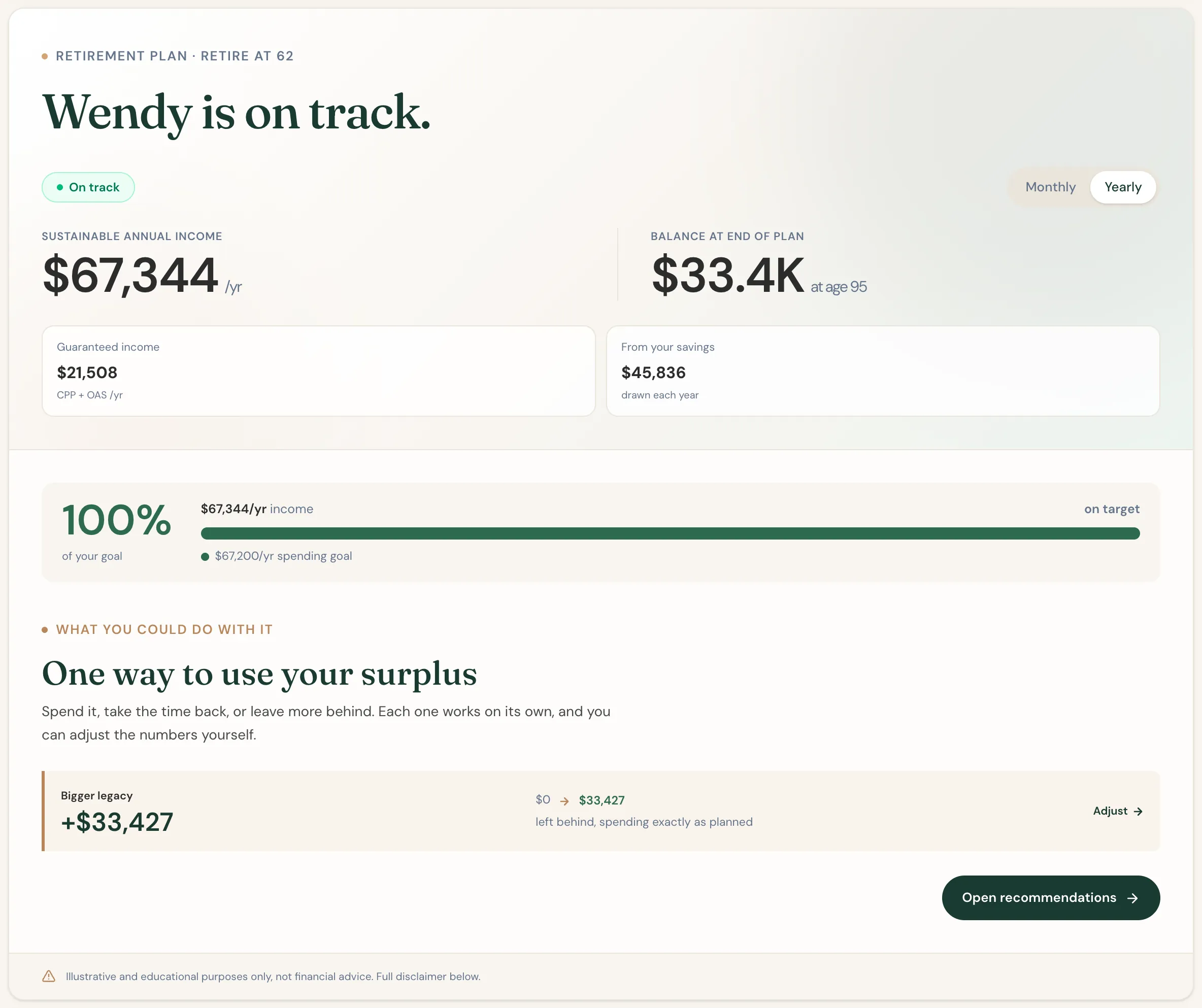 Scenario Lab+'s results for Wendy's plan.
For Wendy, the results say yes, with very little margin. Her plan covers her spending every year and has $33,427 left at 95. Scenario Lab+ estimates she has about $12 a month of room.
The mortgage is the heavy part. Until 70 she draws $74,324 a year from her savings, about 10% of her portfolio. After 70, with the mortgage gone and CPP and OAS in place, she needs only about $20,500 a year from her savings, and her portfolio lasts.
How Much Income Does $750K Provide?
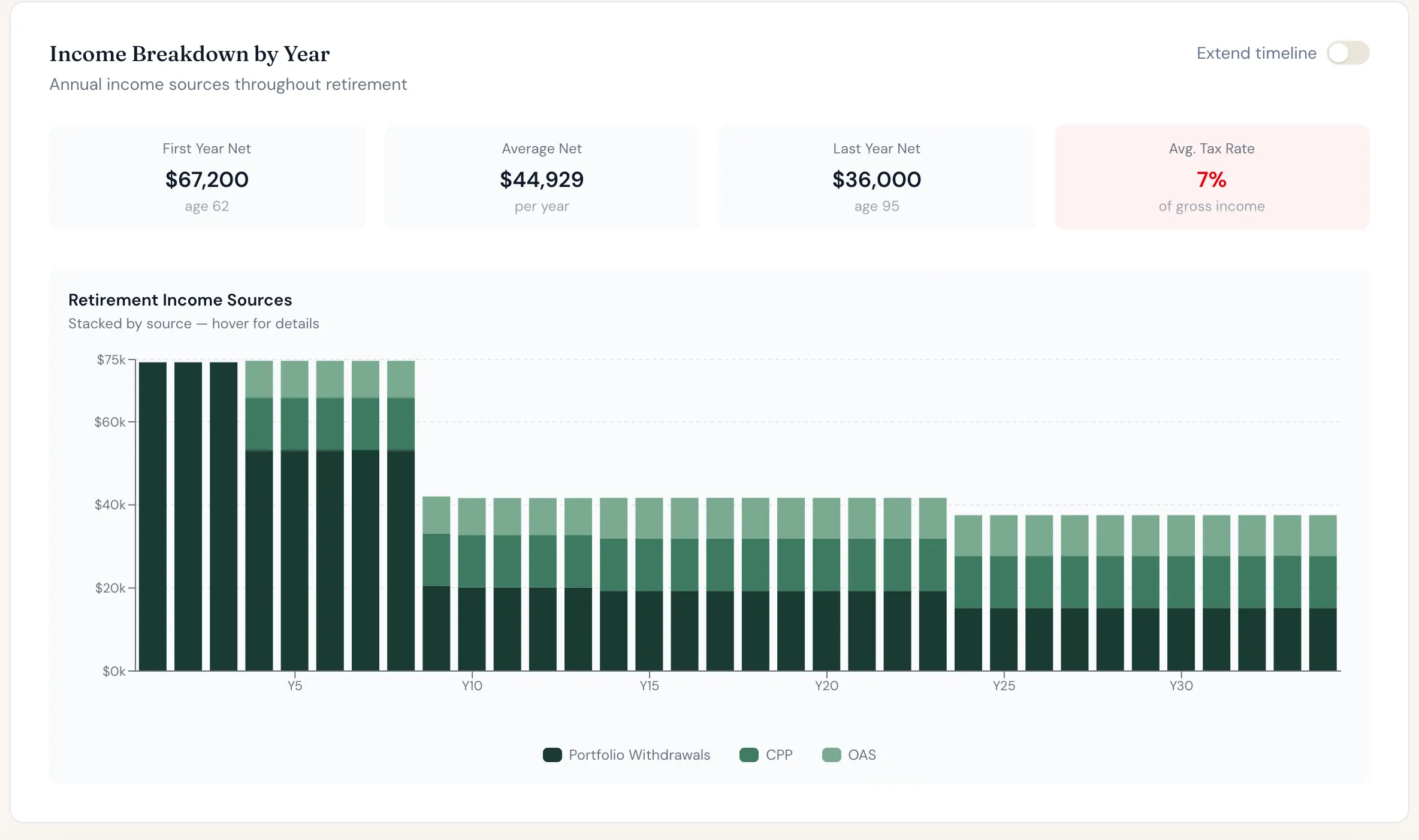 Where Wendy's income comes from each year, by source.
| Source | Age 62 | Age 70 | Taxable? |
|---|---|---|---|
| CPP | $0 | $12,600 | Yes |
| OAS | $0 | $8,908 | Yes |
| RRSP withdrawals | $47,568 | $13,131 | Yes |
| TFSA withdrawals | $14,865 | $4,103 | No |
| Non-registered withdrawals | $11,892 | $3,283 | Only the capital gain |
| Gross income | $74,324 | $42,024 | |
| Income tax | $7,124 | $2,424 | |
| Spending money | $67,200 | $39,600 |

Retiring with a mortgage?
Scenario Lab+ lets you shape your spending around the year your mortgage ends, and test paying it off from different accounts.
Try Scenario Lab+How Much Tax Wendy Pays
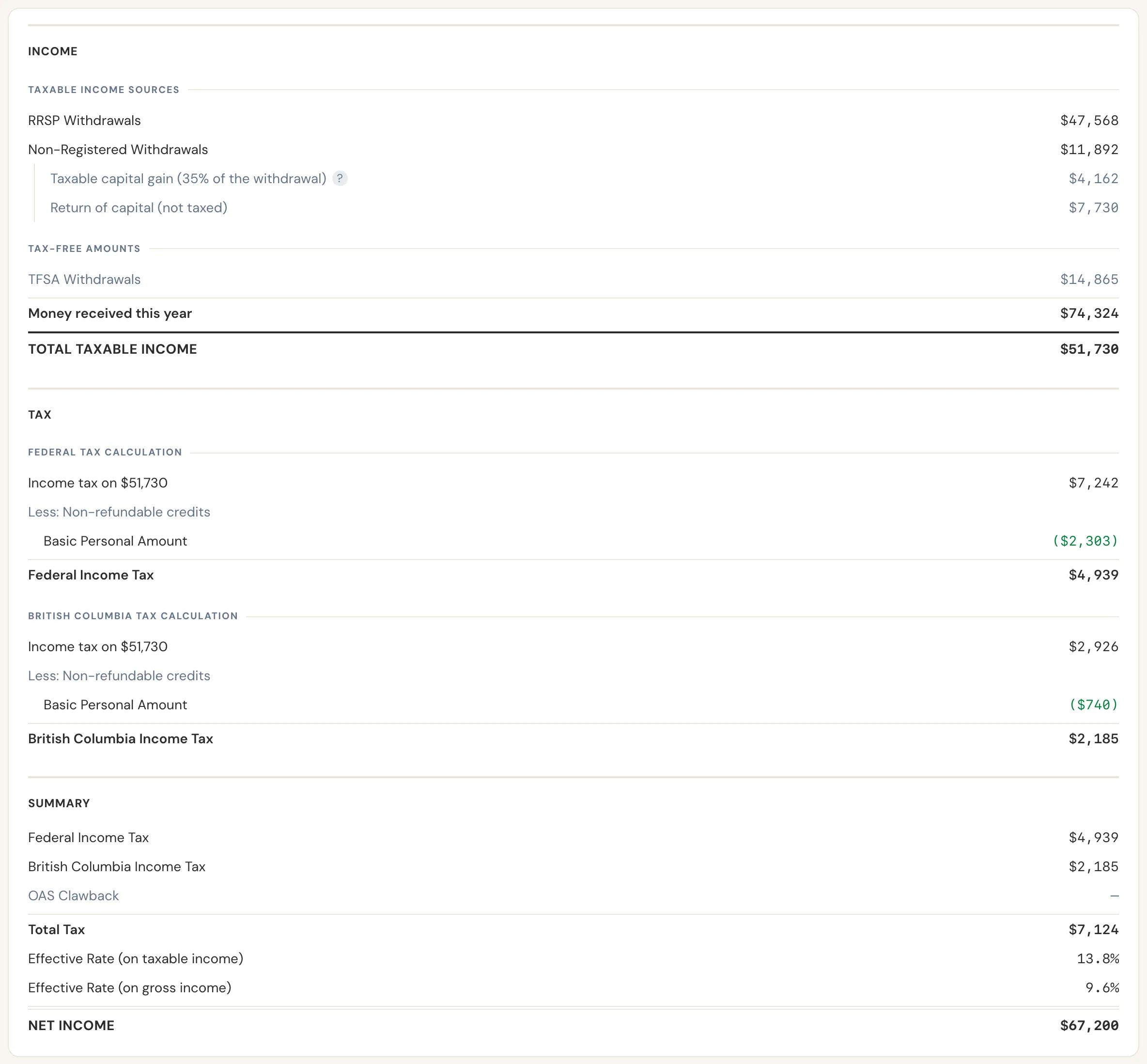 Wendy's tax bill in her first year of retirement, at age 62.
Wendy pays $7,124 in income tax in her first year, about 10% of her income. Over her whole retirement she pays $107,159. Her taxes fall sharply at 70, once she no longer needs to draw for the mortgage.
How Her Plan Changes Over Time
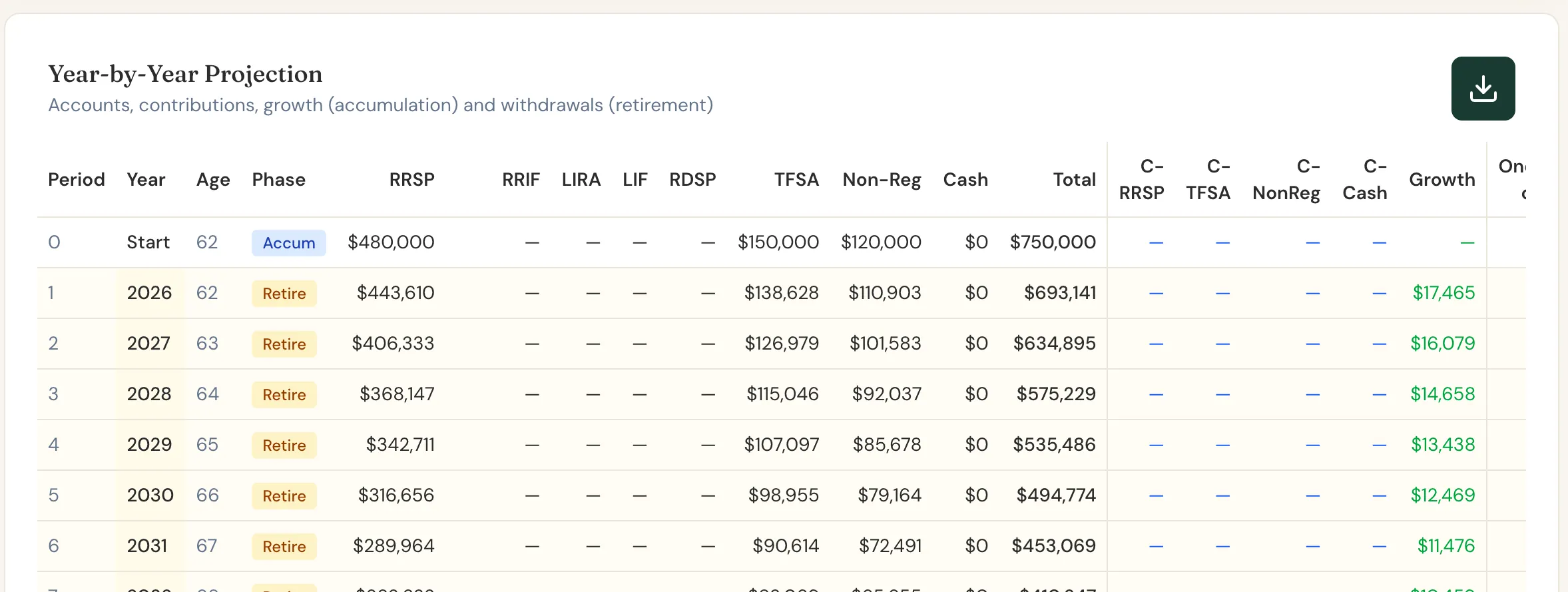 Year-by-year account balances from 62.
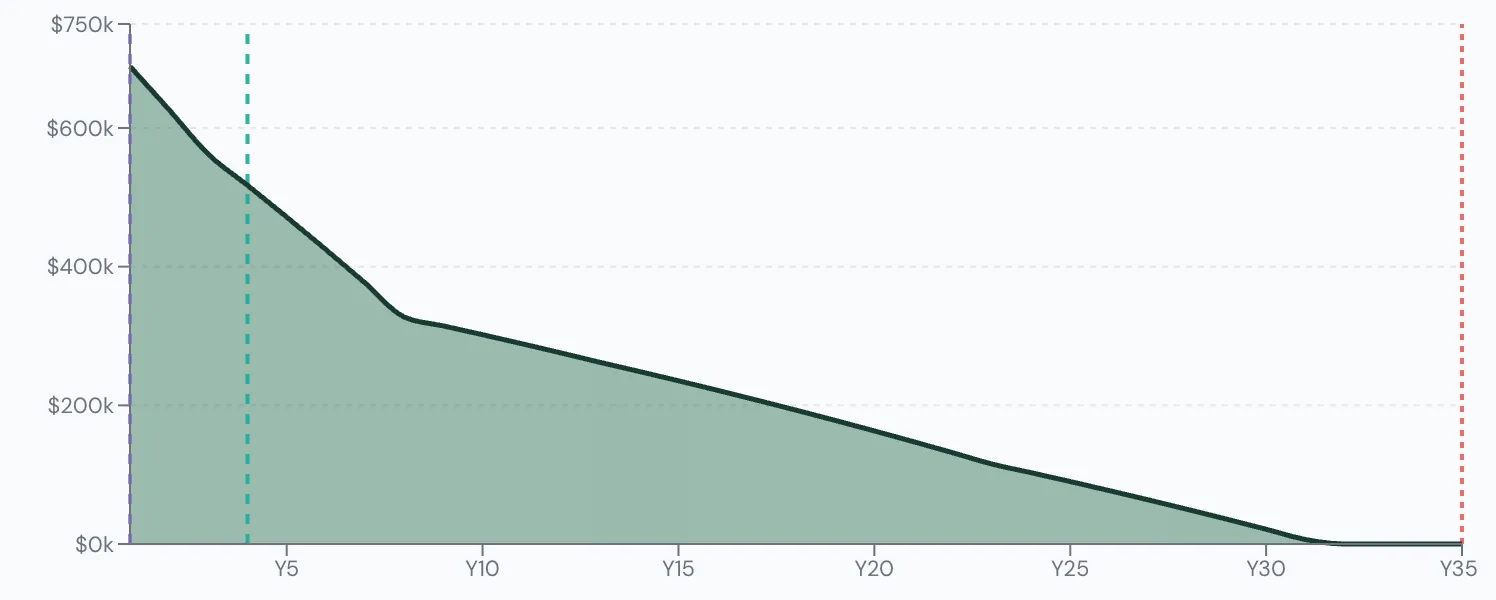
From 62 to 69, she draws heavily. Her portfolio falls from $750,000 to about $367,000.
At 65, CPP and OAS start, and her withdrawals fall by about a quarter.
At 70, the mortgage is paid off. Her spending drops to $3,300 a month, and her withdrawals fall by more than half.
At 95, she has $33,427 left.
But What If We Change the Assumptions?
Wendy's plan works, but only just. The decision she's weighing is whether to pay the mortgage off now, and if so, from which account. We tested both, and what a higher renewal rate would do.
4 versions of Wendy's plan
One assumption changed in each. Charts show the portfolio from 62 to 95 in Scenario Lab+.
Wendy's base plan
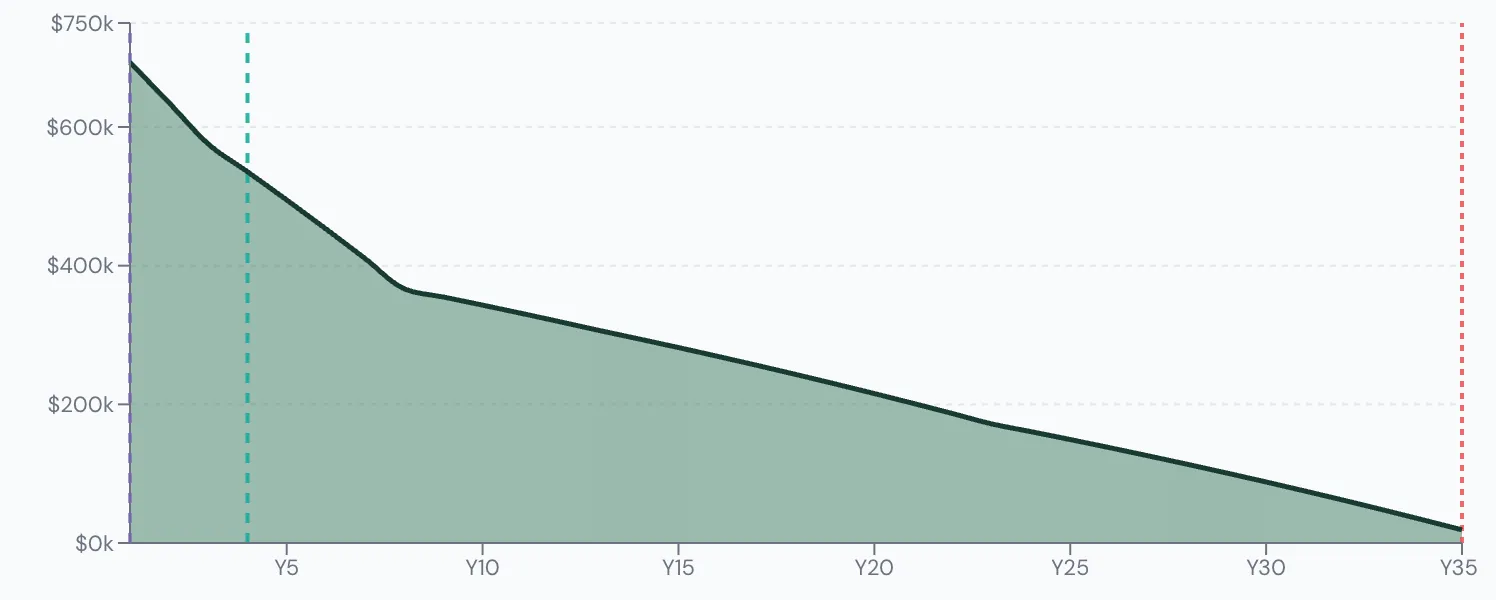
- Spends at 62
- $67,200/yr
- Money lasts
- Past 95
- Left at 95
- $33,427
Pays off the mortgage from her RRSP
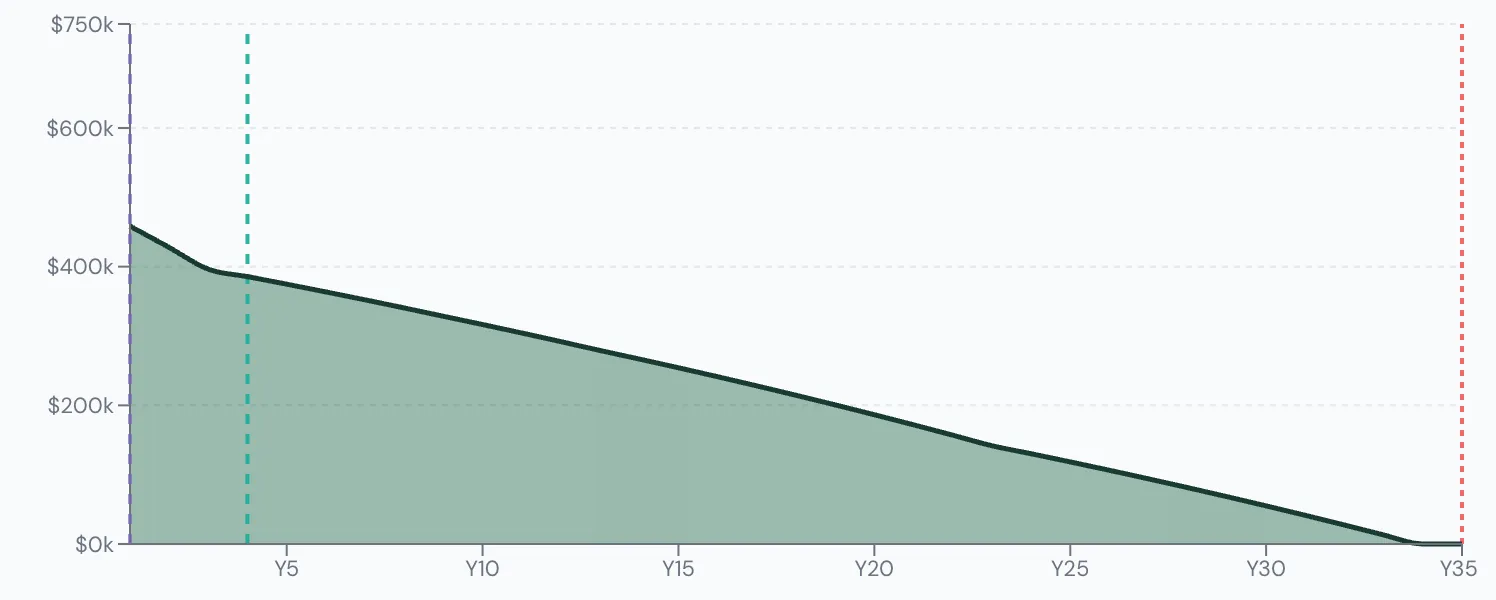
- Spends at 62
- $39,600/yr
- Money lasts
- To age 95
- Left at 95
- $0
Pays it off from her TFSA and savings
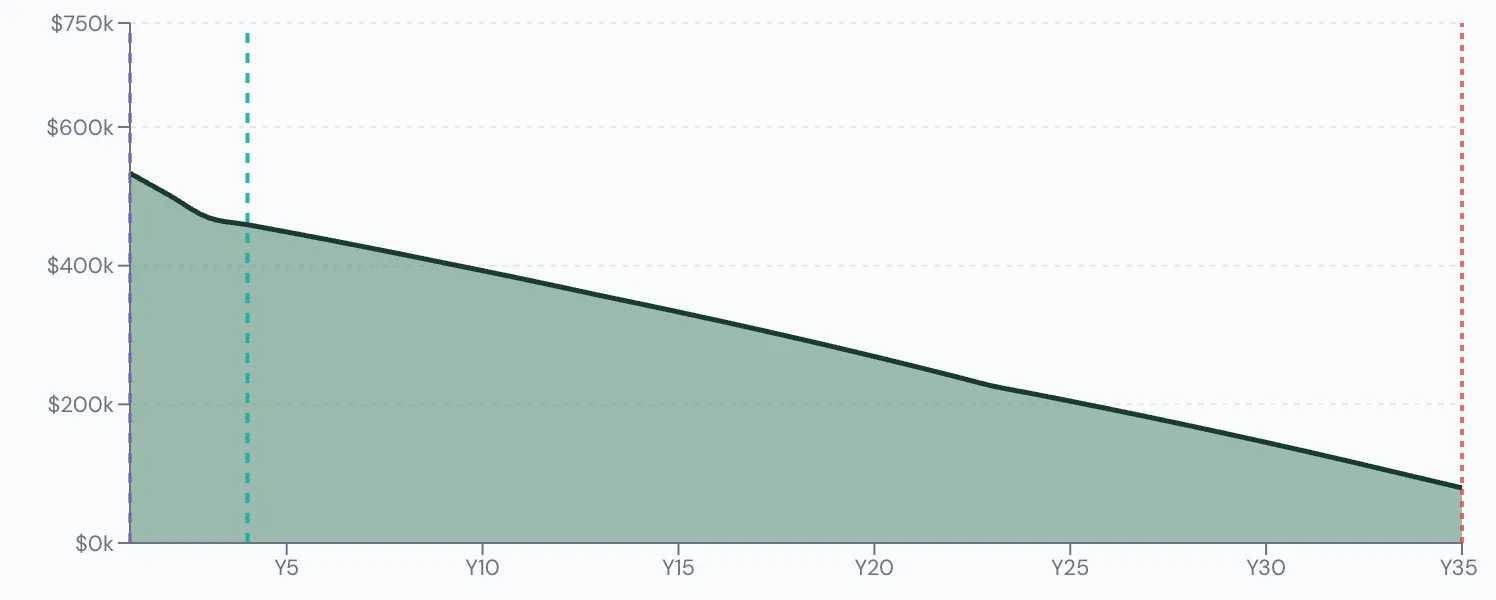
- Spends at 62
- $39,600/yr
- Money lasts
- Past 95
- Left at 95
- $92,746
Renews at a higher rate
- Spends at 62
- $70,800/yr
- Money lasts
- To age 93
- Left at 95
- $0
Scenario 1
Pays off the mortgage from her RRSP
- Spends at 62
- $39,600/yr
- Money lasts
- To age 95
- Left at 95
- $0
What if Wendy pays off the $180,000 at 62 with one withdrawal from her RRSP? Her RRSP is her biggest account, and it can feel like the natural source. We modelled it with the One-Time Transactions feature in Scenario Lab+, and her spending drops by the mortgage payment from then on.
All $180,000 is taxable income in a single year, on top of what she draws to live on. Her tax that year is $84,477. Over her retirement she pays $136,462 in tax, about $29,000 more than if she simply kept paying the mortgage.
Her plan now falls a few months short of 95. At 62 she isn't receiving OAS yet, so the large withdrawal costs her no OAS to the clawback. The same withdrawal at 65 or later would.
Scenario 2
Pays it off from her TFSA and savings
- Spends at 62
- $39,600/yr
- Money lasts
- Past 95
- Left at 95
- $92,746
What if she pays it off from her TFSA and non-registered account instead, $120,000 and $60,000? TFSA withdrawals aren't taxed, and only the capital gain on the non-registered sale is.
Her tax that year is $10,413. She pays about the same tax over her retirement as if she kept the mortgage, and she finishes at 95 with $92,746, about $59,000 more than her original plan. Scenario Lab+ estimates she'd have about $79 a month of room.
Paying off a mortgage is a guaranteed return equal to its interest rate. Paying it off from money that's already been taxed captures that return without a tax bill. For Wendy, the payoff only makes sense from the right accounts.
Scenario 3
Renews at a higher rate
- Spends at 62
- $70,800/yr
- Money lasts
- To age 93
- Left at 95
- $0
What if Wendy keeps the mortgage, but renews at a higher rate, adding $300 a month until it's paid off at 70?
That's about $29,000 more over eight years, and her plan no longer reaches 95. Her savings run out at 93. For a plan with almost no margin, a renewal is a real risk, and paying the mortgage off from her TFSA and savings protects her from it.
Your Mortgage Is Not Wendy's Mortgage
So can you retire with $750,000 and a mortgage? Wendy can, just. Whether to pay it off first depends less on the mortgage than on where the money would come from. Her plan is a starting point, not an answer for anyone else.
Your mortgage rate, and how much you hold outside your RRSP, can change the answer completely. For someone with $1 million and no mortgage, see Susan's plan. For a renter with $500,000, see Linda's plan.
The bigger risk with a mortgage in retirement is paying it off from the account that costs the most to draw.
That's why we built Scenario Lab+.
It is the software behind every number in this article. Give it your own accounts, mortgage, and spending, and it builds the same year-by-year plan for you, including every what-if above. If you'd like to see it first, Wendy's full plan is open to explore.

Build Your Own Canadian Retirement Plan
Enter your own savings, mortgage, and spending in Scenario Lab+ to see whether your number is enough and what happens when your assumptions change.
Start now