

The short answer
- Bob and Carol's plan works with room to spare, and Carol still has $923K at 95.
- When Bob dies, Carol's income falls by about 41% in a year, and she pays a higher tax rate on what's left.
- If Bob dies at 80 instead of 90, the plan still works. The money lasts; the income drops.
Estimates from Scenario Lab+, in today's dollars.
See the demo planMost retirement plans for couples quietly assume both partners live to the end. One of them almost always outlives the other, often by years, and the survivor's finances change overnight: one fewer OAS, part of the other's CPP, part of any workplace pension, and a tax return that can't be shared any more.
Here at Loonie Nest, our mission is to provide free and affordable personal finance education to Canadians so they can gain confidence in their retirement.
Bob and Carol's plan at a glance
$370,000
saved at 70
RRSP
$240,000
Taxed as income when withdrawn
TFSA
$130,000
Withdrawals are tax-free
Spending after tax, in today's dollars
$66,000
$59,400
$52,800
Bob
CPP $1,200 a month from 65
OAS $742 a month from 65
Carol
CPP $500 a month from 65
OAS $742 a month from 65
Our Couple's Retirement Scenario
Let's meet Bob and Carol. They live in Red Deer, AB, and they're both retired. Bob is 70. He spent his career as a power-line technician and has a workplace pension. Carol is 64 and worked part-time in retail. Like many couples with an age gap, they want to know what Carol's retirement looks like if she outlives Bob.
We'll run Bob and Carol's numbers through Scenario Lab+.
Scenario Lab+ is our proprietary retirement planning software. We'll use it to generate and review a tailored retirement plan for the two of them.
To start, here's how their numbers look today:
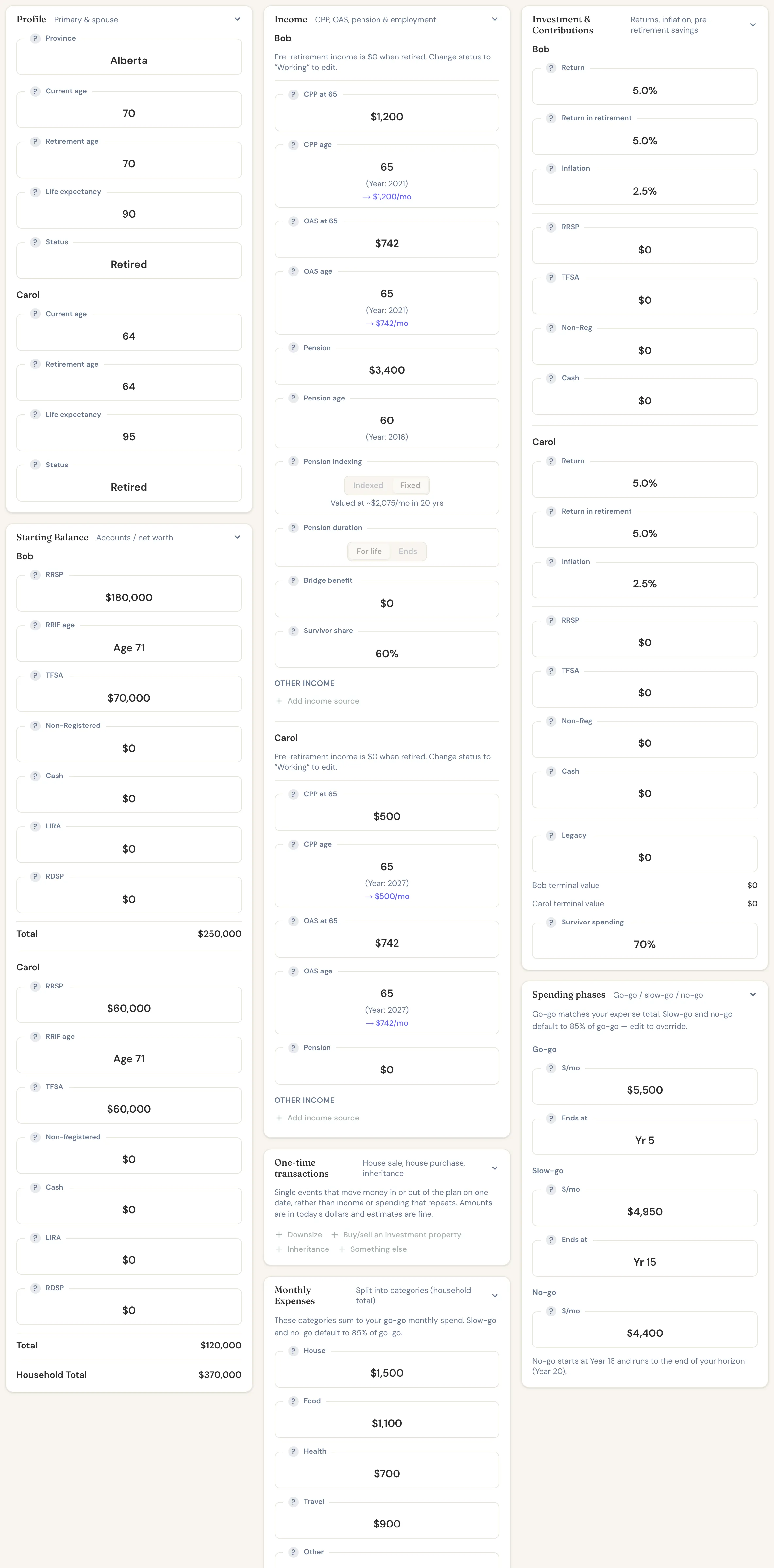 Bob and Carol's plan inputs, including Bob's pension and the survivor settings.
Bob's pension pays $3,400 a month, and 60% of it continues to Carol if he dies first. It isn't indexed to inflation. These figures are an example, not any particular plan's. Scenario Lab+ takes the survivor share as an input on the pension.
$370,000 of savings. Bob has $180,000 in his RRSP and $70,000 in his TFSA. Carol has $60,000 in each.
Their CPP. Bob receives $1,200 a month. Carol's Statement of Contributions shows $500 at 65, which she starts next year. Both receive the full OAS. If you want a refresher on how both programs work, see our guide to CPP and OAS.
Who dies first. We plan Bob to 90 and Carol to 95. Scenario Lab+ models the first death in a couple: whoever reaches their planning age first dies then. Here that's Bob, at 90, when Carol is 84. His accounts roll over to her, his pension's survivor share and a CPP survivor benefit start, and she spends 70% of the household budget from then on.
A few other important assumptions: all figures are in today's dollars, they own their home with no mortgage, they expect their investments to grow 5% a year, and inflation runs at 2.5% a year. Their spending starts at $5,500 a month and steps down at Bob's 75 and 85.
Is Their Plan Enough?
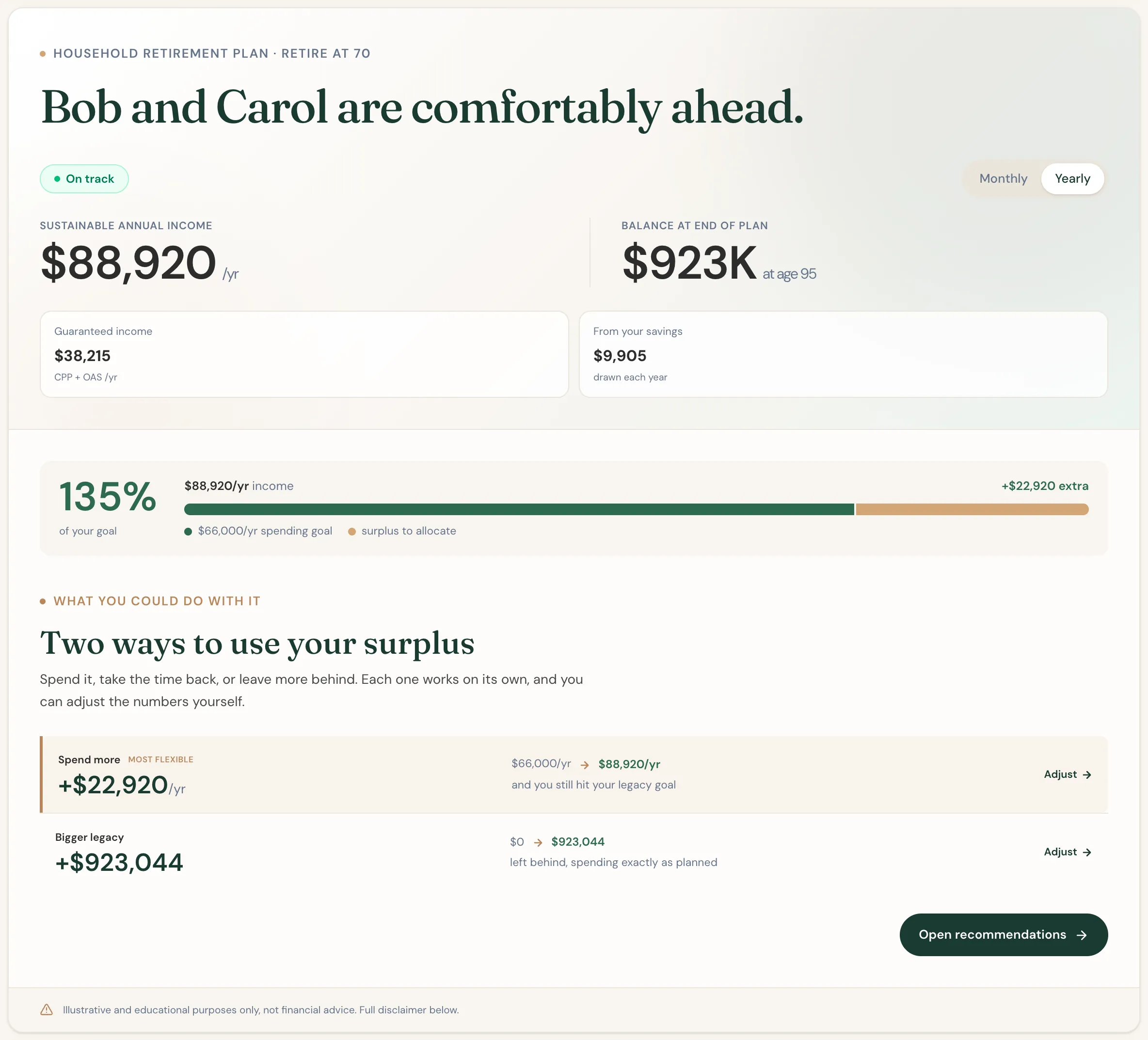 Scenario Lab+'s results for Bob and Carol's plan.
For Bob and Carol, the results say yes, comfortably. Bob's pension, their two CPPs, and their two OAS pensions cover most of what they spend, and their savings grow. Carol still has $923,044 at 95. Scenario Lab+ estimates they could spend about $1,910 more a month.
Because Bob's pension counts as eligible pension income at any age, Scenario Lab+ also splits half of it onto Carol's tax return: $20,400 in their first year. Together they pay only $4,095 in tax that year.
What Changes When Bob Dies
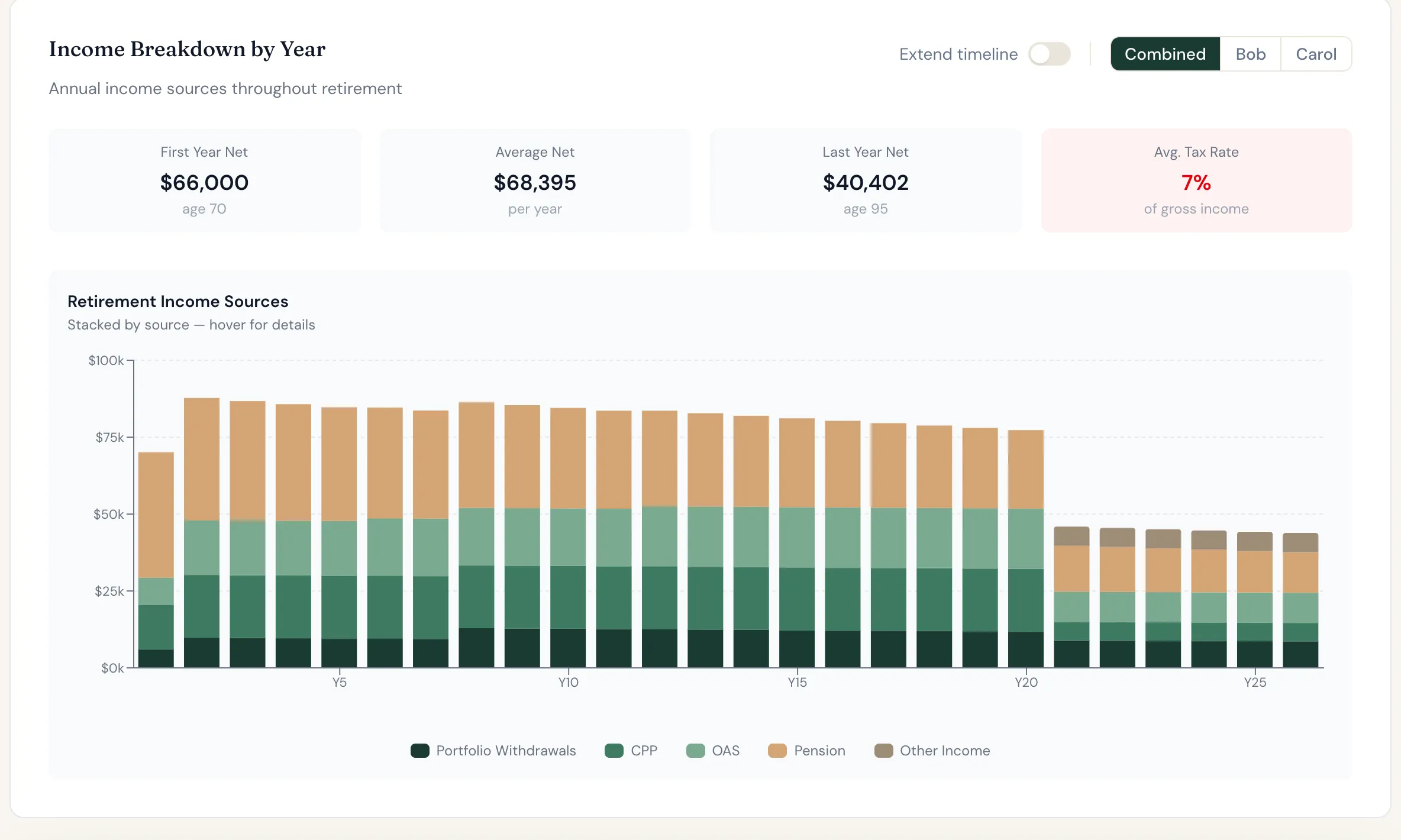 Household income by year, before and after Bob's death.
In the last year they're together, Bob is 89 and Carol is 83. The next year, Carol is on her own:
| Together, last year | Carol alone, first year | |
|---|---|---|
| Gross income | $77,285 | $45,926 |
| Income tax | $4,577 | $3,931 |
| Tax rate | 5.9% | 8.6% |
| Spending money | $72,708 | $41,995 |
Her income falls by about 41% in a single year. She keeps her own CPP and OAS, and inherits Bob's RRIF and TFSA. She loses his OAS entirely, his CPP is replaced by a smaller survivor benefit, and his pension drops to its 60% survivor share. Her survivor pension and CPP survivor benefit together come to $21,180.
Her tax rate rises too. Every dollar is now on one return, with no splitting and one set of credits, so she pays almost as much tax as the two of them did, on 40% less income.
Her plan still works. Scenario Lab+ assumes she needs 70% of their household budget, and her income covers it. But the drop is large, and it's the moment many survivors discover how much of their income was in the other person's name.
What would your survivor's income look like?
Scenario Lab+ models the first death in a couple: pension survivor share, CPP survivor benefit, account rollover, and the survivor's own tax return.
Try Scenario Lab+How Their Plan Changes Over Time
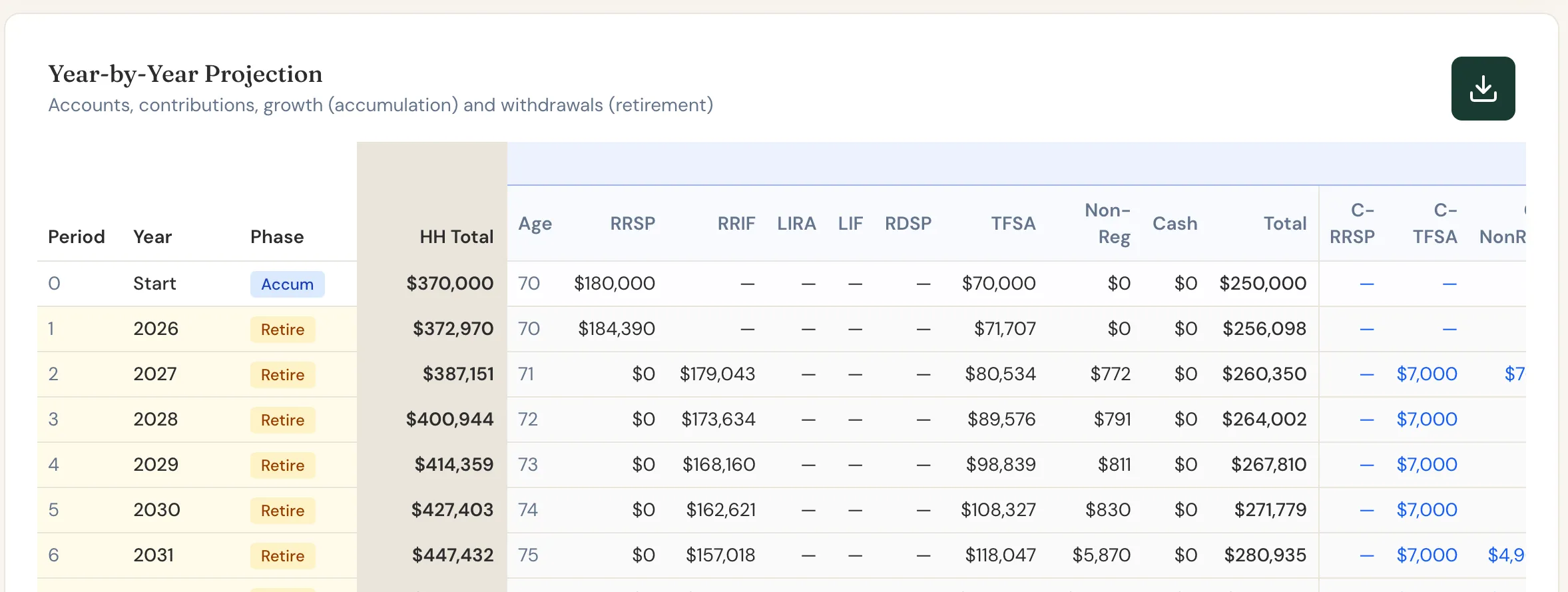 Year-by-year balances for Bob and Carol.
At Bob's 71, his RRSP becomes a RRIF. The minimum withdrawals add to their income, and what they don't spend goes back into their TFSAs. Our RRIF guide covers the rules.
Bob's pension shrinks in real terms every year, because it isn't indexed. By 89 it pays about $25,500 a year in today's money, down from $40,800.
At Bob's 90, he dies. Carol, at 84, continues alone on the plan's survivor budget.
At Carol's 95, she still has $923,044.
But What If We Change the Assumptions?
The question for this couple isn't whether the money lasts. It's how the survivor's income holds up, depending on when the first death comes and the choices they made along the way.
4 versions of Bob and Carol's plan
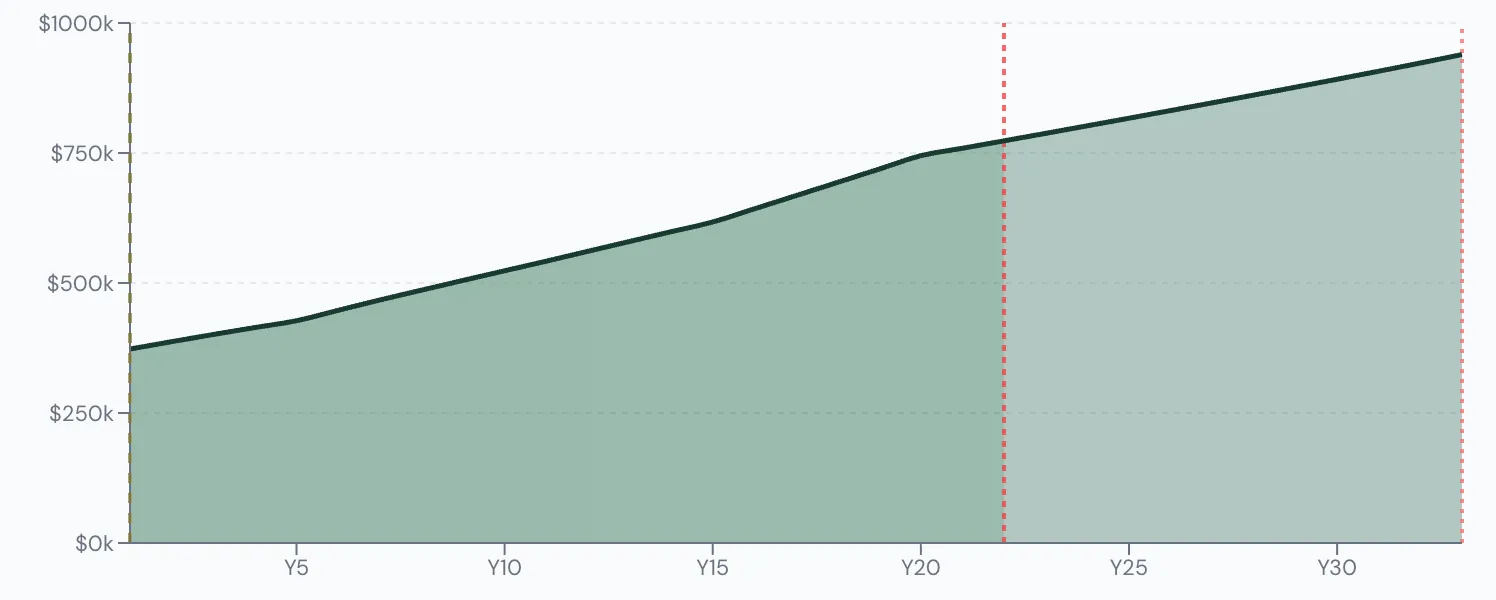
One assumption changed in each. Charts show the portfolio from 70 to 101 in Scenario Lab+.
Bob and Carol's base plan
- Spends at 70
- $66,000/yr
- Money lasts
- Past 101
- Left at 101
- $923,044
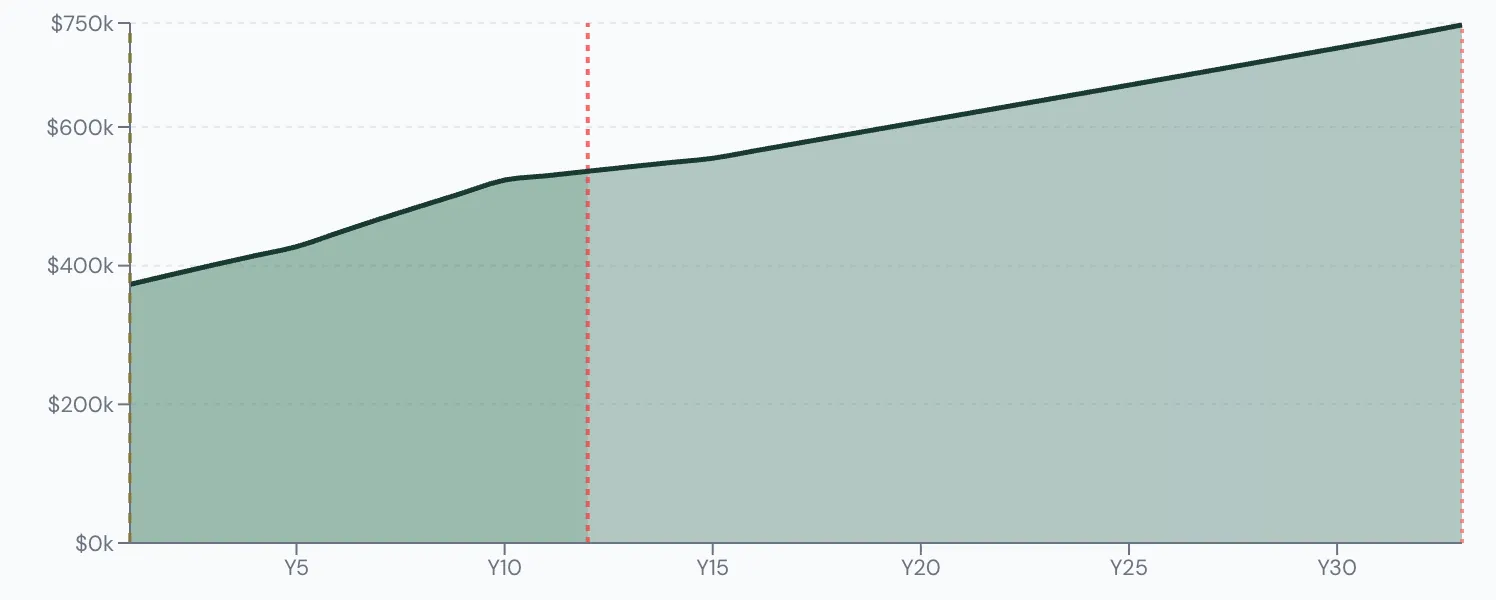
Bob dies at 80
- Spends at 70
- $66,000/yr
- Money lasts
- Past 101
- Left at 101
- $735,715
Bob chose a 100% survivor pension
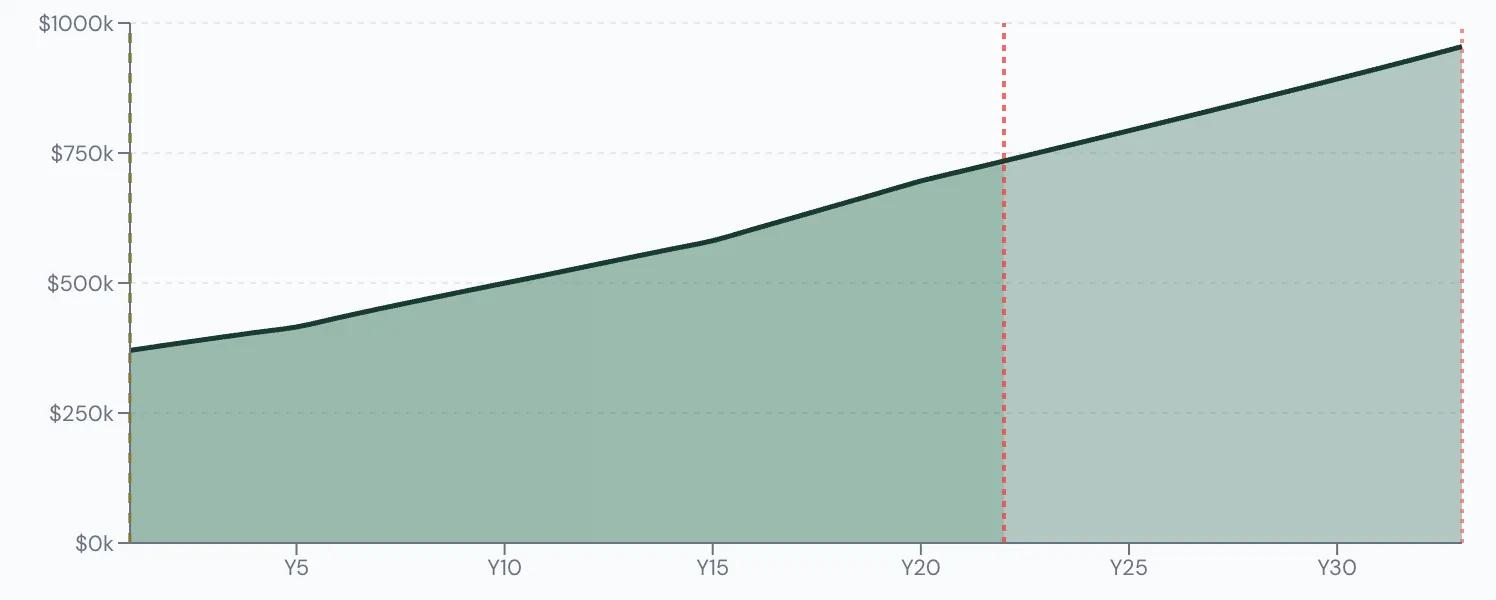
- Spends at 70
- $66,000/yr
- Money lasts
- Past 101
- Left at 101
- $933,376
Carol keeps the house and spends 85%
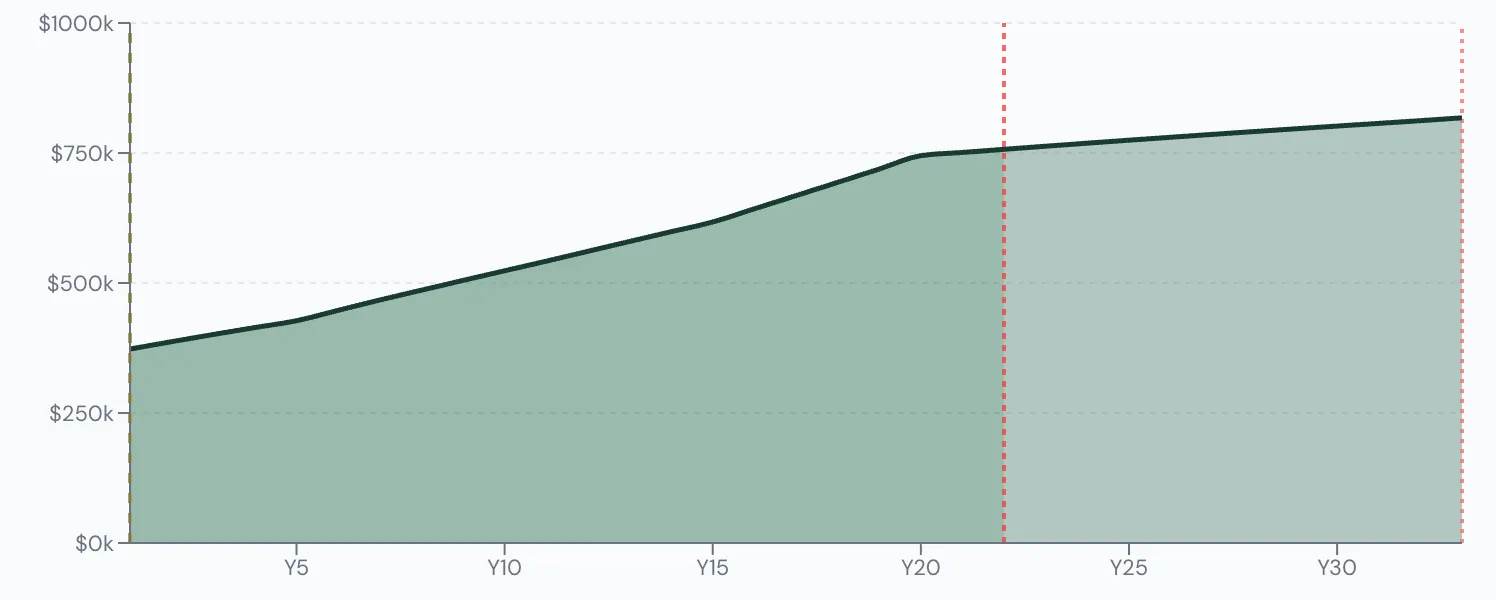
- Spends at 70
- $66,000/yr
- Money lasts
- Past 101
- Left at 101
- $812,178
Scenario 1
Bob dies at 80
- Spends at 70
- $66,000/yr
- Money lasts
- Past 101
- Left at 101
- $735,715
What if Bob dies at 80 instead of 90? Carol is 74, with 21 years ahead of her alone.
Their plan still works, and Carol reaches 95 with $735,715. Her income in her first year alone is $46,050 after tax, against $78,311 for the two of them the year before. An earlier death means Bob's larger pension shrinks to its survivor share sooner, and Carol pays tax as a single person for longer.
Scenario 2
Bob chose a 100% survivor pension
- Spends at 70
- $66,000/yr
- Money lasts
- Past 101
- Left at 101
- $933,376
When Bob retired, his plan likely offered a choice: a higher pension with a 60% survivor share, or a lower one that continues in full to his spouse. What if he'd chosen 100%, at $3,150 a month instead of $3,400?
They have a little less while both are alive. After Bob dies, Carol's income in her first year alone is $48,012, about $6,000 more than with the 60% option, and she keeps that advantage for the rest of her life. She reaches 95 with $933,376, about $10,000 more. They pay more tax over their retirement, because more pension income is paid for longer.
For a couple where one partner has most of the pension and the other is younger, a larger survivor share is insurance against exactly this drop.
Scenario 3
Carol keeps the house and spends 85%
- Spends at 70
- $66,000/yr
- Money lasts
- Past 101
- Left at 101
- $812,178
Scenario Lab+ assumes a survivor spends 70% of the household budget: one person costs less than two, but a house doesn't cost half as much. What if Carol stays in their house and spends 85%?
Her plan still works. She spends $44,880 a year after Bob dies, and she reaches 95 with $812,178, about $111,000 less than at 70%. In Scenario Lab+, the survivor's share of spending is an input, so a couple can test the version of widowhood they expect.
Your Retirement Is Not Bob and Carol's
So what happens to your retirement when a spouse dies? For Bob and Carol the money lasts, but Carol's income falls by about 40%, and her tax rate rises. Their plan is a starting point, not an answer for any other couple.
How much of your income is in one name, and what your pension pays a survivor, can change the answer completely. For a couple where one partner holds most of the savings, see Greg and Anne's plan. For a couple retiring at 60, see Raj and Priya's plan.
The bigger risk for a couple is planning as if both partners will always be there.
That's why we built Scenario Lab+.
It is the software behind every number in this article. Give it both partners' pensions, accounts, and spending, and it builds the same year-by-year plan for you, including the first death and every what-if above. If you'd like to see it first, Bob and Carol's full plan is open to explore.
Build Your Own Canadian Retirement Plan
Enter both partners' pensions, savings, and spending in Scenario Lab+ to see whether your plan holds up for the one who's left.
Start now