


The short answer
- Yes: Melissa can retire at 56, and with Chris working to 62 they spend $7,500 a month with $1.6M left at 95.
- Her pension, fully indexed to inflation, does most of the work. Without indexing, they'd finish about $1 million lower.
- Chris could stop working now, at 58, and their plan would still work comfortably.
Estimates from Scenario Lab+, in today's dollars.
See the demo planTeachers are among the few Canadians who still retire with a large, defined-benefit pension. The question in most teaching households isn't whether the pension is good. It's whether it's enough for two people, and when each of them can stop.
Here at Loonie Nest, our mission is to provide free and affordable personal finance education to Canadians so they can gain confidence in their retirement.
Melissa and Chris's plan at a glance
$655,507
saved at 56
RRSP
$362,618
Taxed as income when withdrawn
TFSA
$227,578
Withdrawals are tax-free
Non-registered
$65,311
Only the capital gain is taxed
Spending after tax, in today's dollars
$90,000
$81,000
$72,000
Melissa
CPP $1,000 a month from 65
OAS $742 a month from 65
Chris
CPP $750 a month from 65
OAS $742 a month from 65
Our Teacher Retirement Scenario
Let's meet Melissa and Chris. They live in Oshawa, ON. Melissa is 56 and has taught high school science for 31 years. Her pension plan lets her retire now with her full pension. Chris is 58 and runs a small landscaping business, with no pension. He plans to keep working until 62.
We'll run Melissa and Chris's numbers through Scenario Lab+.
Scenario Lab+ is our proprietary retirement planning software. We'll use it to generate and review a tailored retirement plan for the two of them.
To start, here's how their numbers look as Melissa retires:
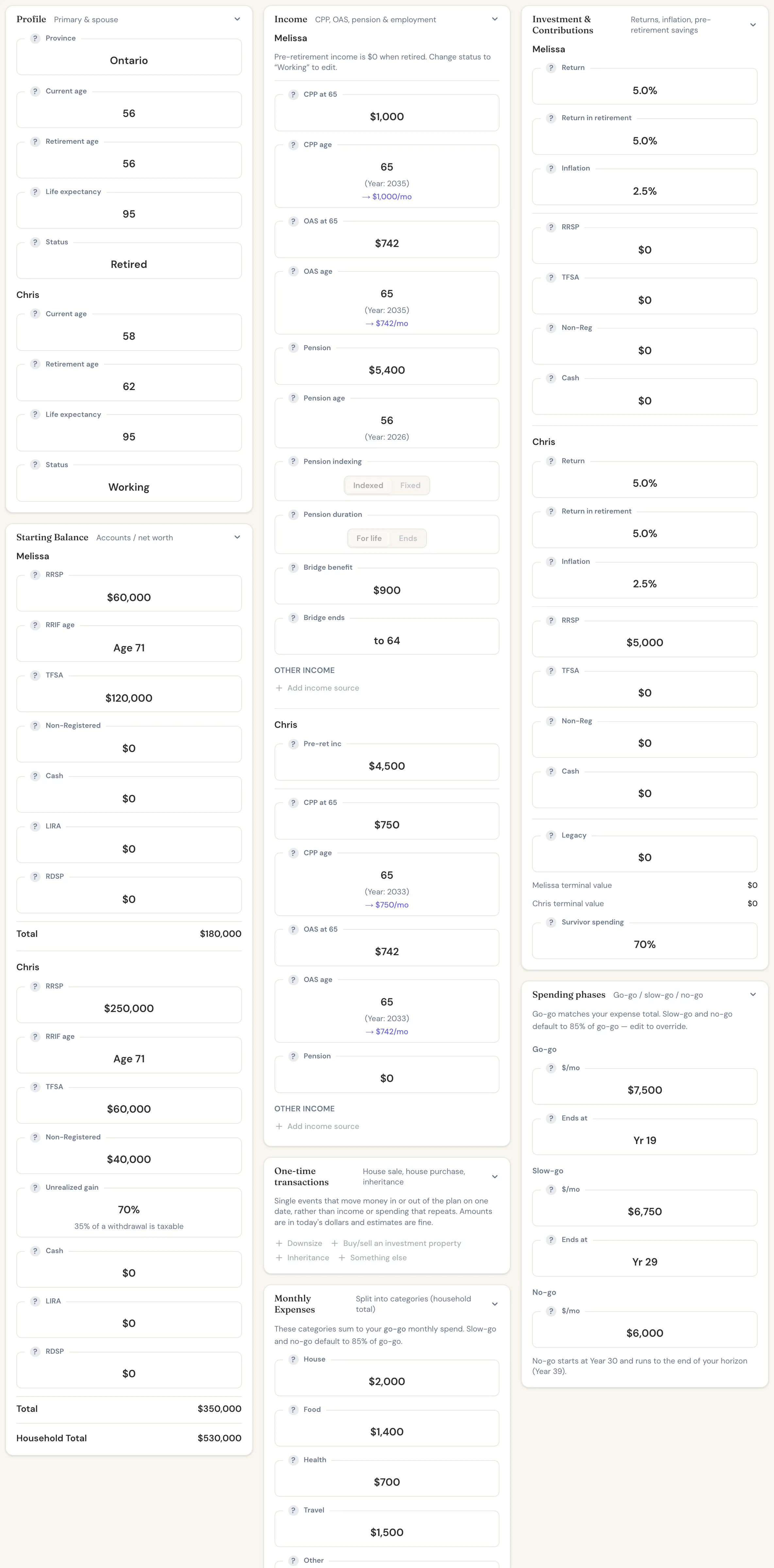 Melissa and Chris's plan inputs, including Melissa's pension and Chris's working years.
Melissa's pension pays about $5,400 a month, plus a $900 bridge until 65. It's fully indexed to inflation. These figures are an example: every plan has its own formula, and Melissa's real amounts would come from her pension statement.
Her savings are small, on purpose. A pension uses up most of a teacher's RRSP room, so she has $60,000 in her RRSP and $120,000 in her TFSA.
Chris keeps working until 62. He earns about $54,000 a year and puts $5,000 a year into his RRSP. He has $250,000 in his RRSP, $60,000 in his TFSA, and $40,000 in a non-registered account.
Their CPP. Melissa's statement shows $1,000 a month at 65, and Chris's $750, reflecting the years he reported a modest income. Both receive the full OAS. If you want a refresher on how both programs work, see our guide to CPP and OAS.
A few other important assumptions: all figures are in today's dollars, they own their home with no mortgage, they expect their investments to grow 5% a year, inflation runs at 2.5% a year, and we plan both of them to 95. They spend $7,500 a month, stepping down at Melissa's 75 and 85.
Melissa and Chris's retirement budget
| Category | Monthly | Annual |
|---|---|---|
| Housing (property tax, utilities, insurance, upkeep) | $2,000 | $24,000 |
| Food and dining | $1,400 | $16,800 |
| Health and dental | $700 | $8,400 |
| Travel | $1,500 | $18,000 |
| Everything else (cars, gifts, entertainment) | $1,900 | $22,800 |
| Total | $7,500 | $90,000 |
Can a Teacher Retire at 56?
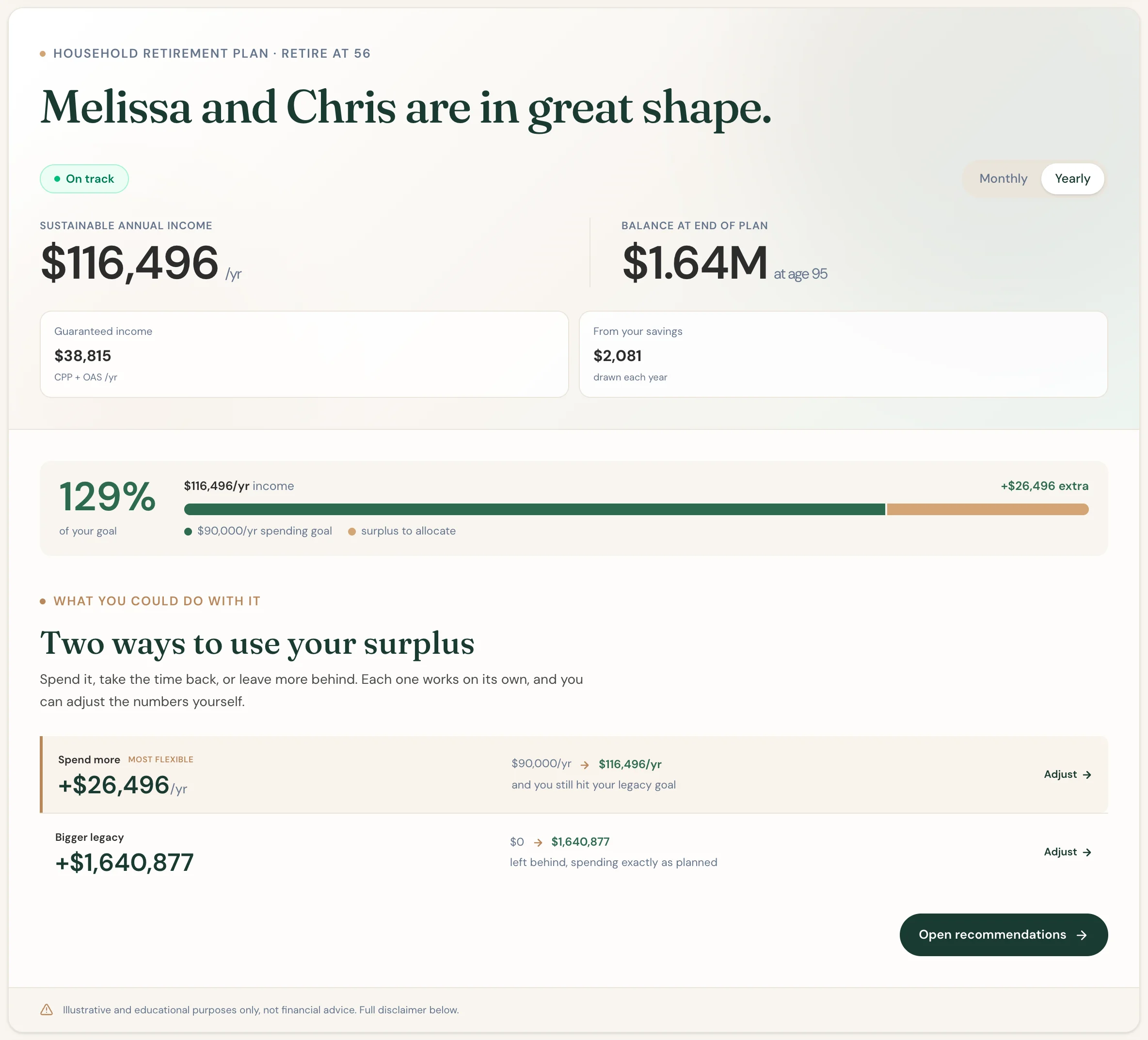 Scenario Lab+'s results for Melissa and Chris's plan.
For Melissa and Chris, the results say yes, comfortably. Their plan covers their spending every year and has $1,640,877 left at 95. Scenario Lab+ estimates they could spend about $2,208 more a month.
Melissa's pension and bridge pay $75,600 a year from 56. With Chris's salary, that more than covers their $90,000 budget, so their savings keep growing until he retires.
How Much Income Does Her Pension Provide?
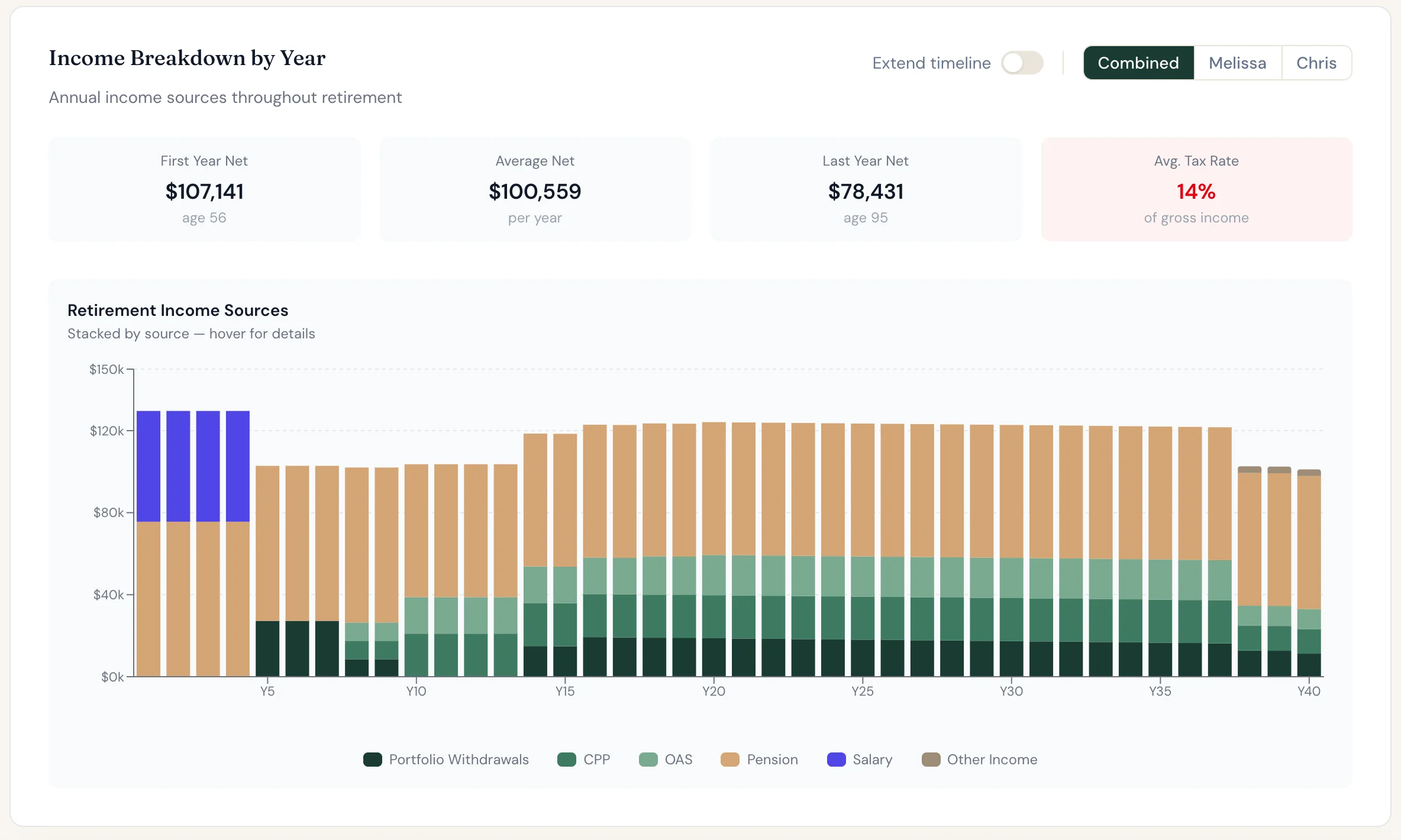 Where Melissa and Chris's income comes from each year, by source.
| Melissa 60, Chris 62 | Melissa 65, Chris 67 | |
|---|---|---|
| Melissa's pension and bridge | $75,600 | $64,800 |
| CPP and OAS (both) | $0 | $38,816 |
| Withdrawals from savings | $27,236 | $0 |
| Gross income | $102,836 | $103,615 |
| Income tax | $12,836 | $11,638 |
| Spending money | $90,000 | $91,977 |
At 65, Melissa's $10,800 bridge ends, and her CPP and OAS start in its place. Chris's started two years earlier, so by then CPP and OAS for the two of them pay more than the bridge did, and they don't need to draw on their savings at all.

Does your household have a pension?
Scenario Lab+ models a workplace pension with a bridge and indexing, alongside a spouse's savings, income, and benefits.
Try Scenario Lab+How Much Tax They Pay
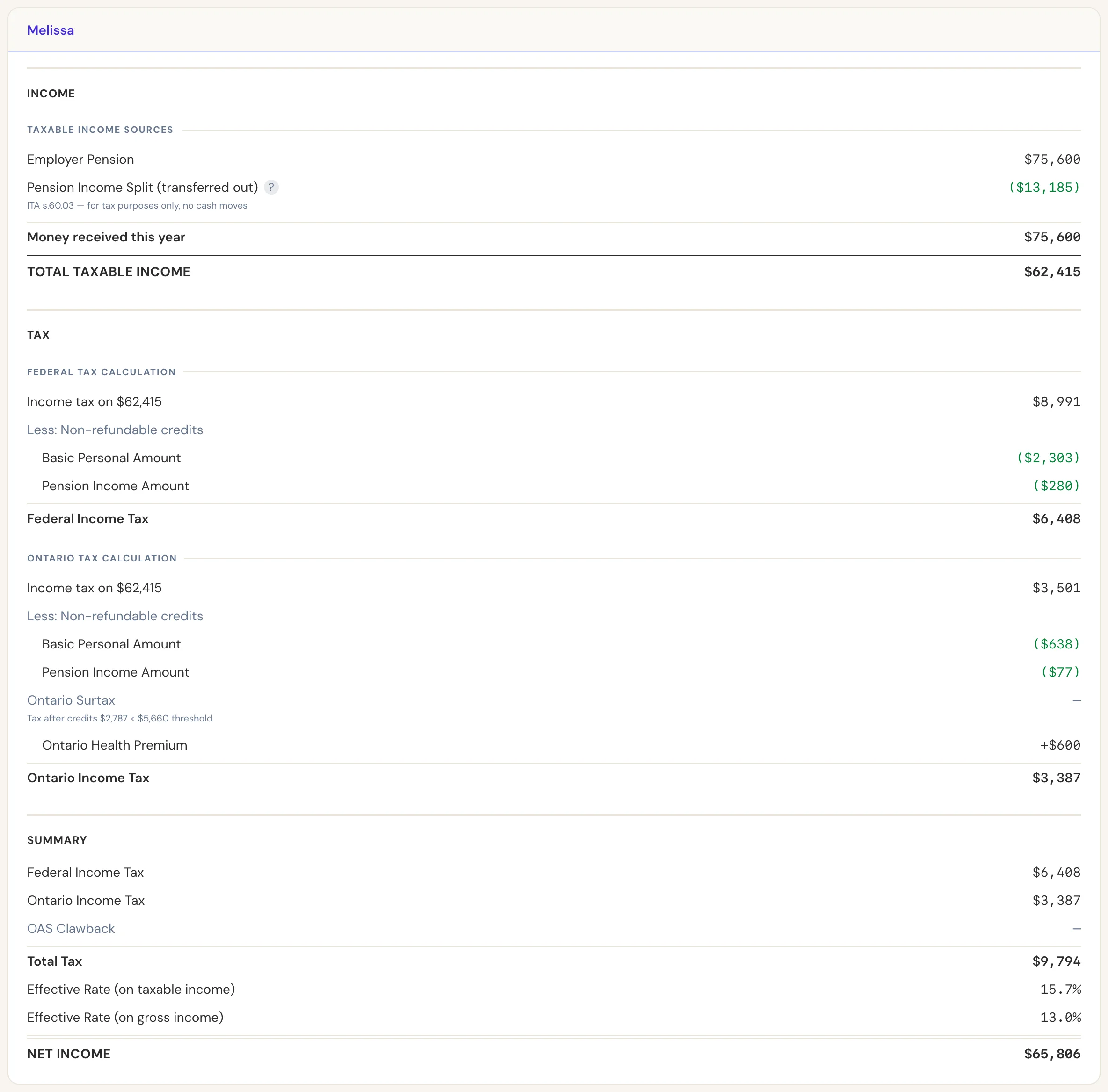 Their tax in Melissa's first year of retirement.
Melissa's pension is fully taxable, but she doesn't have to carry all of it alone. A workplace pension counts as eligible pension income at any age, and Chris can receive a split while he still works. From 56, Scenario Lab+ moves about $13,200 a year of her pension onto his return.
That cuts Melissa's tax at 56 from $13,854 to $9,794, while Chris pays $2,733 more on top of his salary. Together they save about $1,300 a year until he retires.
Once Chris retires at 62, the split grows to about $24,200 a year, and their household tax falls to $12,836 on more than $100,000 of income. Our guide to pension income splitting covers the rules.
How Their Plan Changes Over Time
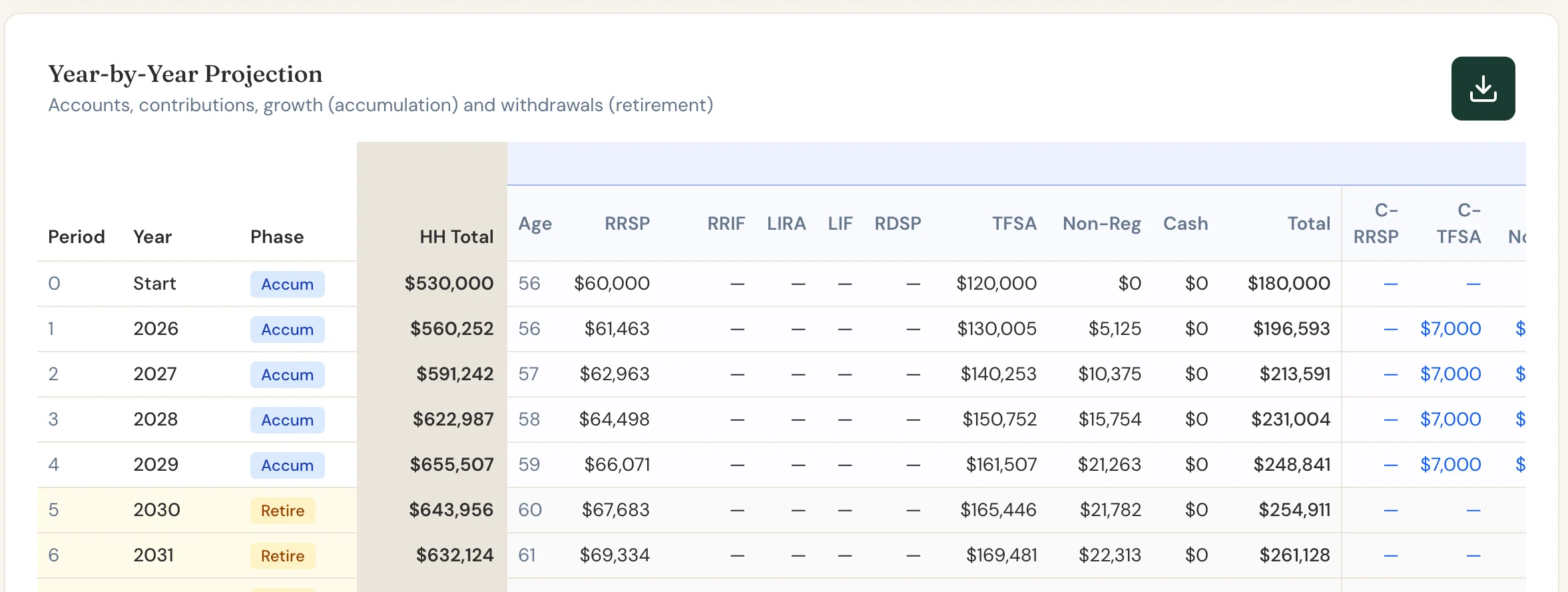 Year-by-year balances for Melissa and Chris.
From 56, Melissa's pension and Chris's salary cover everything. Their savings grow from $530,000 to about $644,000 by the time Chris retires.
At Chris's 62, he retires and the split grows. They begin drawing modestly on his RRSP.
At Melissa's 65, her bridge ends and CPP and OAS start. For now they stop drawing on their savings altogether.
From then on, their savings grow almost every year, to $1,640,877 at 95.
But What If We Change the Assumptions?
5 versions of Melissa and Chris's plan
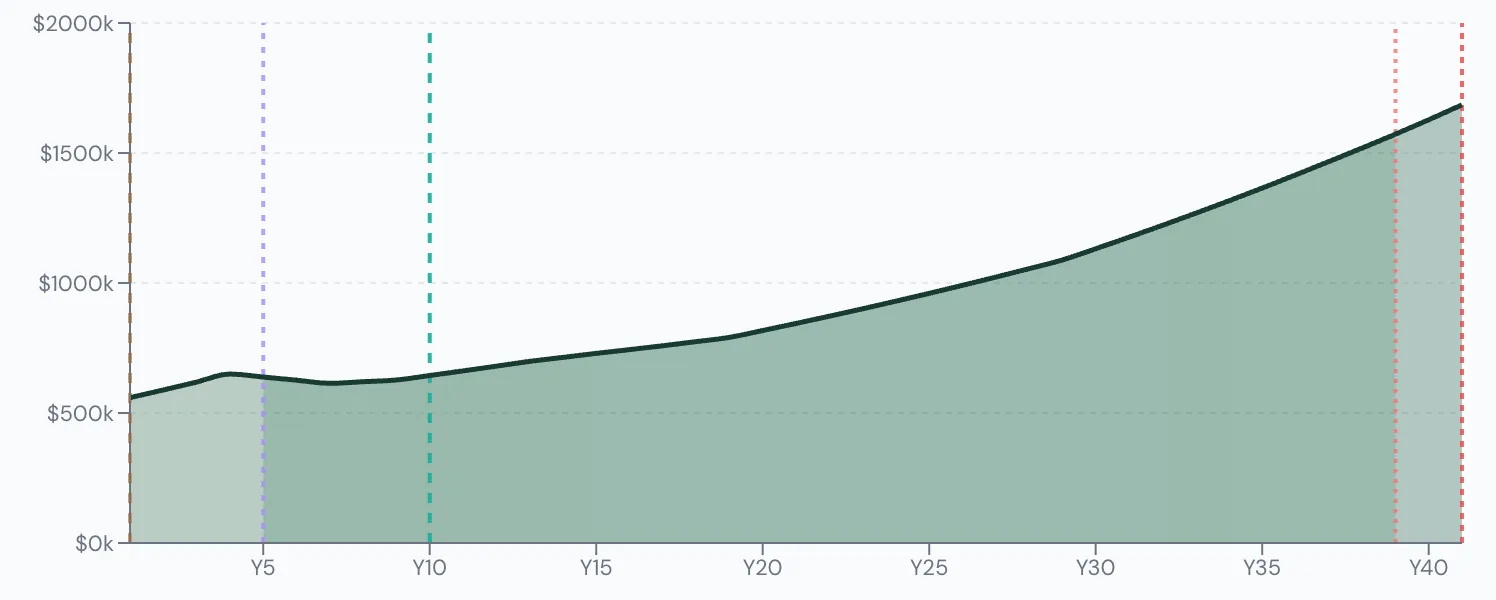
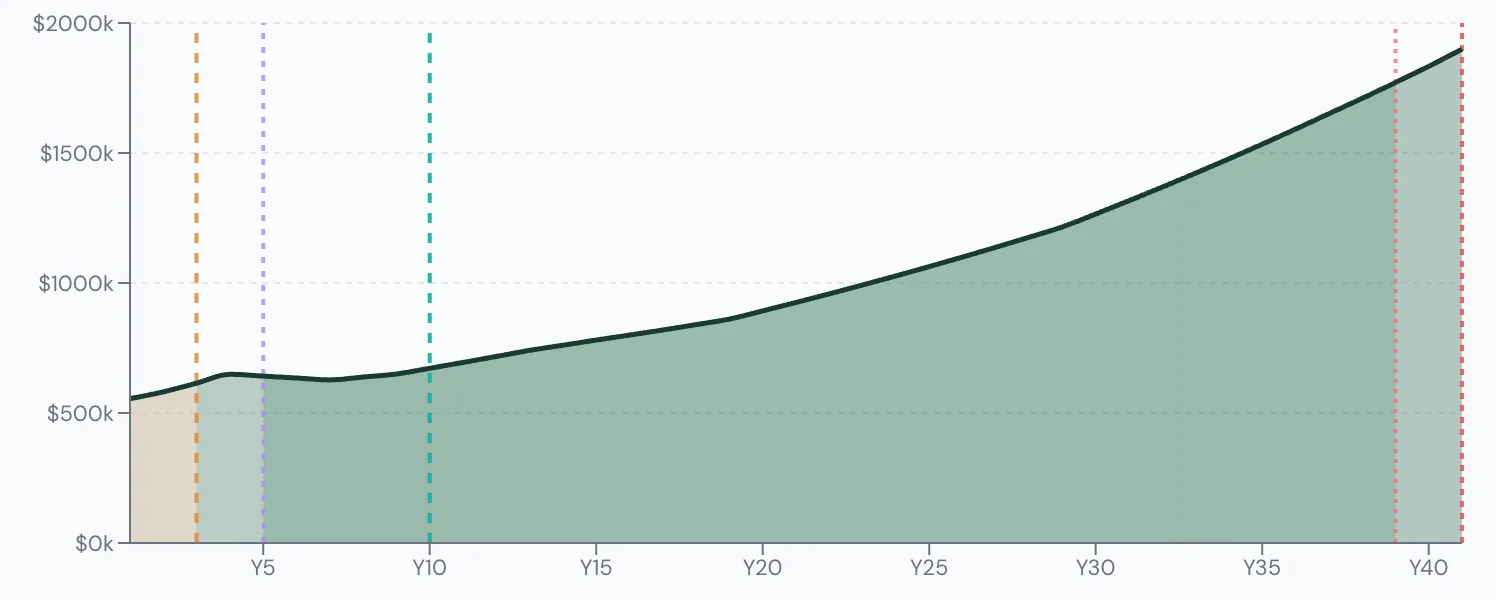
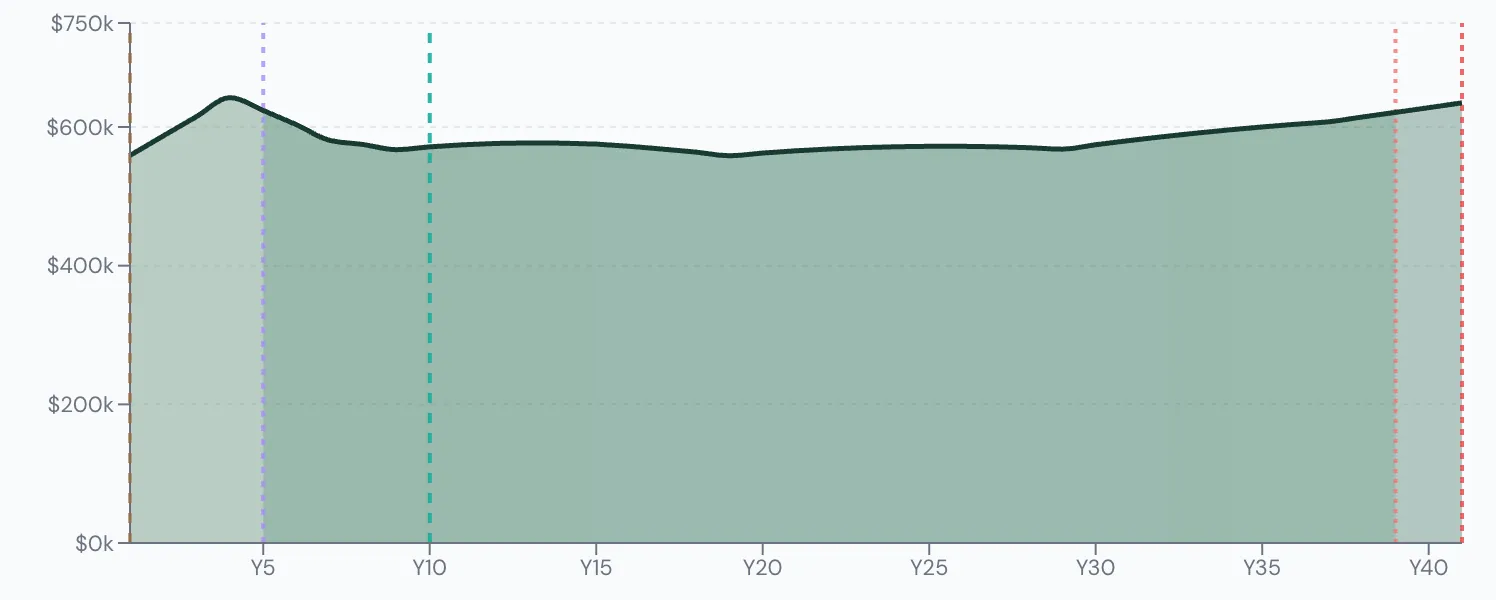
One assumption changed in each. Charts show the portfolio from 56 to 95 in Scenario Lab+.
Melissa and Chris's base plan
- Spends at 60
- $90,000/yr
- Money lasts
- Past 95
- Left at 95
- $1,640,877
Melissa works two more years
- Spends at 60
- $90,000/yr
- Money lasts
- Past 95
- Left at 95
- $1,839,890
Her pension is not indexed
- Spends at 60
- $90,000/yr
- Money lasts
- Past 95
- Left at 95
- $640,388
Chris stops working now
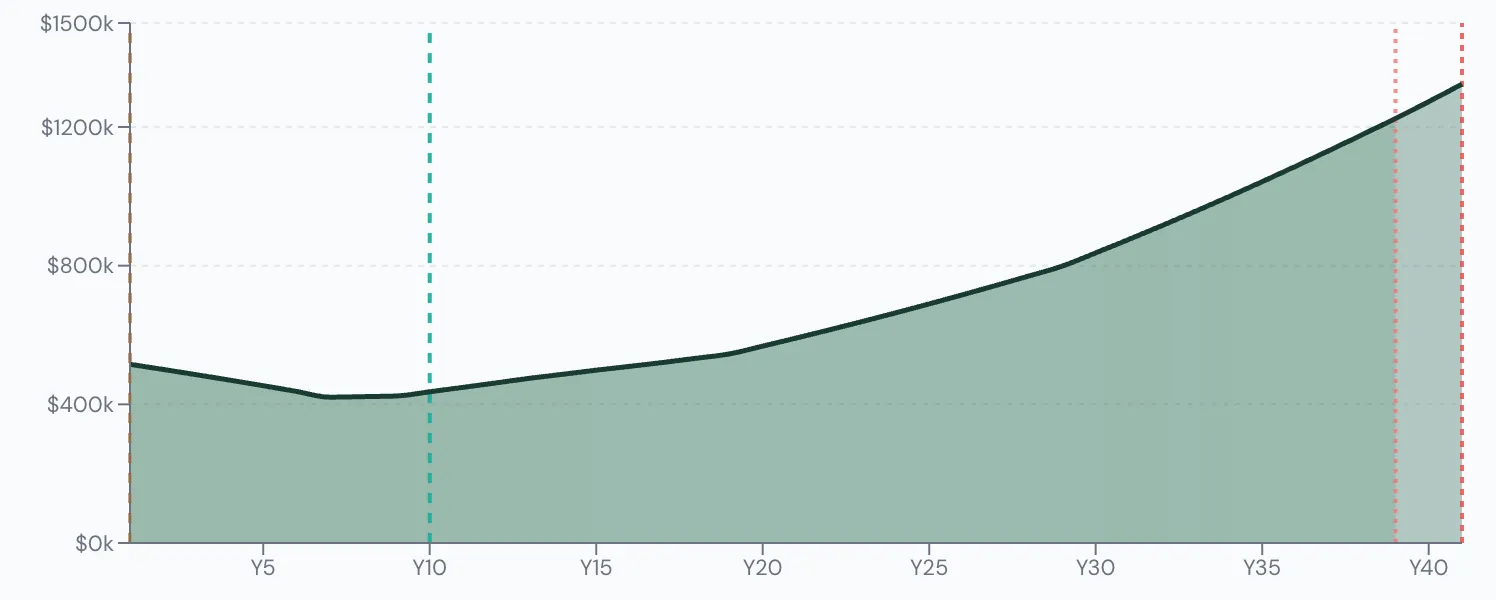
- Spends at 56
- $90,000/yr
- Money lasts
- Past 95
- Left at 95
- $1,273,009
Both take CPP at 60
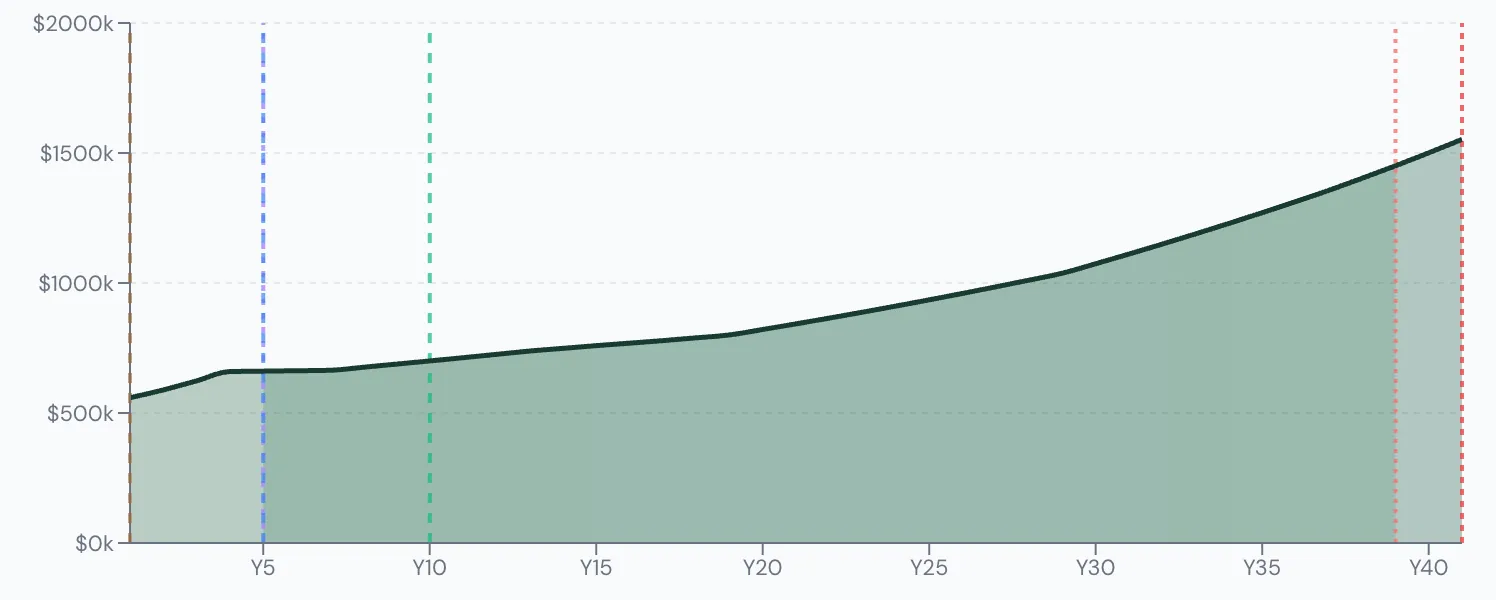
- Spends at 60
- $90,000/yr
- Money lasts
- Past 95
- Left at 95
- $1,510,830
Scenario 1
Her pension is not indexed
- Spends at 60
- $90,000/yr
- Money lasts
- Past 95
- Left at 95
- $640,388
What if Melissa's pension weren't indexed to inflation? Same $5,400 to start, but fixed in dollars for life.
Their plan still works, but they finish at 95 with $640,388 instead of $1,640,877, about $1 million less. By her 80s her pension buys roughly half what it does today, and their savings have to make up the difference.
Many teachers' plans index only part of the pension, or only in years the plan can afford it. Whatever your plan's rule, indexing is worth knowing in detail: it's often the largest number in a teacher's retirement that nobody looks at.
Scenario 2
Melissa works two more years
- Spends at 60
- $90,000/yr
- Money lasts
- Past 95
- Left at 95
- $1,839,890
What if Melissa teaches two more years and retires at 58, with two more years of service? We assumed her pension rises to $5,800 a month.
They finish at 95 with $1,839,890, about $199,000 more, and Scenario Lab+ estimates they could spend about $2,708 more a month. For a plan that already works, two more years add margin, not safety.
Scenario 3
Chris stops working now
- Spends at 56
- $90,000/yr
- Money lasts
- Past 95
- Left at 95
- $1,273,009
What if Chris stops working now, at 58, alongside Melissa? They lose four years of his salary and RRSP contributions, and start drawing on his savings four years sooner.
Their plan still works easily. They finish at 95 with $1,273,009, and Scenario Lab+ estimates they could still spend about $1,668 more a month. With a pension this size behind them, Chris's last four working years are optional.
Scenario 4
Both take CPP at 60
- Spends at 60
- $90,000/yr
- Money lasts
- Past 95
- Left at 95
- $1,510,830
What if they both take CPP at 60, the earliest age? CPP is 36% lower at 60 than at 65, for life.
They finish at 95 with $1,510,830, about $130,000 less than taking CPP at 65. With Melissa's pension covering the early years, they don't need CPP early, and waiting pays them more for longer. Our CPP and OAS break-even calculator shows where that line falls for you.
Your Pension Is Not Melissa's Pension
So when can a teacher retire in Ontario? Melissa can retire at 56, comfortably, and Chris could stop alongside her. Their plan is a starting point, not an answer for anyone else.
Your pension's indexing, and your partner's own savings and plans, can change the answer completely. For a single person deciding between a pension and its commuted value, see Angela's plan. For a couple without a pension, see Raj and Priya's plan at 60.
The bigger risk for a teaching household is working years longer than the numbers require, without ever running them.
That's why we built Scenario Lab+.
It is the software behind every number in this article. Give it your pension, both partners' accounts, and your spending, and it builds the same year-by-year plan for you, including every what-if above. If you'd like to see it first, Melissa and Chris's full plan is open to explore.

Build Your Own Canadian Retirement Plan
Enter your pension, savings, and spending in Scenario Lab+ to see when you could retire and what happens when your assumptions change.
Start now