


The short answer
- Almost: $400,000 at 58, plus seven more years of saving, supports $4,500 a month until Dana is 89, then runs out.
- Working two more years, to 67, makes her plan last to 95 with $122K to spare.
- Spending $4,213 a month instead of $4,500 does the same.
Estimates from Scenario Lab+, in today's dollars.
See the demo planPlenty of people reach their late fifties with less saved than they'd hoped. A divorce or a late start can leave you with seven years to go and a number that feels too small. The useful question is what those seven years can still do, and what it takes to make the plan work.
Here at Loonie Nest, our mission is to provide free and affordable personal finance education to Canadians so they can gain confidence in their retirement.
Dana's plan at a glance
$583,940
saved at 65
RRSP
$412,612
Taxed as income when withdrawn
TFSA
$110,139
Withdrawals are tax-free
Cash
$61,189
Withdrawals are tax-free
Spending after tax, in today's dollars
$54,000
$48,600
$43,200
CPP $1,000 a month from 65
OAS $742 a month from 65
Our $400K Retirement Scenario
Let's meet Dana. She's 58, single, and living in Kitchener, ON. She's an HR manager earning $85,000 a year. She divorced two years ago, and her savings are what she kept from the division of family property. She rents, and she plans to work until 65.
We'll run Dana's numbers through Scenario Lab+.
Scenario Lab+ is our proprietary retirement planning software. We'll use it to generate and review a tailored retirement plan for her.
To start, here's how Dana's numbers look today:
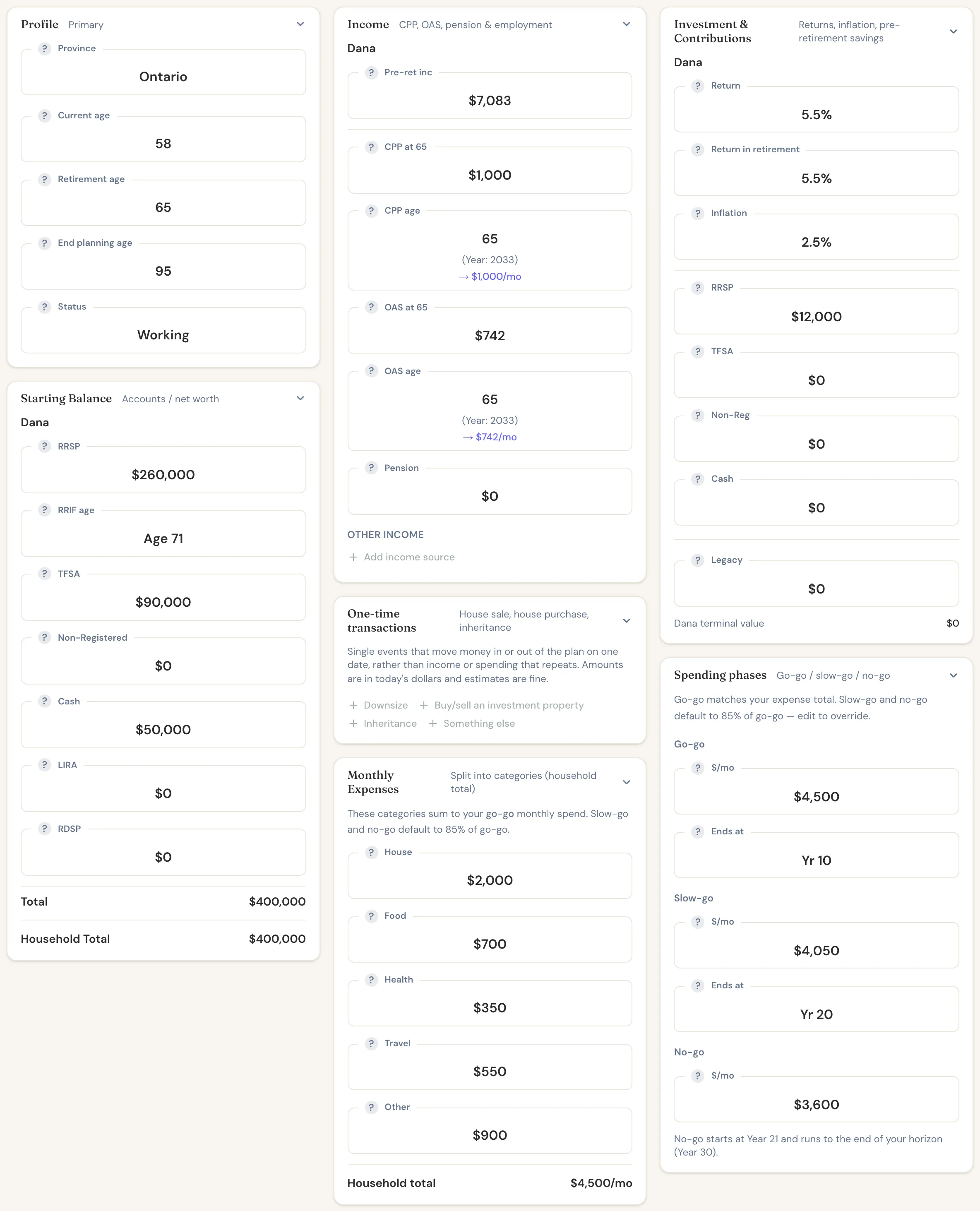 Dana's plan inputs: her profile, income and contributions, account balances, CPP and OAS, and monthly spending.
$400,000 today, across three accounts. She has $260,000 in her RRSP, $90,000 in her TFSA, and $50,000 in a high-interest savings account.
Seven more years of saving. Until she retires at 65, Dana keeps earning $85,000 and puts $12,000 a year into her RRSP. Unlike our other case studies, she isn't retired yet, so her savings keep growing before she draws on them.
Dana's CPP is $1,000 a month at 65. Her Statement of Contributions assumes she keeps working until 65. CPP credits earned during a marriage can be split when it ends, and her statement already reflects that. She gets the full OAS at 65. If you want a refresher on how both programs work, see our guide to CPP and OAS.
Her spending falls as she ages. Her plan starts at $4,500 a month and steps down at 75 and again at 85. In Scenario Lab+, these steps are the plan's Spending Phases.
A few other important assumptions: all figures are in today's dollars, Dana rents her apartment, she expects her investments to grow 5.5% a year, inflation runs at 2.5% a year, and we plan her retirement to age 95.
Dana's retirement budget
Here is how her $4,500 a month breaks down in retirement, until she turns 75:
| Category | Monthly | Annual |
|---|---|---|
| Housing (rent, utilities, tenant insurance) | $2,000 | $24,000 |
| Food and dining | $700 | $8,400 |
| Health and dental | $350 | $4,200 |
| Travel | $550 | $6,600 |
| Everything else (car, gifts, entertainment) | $900 | $10,800 |
| Total | $4,500 | $54,000 |
Rent is the biggest line, and it doesn't stop. Our guide to the best places to retire in Canada compares what it costs to live in different cities and regions.
What $400K Grows to by 65
Scenario Lab+ models the years before retirement as well as the years after. Between 58 and 65, Dana's savings grow from her contributions and her investment returns.
By the time she retires, her $400,000 has grown to about $584,000: $412,612 in her RRSP, $110,139 in her TFSA, and $61,189 in savings. That's the real starting point for her retirement, and the reason a 58-year-old's plan can look very different from what today's balance suggests.
Is $400K Enough to Retire at 65?
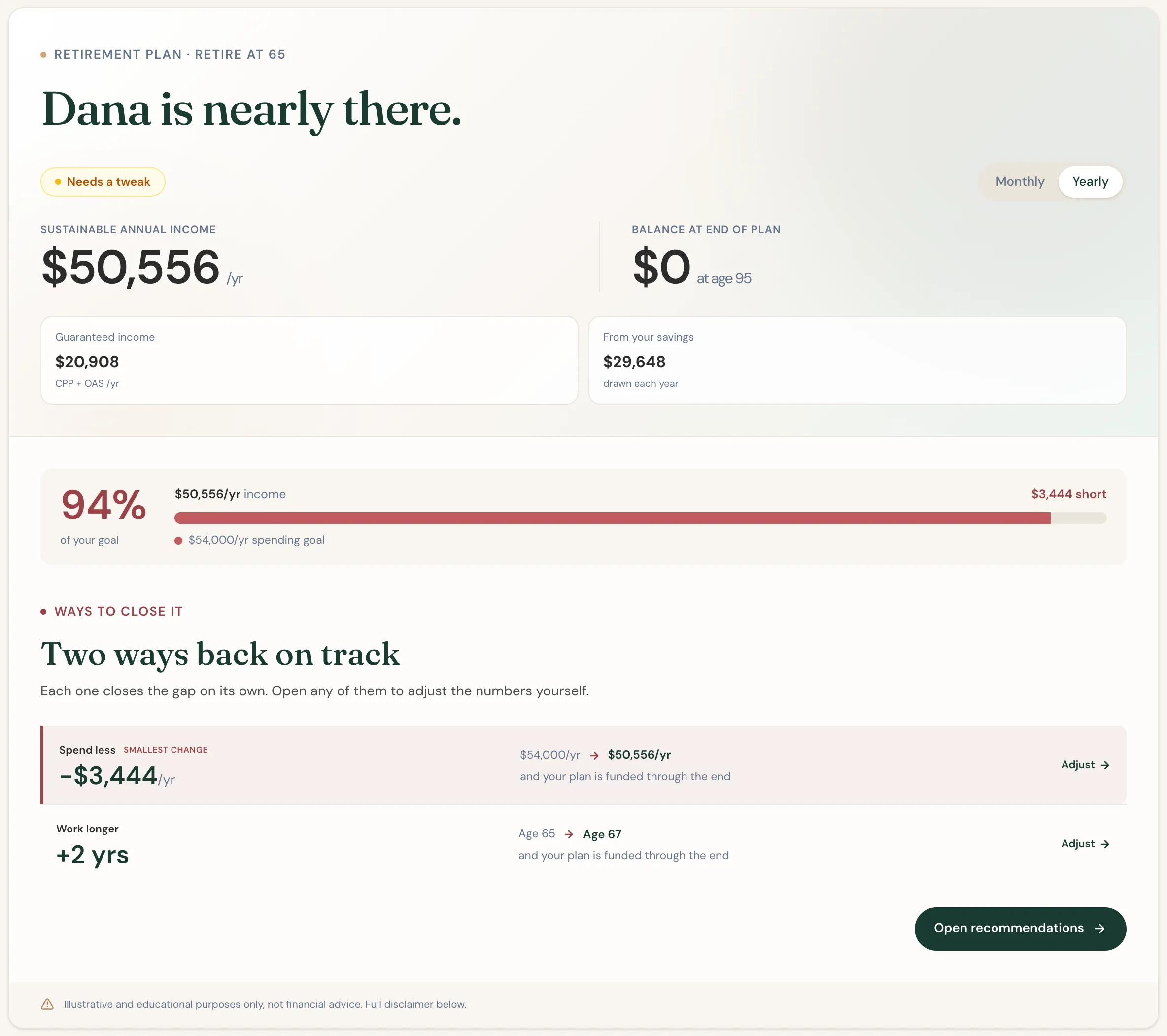 Scenario Lab+'s results for Dana's plan.
Not quite, at the budget she has in mind. Scenario Lab+ estimates her savings cover her $4,500 a month until she's 89, then run out. From then on she'd have only her CPP and OAS, about $21,800 a year, against a budget of $3,600 a month.
Six years short is close. It's the kind of gap a modest change can close, and Scenario Lab+ shows two in its Recommendations tab.
How Much Income Does Her Plan Provide?
In her first year of retirement, at 65, Dana draws $59,210 of gross income to spend $54,000:
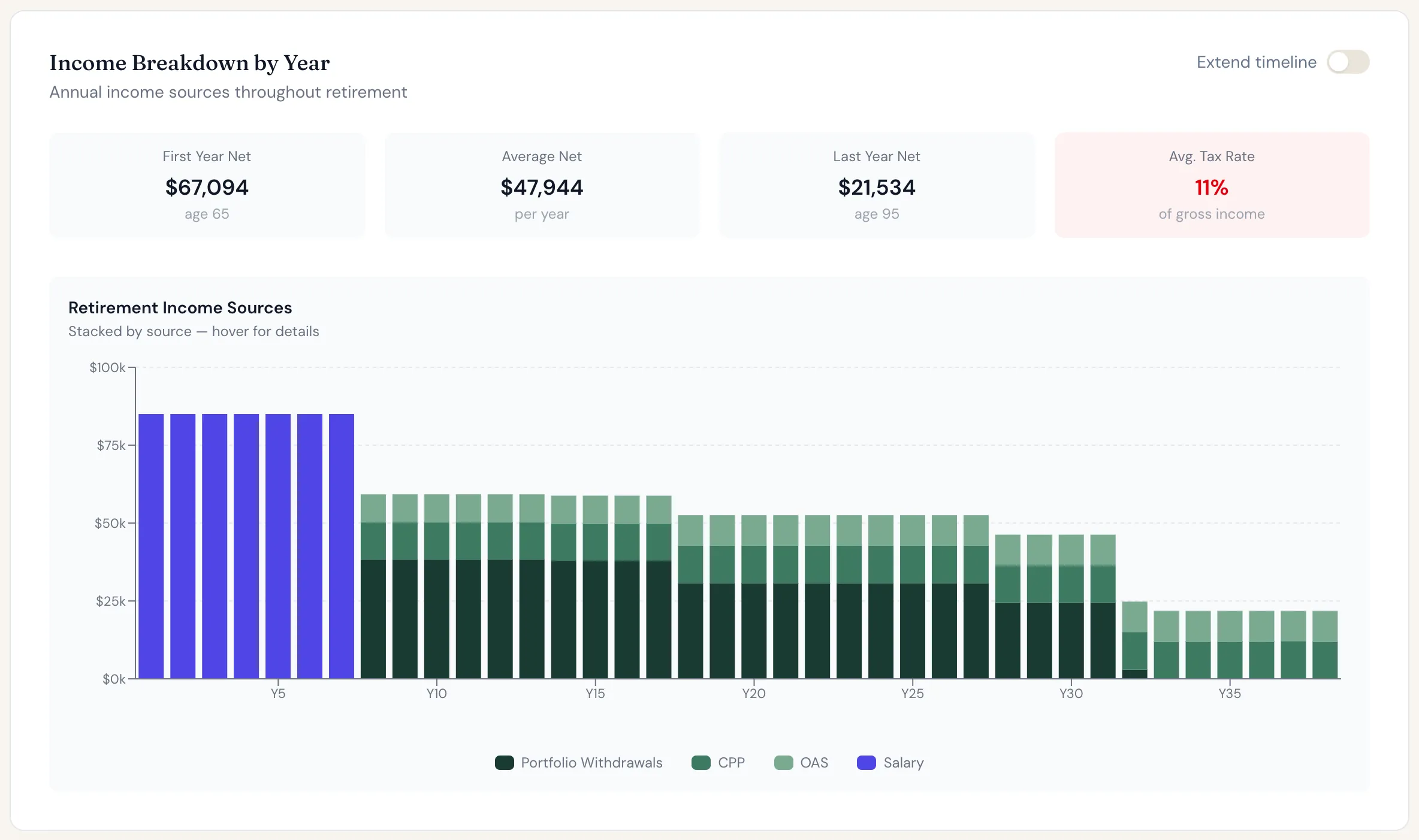 Where Dana's income comes from each year, by source.
| Source | Amount | Taxable? |
|---|---|---|
| CPP | $12,000 | Yes |
| OAS | $8,908 | Yes |
| RRSP withdrawals | $27,064 | Yes |
| TFSA withdrawals | $7,224 | No |
| Savings account | $4,014 | No |
| Gross income | $59,210 | |
| Income tax | $5,210 | |
| Spending money | $54,000 |
CPP and OAS cover about 40% of what she spends. The rest comes from her savings: about $38,300 a year, or roughly 6.6% of her $584,000. That's a high withdrawal rate to keep up for 30 years, which is why her plan runs short.

Still working, and not sure you're on track?
Scenario Lab+ models the years you're still saving, then shows what retiring at different ages, or spending less, would change.
Try Scenario Lab+How Much Tax Dana Pays
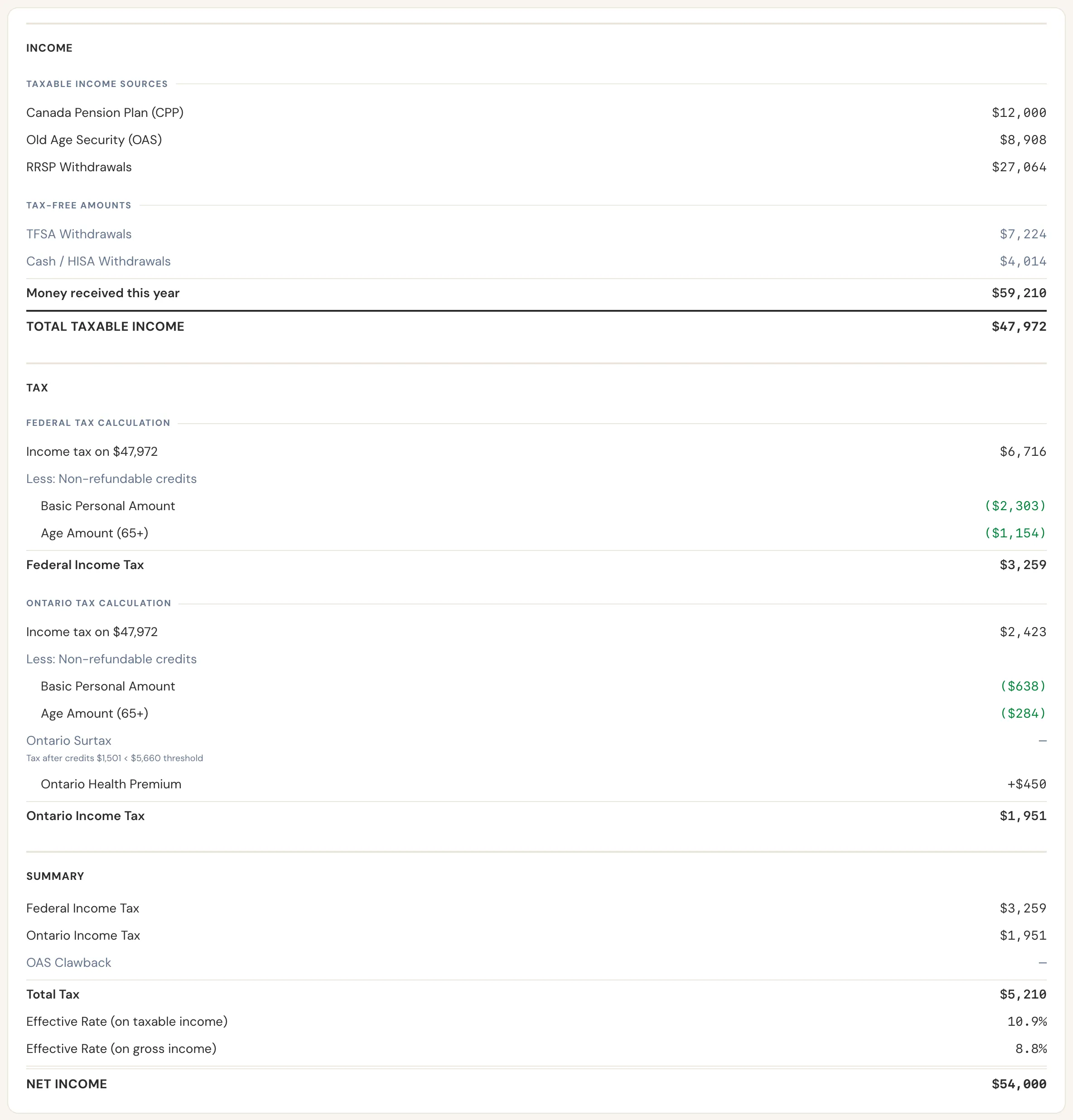 Dana's tax bill in her first year of retirement, at age 65.
Dana pays $5,210 in income tax in her first year of retirement, about 8.8% of her income. Her TFSA and savings-account withdrawals aren't taxable, and the age amount credit, which starts at 65, reduces the tax on the rest.
How Her Plan Changes Over Time
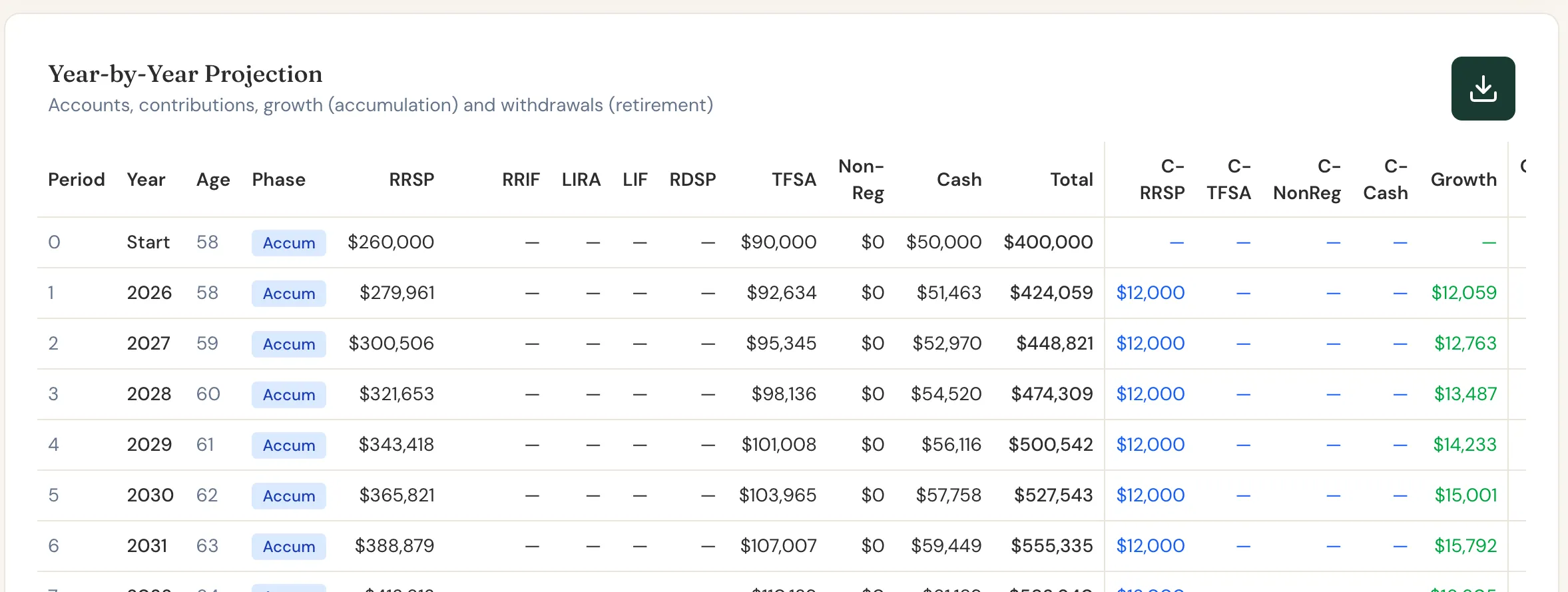 Year-by-year account balances from 58.
From 58 to 64, her savings grow. Contributions and returns take her from $400,000 to about $584,000.
At 65, she retires and CPP and OAS start. Her savings start to fall, by about $20,000 to $25,000 a year at first.
At 71, her RRSP becomes a RRIF. She's already drawing more than the minimum, so little changes. Our RRIF guide covers the rules.
At 75 and 85, her spending steps down. Each step slows the decline, but not enough to reach 95.
At 89, her savings run out.
What Scenario Lab+ Recommends
When a plan falls short, the Recommendations tab works out what would fix it. For Dana it offers two changes, each on its own:
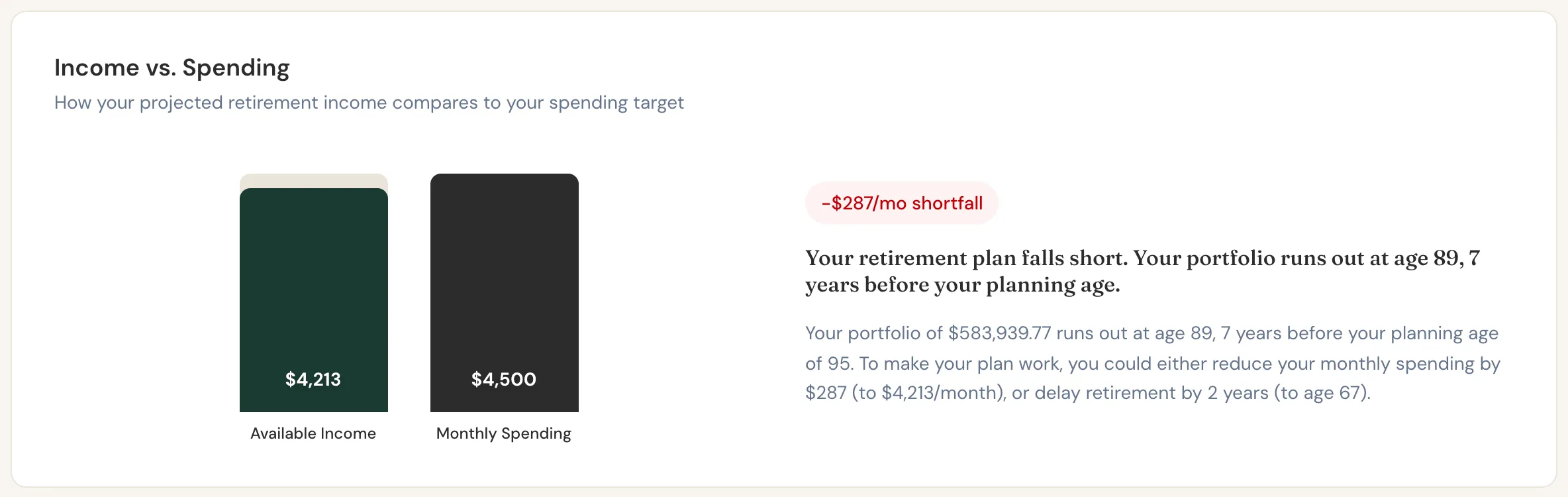 Income available to Dana compared with what she plans to spend.
- Work two more years, to 67. Two more years of salary and RRSP contributions, and two fewer years of withdrawals.
- Spend $287 a month less. A budget of $4,213 a month instead of $4,500.
Either one makes her plan last to 95. We ran both below, along with what happens if she stops earlier than planned.
But What If We Change the Assumptions?
4 versions of Dana's plan
One assumption changed in each. Charts show the portfolio from 65 to 95 in Scenario Lab+.
Dana's base plan
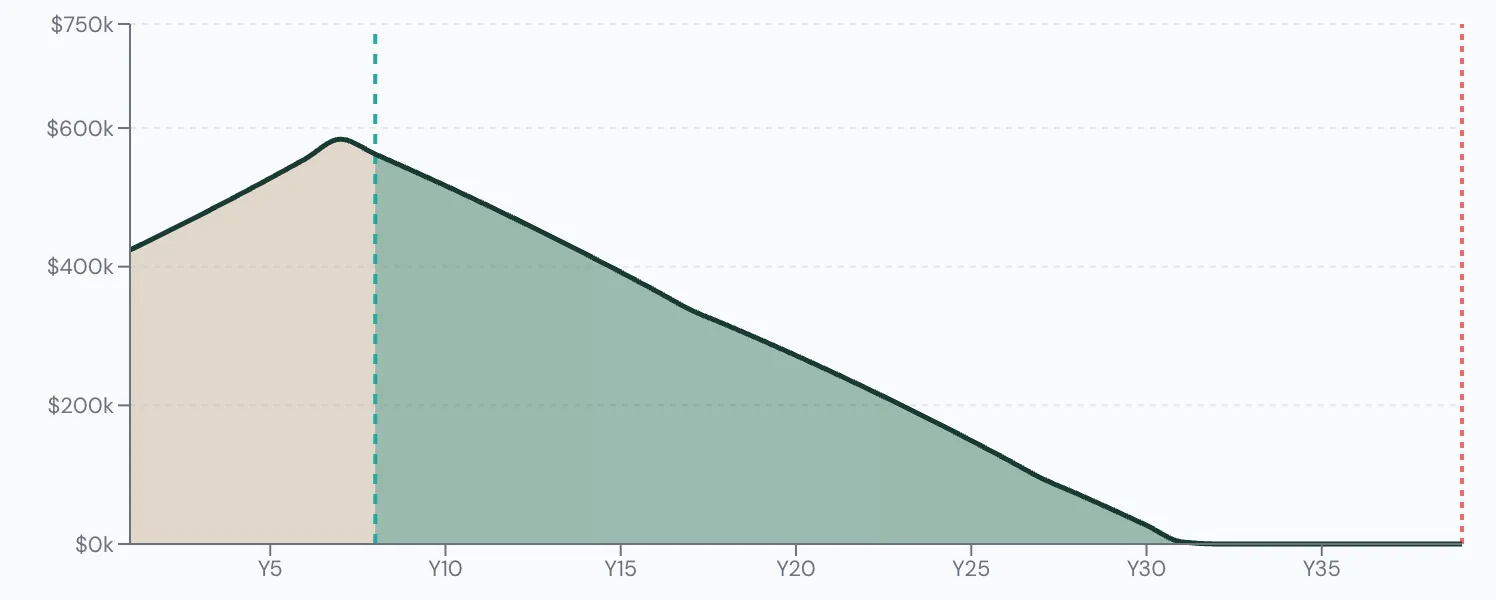
- Spends at 65
- $54,000/yr
- Money lasts
- To age 89
- Left at 95
- $0
Retires at 62
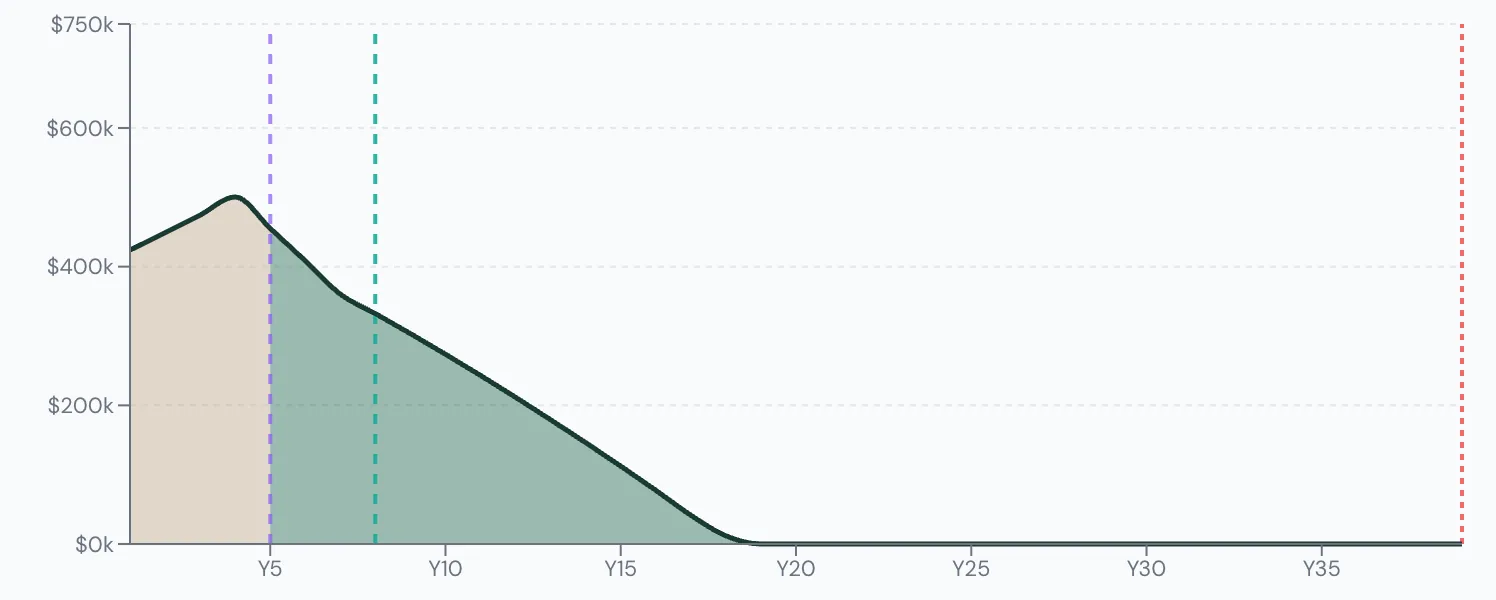
- Spends at 62
- $54,000/yr
- Money lasts
- To age 76
- Left at 95
- $0
Works two more years, to 67
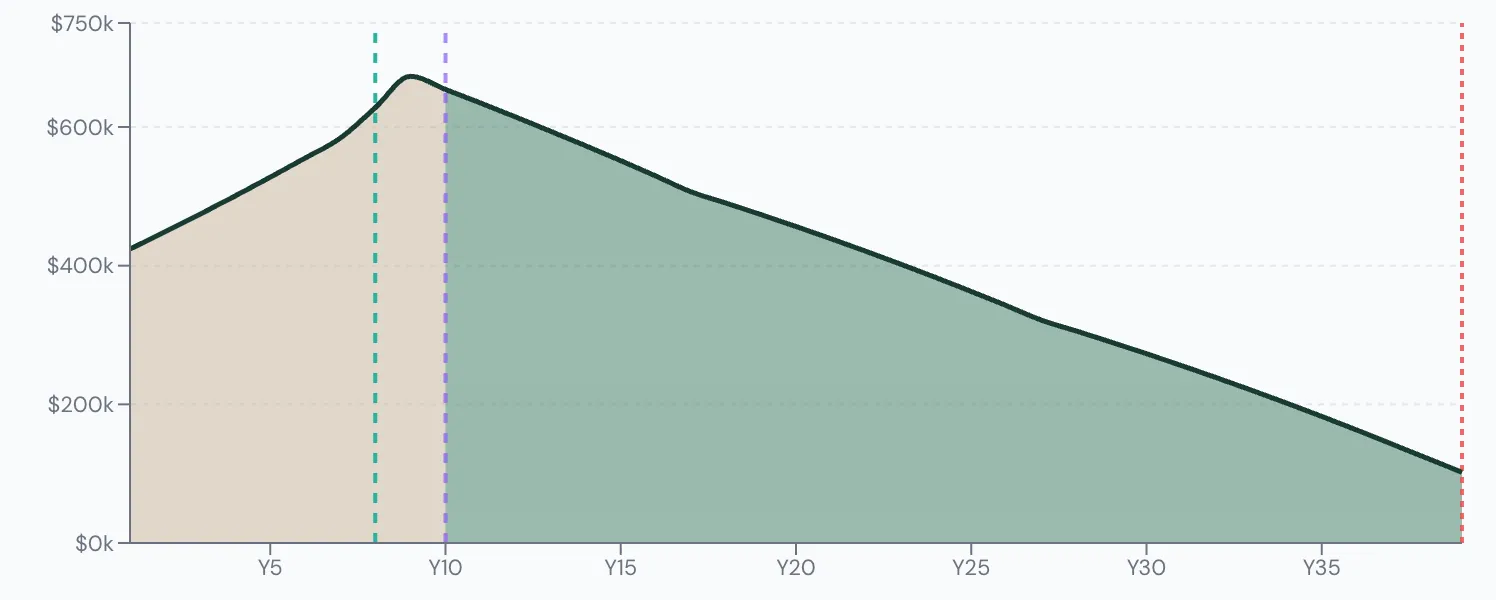
- Spends at 67
- $54,000/yr
- Money lasts
- Past 95
- Left at 95
- $122,295
Spends $4,213 a month
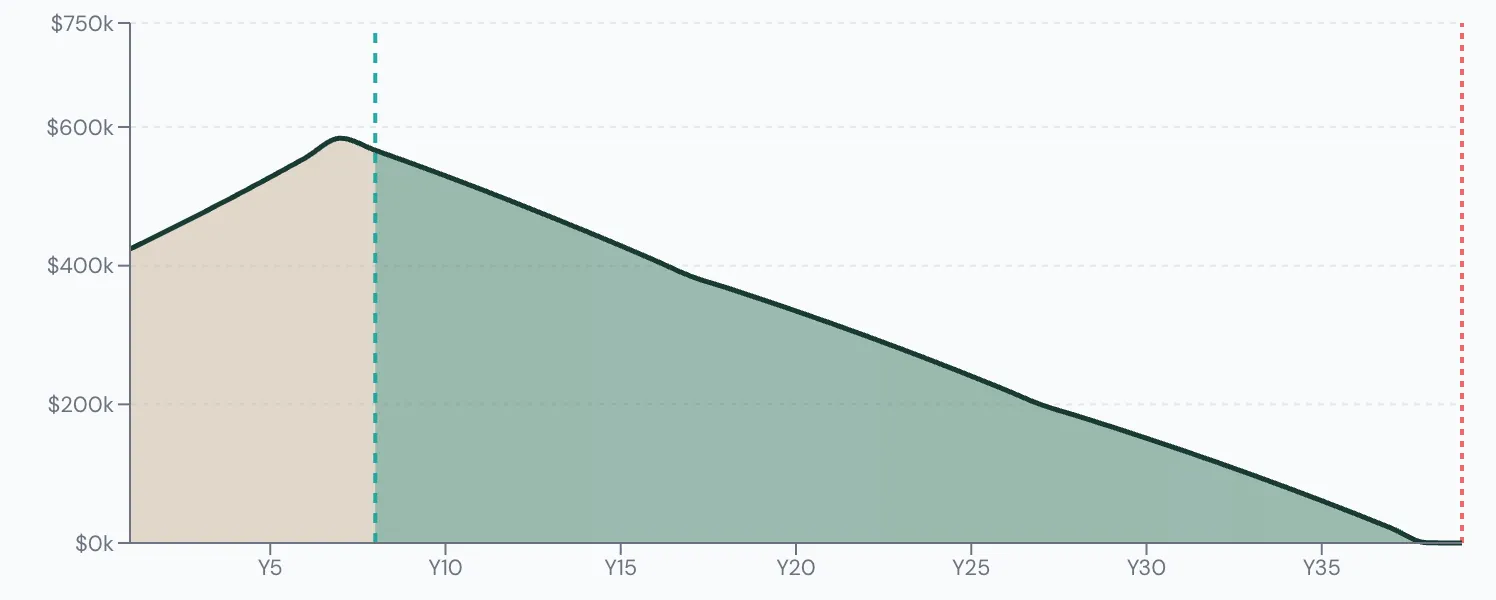
- Spends at 65
- $50,600/yr
- Money lasts
- Past 95
- Left at 95
- $262
Scenario 1
Works two more years, to 67
- Spends at 67
- $54,000/yr
- Money lasts
- Past 95
- Left at 95
- $122,295
What if Dana works until 67 instead of 65? She keeps her salary and keeps contributing for two more years, and she draws on her savings for two fewer years.
Her plan now lasts to 95, with $122,295 left over. Scenario Lab+ estimates she'd even have about $164 a month of room to spend more. Two extra years at the end of a career moves her finish line by more than six years.
Scenario 2
Spends $4,213 a month
- Spends at 65
- $50,600/yr
- Money lasts
- Past 95
- Left at 95
- $262
What if Dana retires at 65 as planned, but spends $4,213 a month instead of $4,500? That's $287 a month less, about $3,400 a year, in every phase of her retirement.
Her plan now just reaches 95, with $262 left. It's a plan with no margin, but it works, and for someone who would rather stop at 65 it's the smaller change. A rent increase or a large expense would push it back over the edge, so Dana would want to re-run it every year or two.
Scenario 3
Retires at 62
- Spends at 62
- $54,000/yr
- Money lasts
- To age 76
- Left at 95
- $0
What if Dana stops earlier, at 62? Three fewer years of saving and three more years of withdrawals, before CPP and OAS start.
Her savings run out at 76, thirteen years sooner than her original plan. To make retiring at 62 work, Scenario Lab+ estimates she would need to spend $969 a month less. For Dana, every year of work between now and 65 matters.
Your $400K Is Not Dana's $400K
So can you retire at 65 with $400,000? Dana nearly can, and two modest changes get her there. But her plan is a starting point, not an answer for anyone else.
Seven years of saving and growth is what turns her $400,000 into a retirement. Someone who is already 65 with $400,000, or who owns their home instead of renting, faces a very different plan. For a retiree at 65 with $500,000 who rents, see Linda's plan. For $500,000 at 60, see Gary's plan.
The bigger risk with a smaller nest egg is not finding out until after you've stopped working.
That's why we built Scenario Lab+.
It is the software behind every number in this article. Give it your own accounts, income, and spending, and it builds the same year-by-year plan for you, including the saving years and every what-if above. If you'd like to see it first, Dana's full plan is open to explore.

Build Your Own Canadian Retirement Plan
Enter your own savings, income, and spending in Scenario Lab+ to see whether your number is enough and what happens when your assumptions change.
Start now